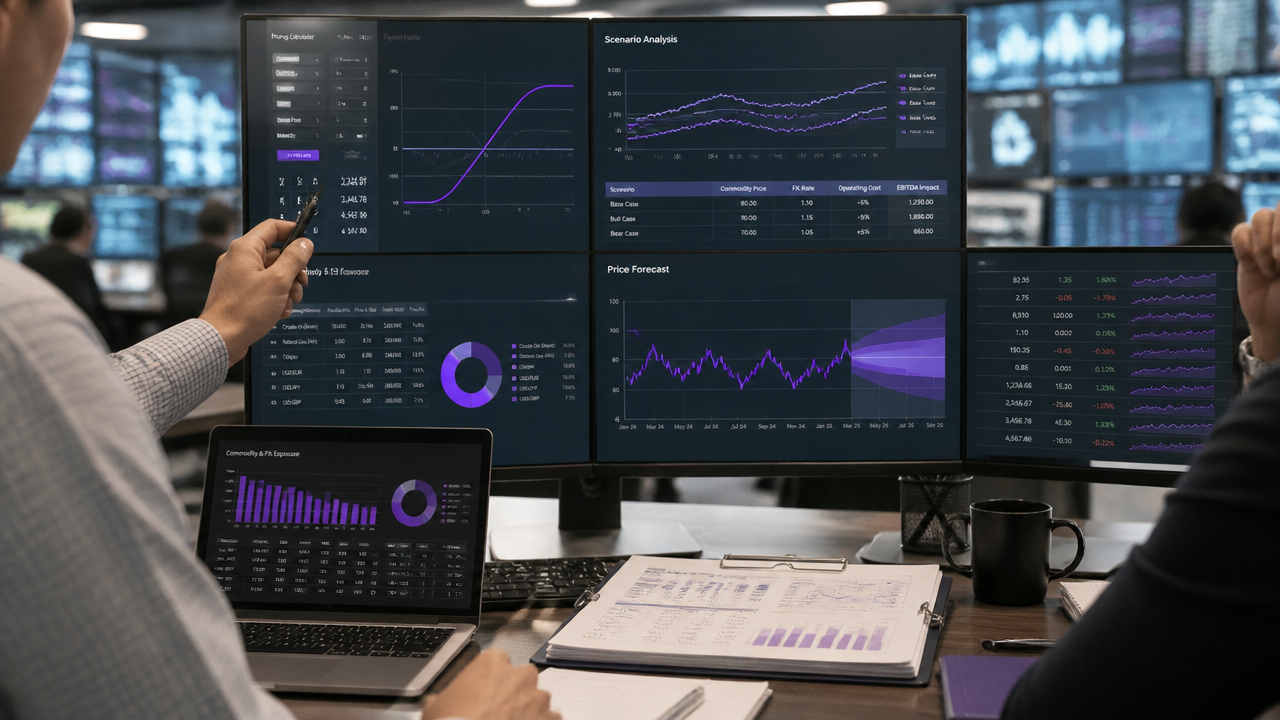
In today’s unpredictable market environment, companies in agribusiness, energy, and industrial sectors must tackle one of their greatest challenges: the effective supervision of financial exposure linked to currencies, interest rates, or commodities. This is a landscape shaped by price swings, strategic decisions under tight timeframes, and layers of regulatory demands.
Where human oversight and fragmented tools fall short, advanced analytics and artificial intelligence (AI) bring a new standard of resilience and transparency to treasury operations.
This story centers on how projects like UHEDGE make a difference by delivering an end-to-end digital treasury and risk technology, specifically designed to bring control, scientific discipline, and opportunity to organizations beset by volatile global factors.
The structural challenge: Why managing risk in derivatives gets complex fast
Treasuries in real-world companies juggle shifting market risks, customer demands, and regulatory scrutiny. For those exposed to commodities, rates, or currency, a single external shock—like a sudden spike in coffee prices or collapsing exchange rates—can ripple through financials and operational plans.
Here’s what stands in their way:
- Fragmented data silos: Most firms manage risks in isolation. FX, interest rate, and commodity positions live in separate spreadsheets, legacy systems, or even people’s heads, with no centralized control or real-time insight.
- Human limits: The sheer volume of market factors—geopolitics, crop yields, currency reserves, central bank policy—makes it "humanly impossible" for teams to react optimally every second of the day. Information overload leads to suboptimal and reactive decisions.
- Traditional solutions fall short: Relying solely on in-house teams or basic market offerings often means slow innovation and high costs. Many solutions provided by financial institutions carry hidden fees and inadequate alignment with the company’s needs.
- Insufficient risk discipline: Without a unified risk framework, companies lack the rigor and discipline needed for real-time controls across asset classes.
Market turbulence isn’t going anywhere. In fact, it is only increasing.
A split-second of missed insight or mistimed hedge can erase months of careful planning.
Companies are often left to play catch-up, adjusting positions only after markets have moved—reactive, not proactive, and sometimes at a heavy cost.
The technology-powered solution: Digital treasury systems with AI and quantitative models
Projects like UHEDGE introduce a complete, AI-driven digital treasury for risk supervision, offering new ways to combine deep quantitative analysis, data integration, and automated hedging.
A system built on scientific rigor brings several key benefits:
- Unified control: Aggregates physical and paper risk exposures—currencies, interest rates, and commodities—into one centralized platform for a clear, actionable view at all times. Every position is visible, mark-to-market is refreshed in real time, and all risk exposures are mapped together.
- Advanced analytics: AI-powered tools digest complex market data and user portfolio specifics, supporting quick detection of threats and opportunities. Quantitative models visualize real market phenomena—volatility surfaces, futures curves, vol smiles—that few teams could reliably calculate manually.
- Trading and pricing at speed: The inclusion of trading-oriented calculators enables the instant design and valuation of even intricate derivative structures (accumulators, fences, swaps), reducing decision cycles from days to seconds and supporting more confident, data-driven trading.
- Algorithmic access to complex products: Through algorithms, companies gain access to bespoke over-the-counter (OTC) derivatives, previously restricted to specialist counterparties in traditional markets.
- Strict risk monitoring and reporting: Real-time portfolio monitoring, performance metrics, and built-in governance checks mean risk discipline is sustained even as market circumstances shift unexpectedly.
The result? Risk management turns from a cost driver into a consistent value generator, with improved bottom-line impact and increased predictability for treasury cash flows.

The main types of derivatives for managing risk
A successful risk management framework rests on picking and combining the right risk-hedging instruments. A digital treasury solution like UHEDGE makes multiple tools available for instant analysis and execution.
1. Forwards and swaps
Forwards are direct agreements to buy or sell an asset at a set future date and price—crucial for locking in exchange rates or commodity prices ahead of uncertain market changes. Swaps, meanwhile, allow companies to exchange cash flows, such as switching from fixed to floating interest payments or vice versa.
2. Options
Options (calls and puts) offer the right, not the obligation, to transact at a pre-agreed price. This provides flexible insurance against adverse movements in FX rates, interest rates, or commodity prices, with a premium attached for the security.
3. Structured derivatives: Accumulators, fences, and custom strategies
Complex needs—such as stair-stepped commodity purchases or layered protection against both up and down swings—are addressed with structured products. Calculators in digital platforms allow easy assembly and comparison of accumulators (which let companies "accumulate" exposure under conditional clauses), fences, and other tailored tools.
- Accumulators: Ideal for phased purchases or sales, common in agricultural cycles, energy procurement, or industrial production planning.
- Fences: Cap and floor certain exposures, protecting against excessive market swings in either direction.
- Vanilla vs. exotic instruments: A good treasury system enables both, depending on risk appetite and exposure type.
These instruments each play a role. Modern treasury management systems incorporate calculators and algorithms to recommend optimal structures, balancing risk, projected cash flow, and company risk tolerance efficiently.
Seeing risk and opportunity: Portfolio monitoring, reporting, and unified control
The ability to monitor portfolio risk in real time is pivotal. Data is only valuable when accessible, understandable, and actionable.
- Unified dashboard: All FX, interest, and commodity positions come together in one clear interface for holistic monitoring.
- Real-time mark-to-market (MTM): Positions are continuously marked, giving fresh visibility on exposures and the impact of every new price tick.
- Comprehensive risk maps: Advanced tools visualize “what if” scenarios, showing how profit-and-loss would change with different market moves or volatility shocks.
- Automated end-of-day reporting: Detailed reports track evolution, performance, and compliance, supporting both decision makers and regulatory needs.
- Strict governance support: The system checks strategy and operations against internal rules, regulatory frameworks, and company-specific risk appetite with every position.
In sum, firms move from fragmented, error-prone oversight to transparent, data-driven control of treasury risk—a key requirement for strategic agility and long-term profitability.
How AI and advanced analytics change the risk game
 AI brings high-value impact to risk controls in treasury operations by processing more data, faster, and with greater accuracy than traditional approaches.
- Pattern recognition: AI detects subtle warning signs, seasonality, and hidden opportunities in market data that can trigger better-timed trades or hedges before visible in typical dashboards.
- Instant simulation: Algorithms run thousands of scenarios instantly, stress testing portfolios against shocks—geopolitical crises, sharp price moves, or unusual volatility.
- Automated recommendations: With the power of quantitative modeling, treasury teams receive proposals for trade structures or hedges sized to their profile and the current environment, reducing subjective decisions and placing more weight on scientific rigor.
UHEDGE’s own platform supports this workflow, embedding AI-driven recommendations, predictive analytics, and automated structure generation that would otherwise require costly, external human consultants.
The impact on sectors: From agribusiness to energy and industry
Industries most vulnerable to shifting benchmarks—such as food producers reacting to commodity cycles, energy companies facing variable fuel prices, and manufacturers managing global supply chains—benefit dramatically from this approach.
- Agribusiness: Farmers and traders rely on derivatives to shield income from wild crop prices or currency swings. Digital treasury platforms have provided notable success stories, like agile hedging in coffee or grain markets, where AI models help outperform standard solutions such as this practical example.
- Energy: Power and fuel companies stabilize input costs, manage regulatory exposure, and optimize buying windows. This enables steadier cash flow projections and more stable purchasing pipelines.
- Industrial/manufacturing: Firms facing global sourcing risks aggregate sheet metal, petrochemical, plastic, and electronics exposure to unify their defense against wipeout scenarios.

Case studies: How algorithmic and data-driven approaches bring transformation
One of UHEDGE’s strengths is demonstrating proved value through real market use. Client endorsements from the commodity and energy sectors report both immediate and lasting improvements in transparency and financial outcomes.
- Commodity hedging example: In a managed portfolio for "C" coffee on the New York exchange, the UHEDGE platform’s strategy delivered prices consistently above those achieved with traditional, leveraged derivative equivalents. This was achieved through disciplined model-driven hedging and real-time responses to market shifts.
- AI-based tactical responses: The digital platform’s embedded AI continuously updates buy/sell/neutral signals. In one example, the AI model for coffee hedging stayed ahead of major price cycles, supporting proactive position adjustments and demonstrating measurable outperformance compared to manual methods.
- Global crisis navigation: Amid global trade tensions, unpredictable tariffs, and surging inflation, algorithmic reallocation strategies enabled companies to realign portfolios dynamically across energy, metals, and agricultural assets, mitigating shocks and supporting stable outcomes.
Graphical risk mapping, such as heatmaps that show how changes in market volatility affect profit-and-loss, solidifies board confidence and strengthens governance reporting. These breakthroughs yield precise, actionable decisions even under pressure.
Governance, regulatory frameworks, and best practices
Externally, regulatory demands are mounting—frameworks like IFRS, Basel, and local rules all require documentation, transparency, and full audit trails for every derivatives position.
- Embedded compliance tools: A digital treasury solution records every decision, trade, and metric, supporting end-to-end traceability.
- Automated “fit for purpose” checks: Algorithms assess each hedge against company policies, regulatory standards, and trading limits, flagging outliers instantly.
- Continuous risk reviews: Real-time risk limit monitoring, alerts on breached thresholds, and auto-generated governance reports (daily, EOD, or on-demand) give boards the assurance needed for oversight.
Best practices now mean more than annual risk policy reviews. They mean systemic, ongoing supervision and data-driven, audit-proof operations.
For further reading on optimal protection and risk strategies in the ever-evolving regulatory landscape, check the guide on interest rate hedging and explorations in risk management strategy.
Strategic agility and the advantage of unified technological approaches
The real success of digital, AI-powered risk controls is measurable in more than just compliance. It is seen in how companies shift from defense to offense, transforming market volatility into opportunity.
- Data-driven insights: Enterprises can now extract signals from global macro movements and act tactically, not just protectively.
- Robust scenario planning: What used to take days and cross-team meetings is now delivered in real-time AI-generated dashboards.
- Consistent value creation: Margins are defended. Losses are minimized. Predictable cash flow emerges, leading to greater stakeholder confidence.
- Compounding knowledge: As companies use more advanced digital tools, accumulated risk history, market pattern recognition, and AI adaptations further enhance future readiness.
These are the outcomes that companies seek, and which UHEDGE and similar digital treasury leaders commit to delivering. More details on derivatives application in multi-asset portfolios are explored further in this derivatives-focused content collection.
Technology, when designed for transparency and discipline, turns market chaos into actionable insight.
Conclusion: Transforming risk into opportunity with UHEDGE-style discipline and AI
The rise of AI and rigorous quantitative methods in treasury operations means that the old days of fragmented systems, slow decision cycles, and costly missteps are over. By embracing centralized, real-time, and data-rich risk oversight, companies unlock true strategic agility and financial confidence.
Whether managing the endless variables of agriculture, bracing for energy price swings, or fine-tuning industrial supply chains, the best answer now brings together advanced technology, experienced quantitative minds, and a single view of risk. UHEDGE exemplifies this approach, extending a legacy of international experience, deep data expertise, and innovation directly to its clients.
It all starts with a diagnosis—an assessment of where risks live, how they are currently managed, and what opportunities lie ahead for more robust financial outcomes.
- If your treasury seeks more predictable results, consistent margin improvement, and the confidence to face any market with clarity, consider learning more about the digital solutions and consulting offered through UHEDGE.
Begin your path toward a smarter, more secure, and more transparent approach to risk management. Take the first step and bring scientific discipline to your treasury.
Frequently asked questions (FAQ)
What is AI-driven derivatives risk management?
AI-driven derivatives risk management is the application of artificial intelligence and quantitative models to the detection, measurement, valuation, and control of financial risks associated with derivatives portfolios. This approach unlocks rapid scenario analysis, automated hedging decisions, unified oversight, and ongoing adaptation—well beyond traditional manual management.
How can AI improve treasury risk controls?
AI improves treasury risk controls by centralizing data, continuously monitoring exposures, and offering timely, scientifically-grounded recommendations. AI can alert the treasury to emerging risks, provide real-time analytics across asset classes, and ensure every hedging action fits both the market context and the company’s financial goals.
What are the benefits of using AI for derivatives?
The main benefits include:
- Faster, data-driven decision-making
- Reduced operational risk and errors
- Consistent and disciplined application of risk policy
- Automatic generation of robust, tailored derivative structures
- Real-time reporting and compliance documentation
Is AI-based risk management cost-effective?
AI-based risk management systems like those offered by UHEDGE significantly reduce costs by eliminating unnecessary spreads, reducing manual errors, and enabling more optimal hedging strategies. The up-front investment in a digital treasury is frequently outweighed by ongoing gains in margin, cash flow predictability, and operational efficiency.
How secure is AI in managing financial risks?
AI risk management platforms prioritize security, data privacy, and compliance. Systems undergo regular audits, use encrypted data channels, and follow strict governance protocols to provide end-to-end protection for financial data and decision processes. This brings peace of mind to treasury leaders and compliance officers alike.