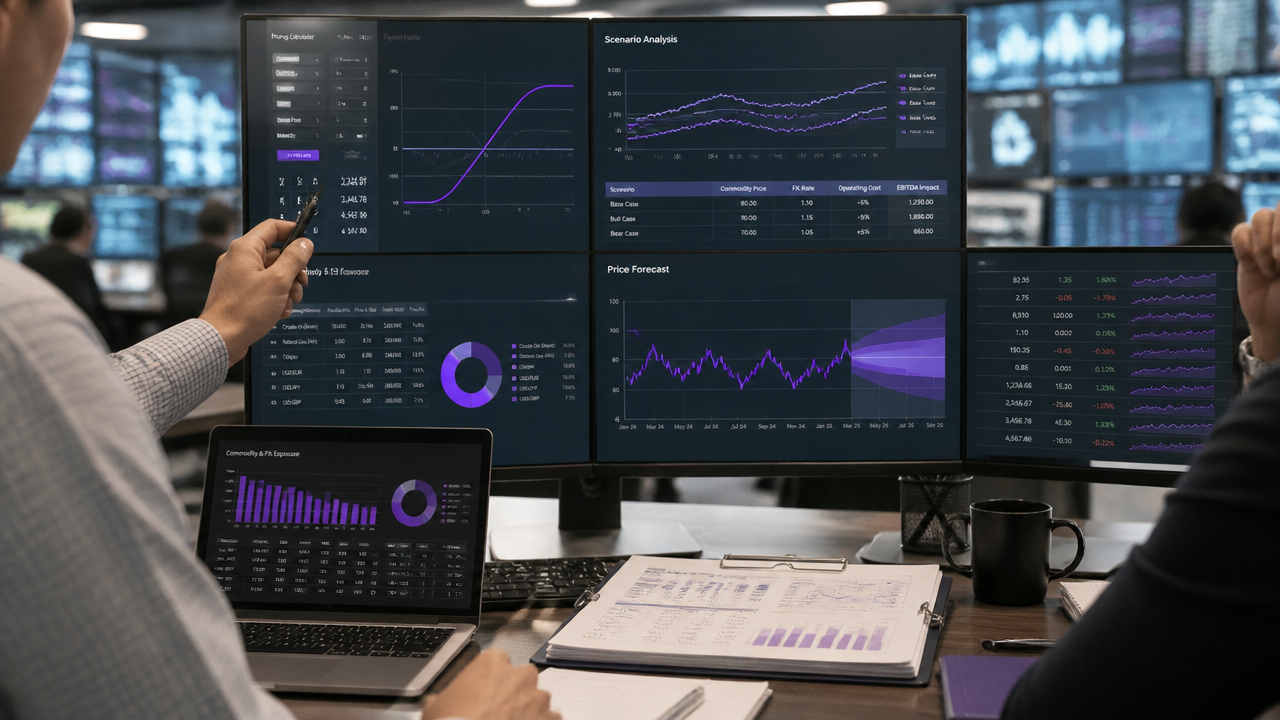
In commodity markets, risk never sleeps. The forces shaping prices, volatility, and investor strategies shift daily, but one element remains constant: derivative pricing is fundamental to controlling uncertainty and creating financial opportunities. Understanding the methods and risk factors behind these valuations is not just an academic pursuit, but a necessity for everyone in the agro-financial chain, from coffee cooperatives to mid-market banks. The story of derivatives in the commodity space is, in many ways, the story of commodities themselves—where nature, policy, and human ingenuity intersect with quantitative models, technology, and real-world constraints.
The foundations of derivative valuation in commodity markets
Commodity derivatives are unique. Unlike pure financial instruments—such as stock options or interest rate swaps—commodities come with intricate real-world features: seasonality, storage constraints, transportation lags, and exposure to geopolitics and weather. The pricing of these instruments demands more than abstract mathematics; it relies on models that blend financial theory with the physical realities of supply chains.
When approached methodically, derivative pricing becomes a tool to manage margin, discipline decision-making, and unify fragmented exposures across spreadsheets, broker statements, and ERP systems. This is the core philosophy behind platforms like UHEDGE, which act as an extension of the risk and trading desk for agro and export businesses.

The journey starts with classical derivative pricing models—including Black-Scholes and binomial trees—but evolves quickly in commodity environments. Before dissecting these tools, it is essential to ask: why do derivatives for coffee, grains, or sugar cane behave so differently from those for equities or currency?
Key differences: Financial vs. physical price dynamics
- Physical settlement triggers real-world logistics, not just cash flows
- Storage, quality, basis risk, and seasonality shape every quote
- Options and swaps must integrate weather and geopolitical shocks, not just volatility measured on an exchange
Where do models begin?
The earliest approaches—constructed in the 1970s—were built for markets viewed as “complete and liquid.” In finance-speak, a complete market is one where every risk can, in theory, be perfectly hedged or replicated by trading in available instruments. Most commodity markets, however, are incomplete; real-life traders cannot always create a perfect hedge. This limitation re-emerges throughout this discussion.
“Every commodity model is a blend of theory, empirics, and hard-earned intuition.”
Classical mathematical models: Black-Scholes and binomial trees
The Black-Scholes model, the workhorse of options pricing, assumes lognormally distributed prices, constant volatility, frictionless trading, and the ability to construct risk-neutral portfolios via continuous hedging. In commodities, some of these premises collapse quickly. Still, Black-Scholes remains a benchmark, especially for vanilla European-style options on liquid futures.
The binomial tree approach, with its step-by-step scenario construction, introduces greater flexibility. It can accommodate American-style exercise and variable volatility. For commodity derivatives, analysts often modify the base scenario to include jumps in underlying prices or to reflect the realities of contract delivery and “convenience yield”—the value placed on having physical stock available, which is not present in purely financial assets.
- Convenience yield, as shown in empirical studies, improves in-sample fit during financialized commodity cycles and reflects inventory management—which can be modelled as an effective dividend yield in adjustments to Black-Scholes-like equations (Empirical study (1994–2021) published in 2025).
- Adjustment techniques using storage models and mean-reverting processes further enhance pricing accuracy.
But even the most elegant formula stumbles on reality’s bumps: illiquidity, large price moves, and structural breaks from geopolitical events demand models that can adapt rapidly.
Risk-neutral and arbitrage-free frameworks: What do they mean in commodities?
In textbook settings, the risk-neutral measure is a mathematical construct: a “phantom world” where investors are indifferent to risk, so everything gets discounted at the risk-free rate. The beauty is that, in complete markets, the arbitrage-free price equals the expected (risk-neutral) payoff, discounted by the risk-free rate. In reality, especially in grains or energy, risk-neutral pricing becomes a starting point, not an end.
- Factors like basis risk—the difference between local physical prices and reference futures—cannot always be captured in risk-neutral modeling.
- Storage costs, convenience yields, and seasonality vary across crops and regions—a corn hedge in Brazil faces different risk compared to soybeans in Chicago.
- The presence of illiquid markets, where not all risks can be hedged, introduces risk premia and deviations from theoretical values.

Arbitrage-free pricing: Replication and market completeness
Arbitrage-free pricing means that, given enough instruments, one can replicate the payoff of any derivative by trading in those instruments. In agricultural and energy commodities, this replication is restricted. Not all risk factors—such as local droughts, storage shortages, or transportation disruptions—can be offset with listed contracts. This incompleteness means practical prices often include risk premia reflecting unhedgable exposures.
- As noted in research extending competitive storage models, market volatility and co-movement can increase under changing real interest rate regimes, highlighting the limits of perfect replication and emphasizing the need for risk premia and liquidity adjustments (2024 paper extends competitive storage models).
- Seasonality, as identified in agricultural commodities, directly influences the basis and risk factors underlying derivative quotes, carrying predictive power for spot price changes and influencing option values across planting and harvest seasons (2013 cross-commodity study).
Risk factors unique to commodity derivatives
The mosaic of risks in commodity derivatives is broad and multi-layered. A trader in Sao Paulo balancing BRL/USD currency, ethanol price exposure, and local crop risk faces a landscape shaped by multiple forces:
- Price risk—Driven by global spot and futures markets, but complicated by local demand and supply shocks.
- Basis risk—The uneven relationship between local physical prices and exchange-contract prices. Basis is not just a technical annoyance; its shifts can make or break a hedging strategy.
- Volatility risk—Standard models assume stable volatility, but commodity volatility is asymmetrically affected by weather, geopolitics, and macroeconomic policy. Volatility surfaces and “smiles” observed in the options market highlight this complexity.
- Liquidity risk—Many commodity derivatives are thinly traded, leading to pricing gaps and less reliable marks for accounting purposes.
- Credit and counterparty risk—Especially present in OTC contracts, where mark-to-market practices and initial/variation margins are vital controls.
- Operational and legal risk—From failed deliveries to unclear contract terms in cross-border trades.
Advanced systems, such as the quantitative environment offered by UHEDGE, address these issues through comprehensive analytics and integrated position management, lowering the burden of fragmented risk management and improving discipline and transparency.

Physical versus paper commodity risk: Two sides of the same coin
Some exposures, like future sales of sugar or deliveries of oil, are “physical”—the concern is the actual transfer of product at a fair price. “Paper” exposures, such as financially settled swaps or options, offer a way to transfer risk, but converting back and forth between physical and paper can introduce new sources of error, especially when the two prices diverge. Bridging this gap in practice is a core focus for modern platforms and methodologies, as described by UHEDGE’s integration of both physical and paper risk into unified analytics.
“Basis is where theory meets mud on the boots.”
Standard models in illiquid or incomplete markets
A decade ago, pricing a standard grain option might have relied mainly on listed market quotes and a simple volatility estimate. In today’s world of fragmented liquidity and regulatory scrutiny, that approach is often insufficient. Illiquid markets create uncertainty on even the vanilla end of the spectrum. OTC products, such as accumulators and fences, require careful adaptation of classical models—inputting stress-tested volatility scenarios and adjusting discount factors to account for counterparty and liquidity risks.
- Adjusted volatility estimates and forward curves become essential when clear two-way prices are unavailable.
- Models such as mean-reverting processes for commodity prices, or models incorporating explicit inventory effects, help explain premium movements and improve predictive capacity (Aarhus University working paper).
- Electronic platforms with access to multi-source price feeders—central to the UHEDGE approach—improve real-time pricing and the replication of OTC products without hidden spreads or opaque commissions.

Market completeness, risk premia, and the challenge of replication
A “complete market” is a theoretical setting where every risk can be offset by some combination of traded instruments. Incomplete markets are the norm in commodities: weather, logistics, and political regime changes often introduce exposure that cannot be fully hedged. The practical outcome? Derivative prices frequently include premiums for bearing these real-world risks—premiums that reduce as liquidity increases or as more hedging tools become available.
- The measurement and decomposition of risk premia, especially in agricultural options, is a vibrant field of research. Studies show that these premia are time-varying and often predictable based on market structure and seasonality. This is linked to trader categories: commercial versus speculative actors bring different signals to pricing (Empirical study on convenience yield and trader behaviour).
UHEDGE clients benefit from this research-backed understanding by receiving pricing and strategic advice that is not just mathematically sound, but also tuned to seasonal and microstructural features of the markets they actually operate in.
Regulation, hedge accounting, and reporting requirements
Oversight is now a fact of life for regulated asset managers and corporate treasuries alike. In Brazil, CVM 539 governs asset management. Globally, IFRS 9 and CPC 38 set high standards for hedge accounting, driving new requirements on documentation, effectiveness testing, and transparency.
- Mark-to-market (MTM) requirements: Frequent revaluation of positions using current market prices.
- Effectiveness testing (Dollar-Offset Ratio and others): Quantitative checks to ensure the hedges perform as intended, within accepted bounds.
- Comprehensive audit trails: Systems that automatically capture every decision and valuation are an antidote to audit burdens.
- Automatic generation of designation reports and compliance logs: No more manual scramble during audit season; advanced risk platforms produce these deliverables with each transaction.
Systems like UHEDGE automate much of this workflow, integrating accounting and risk monitoring with machine-driven calculations to satisfy both internal control and regulatory demands.

From spreadsheets to digital risk discipline
Moving beyond the legacy practice of scattered spreadsheets is a leap in control and precision. The transition to centralized, auditable platforms brings four main advantages:
- Instant visibility of all exposures—across physical and financial contracts, and across regions and currencies.
- Repeatable risk discipline, driven by pre-set policies and monitored by smart algorithms.
- Fewer operational errors, and better compliance with auditor and regulator requirements.
- Faster, data-driven strategic decisions that respond to changes in market regime, volatility, and correlation structures across commodities, FX, and rates.
These advantages do more than just protect against risk—they create the conditions for capturing market opportunities when “the world goes noisy.”
New frontiers: Machine learning and alternative models
Recent years have ushered in a new era of risk measurement and derivative pricing in commodities. Machine learning (ML) and artificial intelligence (AI) now supplement traditional stochastic models. The focus is on learning from vast, multi-source datasets—including weather, geopolitics, and sentiment analytics—to anticipate shifts in volatility, correlation, and basis relationships.
- Supervised ML models can forecast spot and forward price changes based on complex patterns in physical inventory, seasonality, and global macro risk factors.
- Neural networks and advanced regression techniques enhance volatility surface estimation, allowing for more accurate pricing and risk management of exotic options and complex OTC structures.
- Optimization algorithms, as used in leading digital platforms, automate both “what if” scenario analyses and real-time risk control—putting compute power behind every risk policy.
Uhedge’s deployment of algorithmic tools reflects this future-focused approach, with custom solutions modeled on years of commodity trading expertise and continual adaption of the latest research findings.
Why does this matter for decision-makers?
“Disciplined, automated risk management is the only sustainable way to thrive when markets turn unpredictable.”
The “where others see chaos, UHEDGE sees opportunity” mindset is about more than just weathering storms—it is about building persistent margin and capturing outperformance, backed by rigorous science, transparent processes, and speedy adaptation.
Common structures and how they’re priced: Agro, energy, and export use cases
For those managing positions in grains, sugar, ethanol, or energy, several derivative “structures” dominate. Each has its pricing quirks:
- Vanilla options (calls and puts): Priced using modified Black-Scholes or binomial models, but often with custom volatility inputs or adjustments for delivery risks.
- Accumulators: Structured products offering buyers or sellers the ability to buy or sell a commodity at levels that “accumulate” risk or reward over time, often requiring scenario-based pricing tools—because market jumps or “knockout” conditions make plain vanilla models insufficient.
- Fences and costless collars: Marry multiple vanilla options, combining purchases and sales to create a predefined price corridor for protection.
- Asian (average price) options: Options priced on the average value of an underlying asset, requiring simulation models or analytical formulas adapted from standard models—but with more attention to serial correlation and mean-reversion typical of physical commodity prices.
- Replication via OTC structures: Many risk managers now replicate OTC products on electronic platforms using algorithms, removing inefficiencies and hidden costs typically associated with traditional brokers.
On the UHEDGE platform, for example, clients are provided with tools to price, monitor, and report both simple and complex derivative strategies, integrating margin management, risk monitoring, and real-time basis intelligence—creating a single, auditable environment from exposure planning to accounting logs. Practical guides and lessons learned from these cases are further detailed in resources such as hedge strategies for commodity margin protection and common mistakes in commodity hedging.
“In commodities, complexity is the rule—pricing must adapt fast, or risk gets out of control.”
Trends and the future: Integrating data, analytics, and strategic execution
The evolution of derivative valuation in the commodity sector has moved well beyond manual calculation and guesswork. The shift is now toward using real-time data, machine detection of emerging risk, and full-cycle integration of trading and accounting processes. This empowers many organizations—not just those with the largest trading floors or the deepest benches of quantitative talent—to build resilient margin, mitigate shocks, and grow with confidence.
In today’s environment, the difference between underperformance and outperformance is clear: embrace scientific rigor, orchestrate data-driven risk discipline, and break down siloes across teams and tools. Solutions like UHEDGE are helping define this new future, where opportunity, not chaos, becomes the default outcome for prepared businesses.
Conclusion
Pricing derivatives in the commodity markets brings together advanced financial mathematics, physical market realities, regulatory compliance, and fast-moving data science. The methods available—from classical formulas to machine-driven analytics—offer powerful ways to understand, mitigate, and capitalize on risk. Yet, only organizations with disciplined, integrated systems and a scientific culture excel in the face of uncertainty.
To see how intelligent risk management can unlock higher profit margins, predictable cash flows, and proactive trading, enterprise leaders and risk professionals are invited to experience UHEDGE’s solutions firsthand. The journey from complexity to confident action begins with a single step: choose a technology-driven, expert-supported partner in commodity risk and derivative pricing.
Frequently asked questions
What is commodity derivative pricing?
Commodity derivative pricing is the process of calculating the fair value of financial contracts—such as futures, options, and swaps—whose payoff depends on the price of a commodity like coffee, oil, or grains. This involves models that consider not only market data and volatility, but also the physical realities of storage, transportation, seasonality, and basis risk unique to each commodity. Effective pricing frameworks blend financial theory, quantitative methods, and real-world market intelligence.
How are commodity derivatives priced?
The pricing of commodity derivatives starts from mathematical models—such as Black-Scholes for options and binomial trees for more flexible structures—and adjusts for commodity-specific features like inventory, seasonality, and delivery logistics. Market completeness, liquidity, and risk factors (including convenience yield) are incorporated to better reflect actual trading conditions. Sophisticated platforms may also use machine learning and real-time analytics, allowing for fast, adaptive valuations as market dynamics change.
What risks affect derivative pricing in commodities?
Commodity derivatives are influenced by an array of risks. Price risk—due to unpredictable spot and futures prices—sets the base for volatility. Basis risk arises from differences between local prices and futures markets. Seasonality, weather, and geopolitical shocks affect both the value and risk of derivatives. Additional challenges include liquidity risk (thin markets), credit risk (OTC counterparties), operational risk (delivery mismatches), and regulatory risk (accounting and reporting standards).
Which pricing models are most accurate?
No single pricing model is universally “the best.” The accuracy of a model depends on the context: for highly liquid, standardized contracts, modified Black-Scholes or binomial approaches may suffice. In illiquid or incomplete markets with unique commodity features, extended models like those incorporating mean reversion, inventory effects, and empirical volatility are superior. Empirical studies show that including convenience yield, inventory levels, and seasonality enhances out-of-sample predictive power and pricing accuracy.
How do market factors impact pricing?
Market factors—including spot and forward price levels, volatility, liquidity, seasonality, storage rates, and even interest rate cycles—directly impact how derivatives are valued. When physical markets are stressed by events such as drought, logistical bottlenecks, or sudden regulatory shifts, derivative prices can diverge markedly from standard models. Adaptive pricing platforms blending real-time data, statistical analytics, and scientific rigor are best equipped to respond to such rapidly evolving conditions.
For more insights, in-depth guides, and technical resources, readers are encouraged to browse topics like derivative instruments and commodity trading on the Uhedge blog. To transform risk management from a cost center to a source of margin and consistency, reach out and discover how Uhedge can support your business.