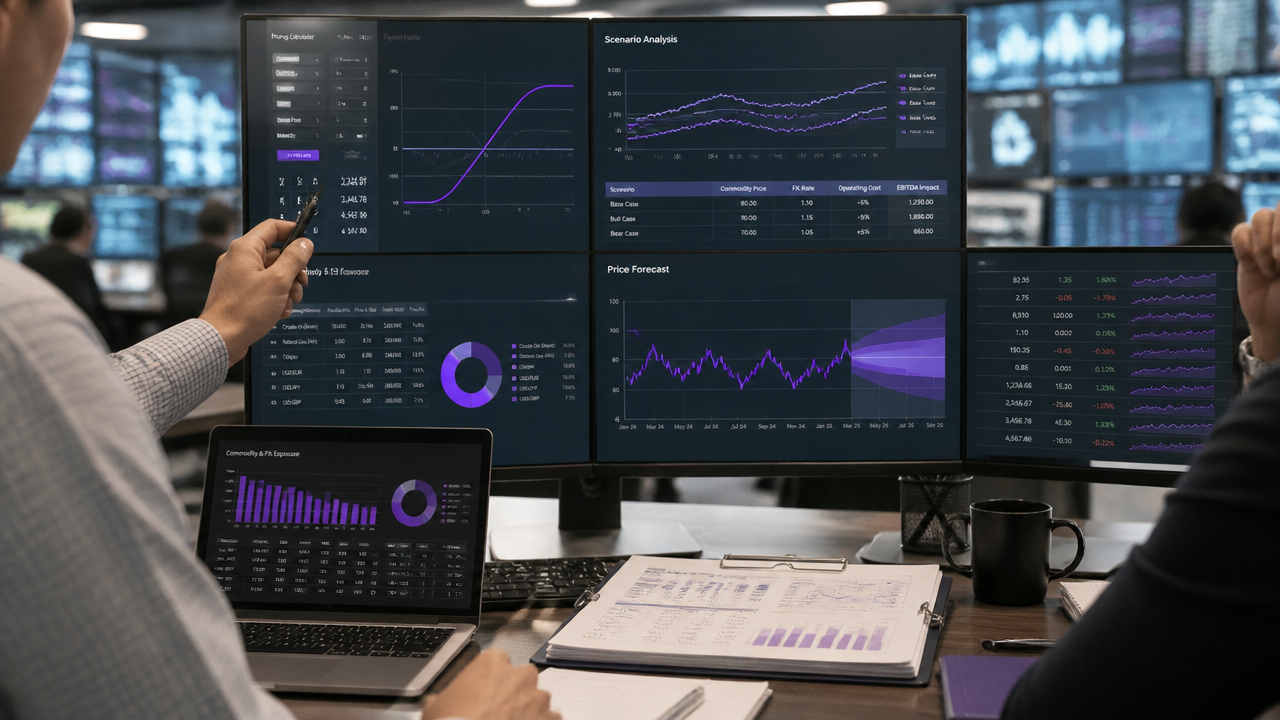
Derivative pricing in the commodity sector is not just a mathematical puzzle—it is a field where science, technology, and practical experience meet the daily reality of financial risk and commercial opportunity. In the world of grains, energy, softs, and beyond, participants face a relentless storm of market variables. They require both robust discipline and acute insight. Here, Uhedge, with its quantitative backbone and market wisdom, has shaped a platform that brings order, transparency, and control.
Trading volumes tell the story of why this matters. As the World Federation of Exchanges recently reported, commodity derivatives trading in 2025 amounted to 12.49 billion contracts—an annual growth of 17.5%. Options alone grew 48% in volume. Futures increased 10%. Different regions each saw growth above 10%—clear evidence that risk management and smart exposure are at the heart of modern agro-financial and industrial chains. The size of the derivatives market, as tracked by BIS, touched $846 trillion notional this year, led by interest-rate derivatives but with commodities playing a rising and strategic role: from commodity producers to mid-market banks and family offices .
This article will shed light on the fundamental and advanced concepts that drive the pricing of complex derivatives in commodities. The discussion will be grounded in science, illustrated by real examples, and connected to the practical, quant-led approach of Uhedge. There will be guidance for those navigating grain, coffee, energy, FX, and all the hybrid risks they bring.
Precision, discipline, and transparency are the bedrock of true financial control.
Foundations: The science behind derivative pricing
Every pricing effort in the commodity markets stands on the shoulders of core financial theory. These principles bring rigor, fairness, and structure to the uncertain world of futures and options:
- No-arbitrage: In a market with no free profit, prices reflect all available information, and any pricing differences should vanish instantly when spotted.
- Risk-neutral valuation: This method removes individual preferences and evaluates instruments as if every participant is indifferent to risk—allowing prices to be constructed from expectations of future outcomes, discounted at the risk-free rate.
- Stochastic modeling: Prices are modeled as evolving randomly over time, influenced by volatility, interest rates, and other factors. This is essential for capturing the chaos—seasonality, geopolitical shocks, supply chain disruptions—that define real markets.
From these basics, practitioners move to the building blocks of mathematical finance: The Black-Scholes and binomial models. These are still in use for pricing vanilla options—yet in commodities, simple cases are exceptions rather than the rule.
The Black-Scholes model: A starting point
The Black-Scholes framework, adapted slightly for commodities, was a revolution. Inputs include spot price, strike price, time to expiration, interest rate, volatility, and for physical commodities, sometimes cost of carry and convenience yield. It is a classic tool for pricing European-style options.
However, it assumes constant volatility and frictionless markets—assumptions rarely met in agriculture or energy.
The binomial tree: Flexibility for structured products
The binomial method allows the user to build a tree of potential price outcomes in small steps, mapping out all possible final payoffs and working backward. This brings flexibility, making it possible to price American-style options, which can be exercised at any point up to expiry.
Both models are key, but real-world commodities demand more. Here, simulation and calibration step in.

Advanced toolkit: Monte Carlo, volatility surfaces, and calibration
Markets rarely behave politely. Commodity prices often jump, spike, or trend due to supply shocks, policy changes, or weather events. To reflect this complexity, advanced models are brought into play.
Monte Carlo simulation: The pathway for exotics
Monte Carlo methods deploy randomized simulations, generating thousands or millions of possible price paths. For every path, final payoffs are calculated, then averaged and discounted. This is essential for path-dependent derivatives—those whose value depends on the route prices take, not just their endpoint.
Think of Asian options (payoff depends on the average price over time), accumulators (which keep adding exposure as levels are breached), or structured hybrids that blend features of swaps, options, and futures. Monte Carlo lets professionals map out all the ways markets could unfold.
Calibration: Tuning the engine to real market data
A model is only as reliable as its inputs. Markets change, and so must the underlying volatility assumptions and price behaviors. Calibration means matching the model’s outputs to current real-world prices, especially the prices of liquid, listed instruments.
Sophisticated firms, such as Uhedge, frequently recalibrate to the market using latest futures and listed options as benchmarks. This practice draws from research like the two-step regression calibration used by Rauch et al., which compares different local volatility and mean-reversion specifications to ensure consistency with both single-commodity and index-derivative markets .
This means every platform price output reflects today's market reality, not a frozen guess from history.
Volatility surfaces and market anomalies
One of the greatest challenges in commodity derivative pricing is understanding how implied volatility—market expectations of future swings—changes with strike price and time. Unlike the interest-rate world, commodity volatility is not always symmetric and rarely flat.
Advanced pricing environments, like that at Uhedge, display detailed volatility surfaces. These charts show how the market’s forecast of future risk evolves for different outcomes and dates. Models such as those proposed by Trolle & Schwartz, which capture unspanned volatility factors in crude oil, provide powerful tools for capturing these features .

Sectors and risk factors: What makes commodities different?
Commodity derivatives bring a host of unique challenges not present in equities or pure financial contracts. Anyone following the latest discussions on derivatives and commodities appreciates the need for careful attention to these features.
- Basis risk: The difference between the local spot price and the global futures price. For grain growers or coffee cooperatives, this can turn a perfect hedge into an imperfect patchwork. Market participants must price basis risk as a distinct component.
- Seasonality and storage costs: Unlike equities, corn or sugar can rot—or cost money to store. This is factored into forward curves, modifying option prices.
- Government policy and geopolitics: Factors like embargoes, tariffs, or sudden policy changes induce abrupt price shifts, not captured by basic models. Robust pricing includes stress-testing and scenario analysis.
- Liquidity, roll, and physical settlement: Many commodities require rolling contracts or managing delivery logistics, creating risk factors that do not exist in cash-settled equity markets.
In commodities, local factors often eclipse the global story.
Exotic and structured products: From accumulators to multi-asset hybrids
Uhedge’s platform gives producers, exporters, and industrial users access to a full ecosystem: from plain vanilla calls and puts to exotics once available only to large banks. Participants today price and trade multi-leg structures:
- Accumulators: These allow exposure to increase as the market hits specific price triggers. Their risk profile is complex, as are the mathematical descriptions needed to price them fairly.
- Fences and risk reversals: Structures that simultaneously buy and sell options above and below the spot price, often paired for zero or reduced upfront cost.
- Asian options: Payoffs depending on the average price over a period—a structure that needs Monte Carlo simulation for realistic valuation.
- Basket and spread options: Payoffs tied to the difference or basket of several underlying commodities—requiring joint modeling and correlation estimation.
Pricing these hybrid products calls for sophisticated tools that can model multiple risks at once, capture nonlinear payoffs, and include scenarios for stress and jumps.
Real-world example: Hedging for a sugar cooperative
A producer’s margin is threatened not just by international sugar futures but also by local weather, currency swings, and transport bottlenecks. By building a custom hedge as a combination of vanilla puts (protecting against price drops), accumulators (adding upside in incremental steps), and a fence (limiting downside), the participant can map precise risk contours. Uhedge’s environment allows instant pricing and mark-to-market for these multi-leg trades, with full audit and documentation built in for compliance and strategic review .
From agriculture to energy: Case studies and insights
The agricultural and energy markets showcase how advanced pricing transforms commercial outcomes.

Example: Managing coffee price exposure
Uhedge’s platform tracks ten-lot "C" coffee portfolios—covering exposures in NYBOT futures with strict leverage controls and systematic overlay of vanilla and exotic structures. With AI models tracking performance, the outputs are not static—they’re updated in real-time as new macro signals emerge.
For a period marked by global turbulence, such as 2025 with tariffs and inflation spikes, dynamic allocation across energy and agriculture supported robust performance. The underlying quantitative approach amortized shocks and turned uncertainty into actionable signal—proving again that the right modeling creates both protection and opportunity .
Energy and FX: Interlinked risk and solutions
Biofuel plants and sugar mills must manage the joint risk of FX swings (USD/BRL, for instance), local fuel benchmarks, and international energy prices. Uhedge’s solution overlays exposures, so hedging cannot stop at the contract level. Instead, everything is modeled at the portfolio level, with stress testing and full mark-to-market documentation for IFRS 9 and audit requirements .
Every derivative model must face the facts of the market—no exceptions, no shortcuts.
Machine learning in pricing: Promise and trade-offs
Advanced platforms now integrate machine learning (ML) with classical methods, as institutional practice and academic research converge.
- ML models detect patterns in historical and live data, suggesting where volatility or correlations depart from historical averages.
- AI-based models can provide instant recommendations for hedging structures, updating as new data arrives.
- However, every ML-based approach—no matter how clever—requires strict oversight and frequent recalibration. All models are only as good as their last fit, and transparency is essential for regulatory and audit demands .
Uhedge’s framework blends classical “Greeks” (Delta, Gamma, Vega, Theta) and cutting-edge AI, guiding both the pricing process and risk recommendations. Reports, mark-to-market statements, and governance checks are automatically generated—key for audit and management diligence.

Risk management and hedge accounting: The audit trail
No pricing method is complete unless it fits in the larger context of risk management and formal hedge accounting. Uhedge stands out by unifying these efforts in a single platform—with discipline, transparency, and regulatory support in mind.
- Every trade is accompanied by mark-to-market, risk mapping, and historical P&L explainers.
- IFRS 9 and CPC 38 requirements are built into the documentation process—helping clients prove effectiveness and compliance to the Big Four and other auditors.
- Portfolio risk is continuously monitored, and every client interaction is auditable and aligned with their objectives and risk appetite.
Full documentation, real-time reporting, and automated end-of-day (EOD) reports turn what once was a compliance burden into a source of value and insight .
Organizations that once struggled with disconnected spreadsheets, patchwork broker statements, and delayed accounting reviews now find themselves operating in an environment of discipline and foresight.
How robust pricing empowers the agro-financial chain
From grain cooperatives to energy plants and food manufacturers, robust derivative pricing tools unlock the ability to:
- Control and predict cash flow in volatile times;
- Avoid costly margin erosion caused by bank spreads and hidden fees;
- Respond to sudden market shocks proactively, not reactively;
- Reduce audit and compliance overhead by integrating mark-to-market and designation reports into every step;
- Transform uncertainty into measurable value with aligned, evidence-based strategies.
Examples shared by Uhedge’s clients—such as coffee buyers who outperformed traditional risk solutions through AI-driven allocation, or energy trading desks that navigated pricing storms with full transparency—point to a future where “complex” becomes “controlled” .
For more on sector-specific strategies, readers may wish to see in-depth guides on commodity management, practical hedging approaches for protecting margin in unpredictable markets, and the role of derivatives for predictability in agribusiness.
Science, technology, and experience—combined, they make risk manageable and margin visible.
Conclusion: A call to action for tomorrow’s commodity leader
Pricing is not just about calculation—it is about vision, transparency, and purpose. The complexity of commodity derivatives, whether vanilla or exotic, does not intimidate firms that bring discipline, quantitative rigor, and a commitment to their clients’ interests.
Uhedge unifies market intelligence, advanced simulation, and automated control into a single environment. By doing so, it transforms risk management from a headache into a strategic advantage. Producers, exporters, and risk professionals are invited to consider how much more resilient—how much more valuable—their operation could become with clarity and science at every turn.
For those ready to move from reactive “defense” to proactive financial control, the next step is clear. Learn more about how Uhedge can help unify, automate, and elevate your risk management and pricing environment. Strong decisions, robust outcomes—this is the way forward.
Frequently asked questions
What are complex derivatives in commodities?
Complex derivatives in commodities include structured products such as accumulators, fences, Asian options, and basket or spread options. These instruments derive their value from more than just the final price of a commodity—they often depend on the full price path, multiple underlying assets, or contain embedded options and triggers. Such products address specialized risk needs for producers, cooperatives, and industrials beyond what vanilla contracts can achieve.
How do you price exotic commodity options?
Exotic commodity options are priced by employing simulation methods like Monte Carlo, capturing how price paths evolve based on real market data and stochastic models. Advanced volatility surfaces, mean-reversion effects, and calibration to observed market prices all play a role in ensuring fair value estimation. The complexity of exotics demands that every assumed input is grounded in up-to-date, high-quality data and frequently recalibrated.
What factors impact commodity derivative pricing?
Key factors include spot price, strike price, volatility (implied and realized), basis risk, time to expiration, interest rates, convenience yield, seasonality, and liquidity. In addition, geopolitical risks, weather, transportation bottlenecks, and regulatory changes can force sudden revaluations. Each risk driver is modeled separately, often using scenario analysis and quant-driven stress testing.
Which models are used for pricing derivatives?
Common models include Black-Scholes for classic options, binomial trees for American-style or structured products, and Monte Carlo simulation for path-dependent or basket options. Advanced models, such as stochastic volatility frameworks and machine learning algorithms, are increasingly used for calibration and forecasting. The most reliable approaches blend mathematical rigor with empirical calibration to current market prices.
Is it worth trading complex commodity derivatives?
Trading complex commodity derivatives can bring significant benefits for those with real exposures to control. They allow for more precise hedging, margin preservation, and risk transformation. However, they require robust quantitative frameworks, experienced oversight, and transparent governance—as provided by advanced platforms like Uhedge. For participants in agriculture, energy, or FX, sophisticated derivatives are a powerful tool when managed with discipline and clarity.