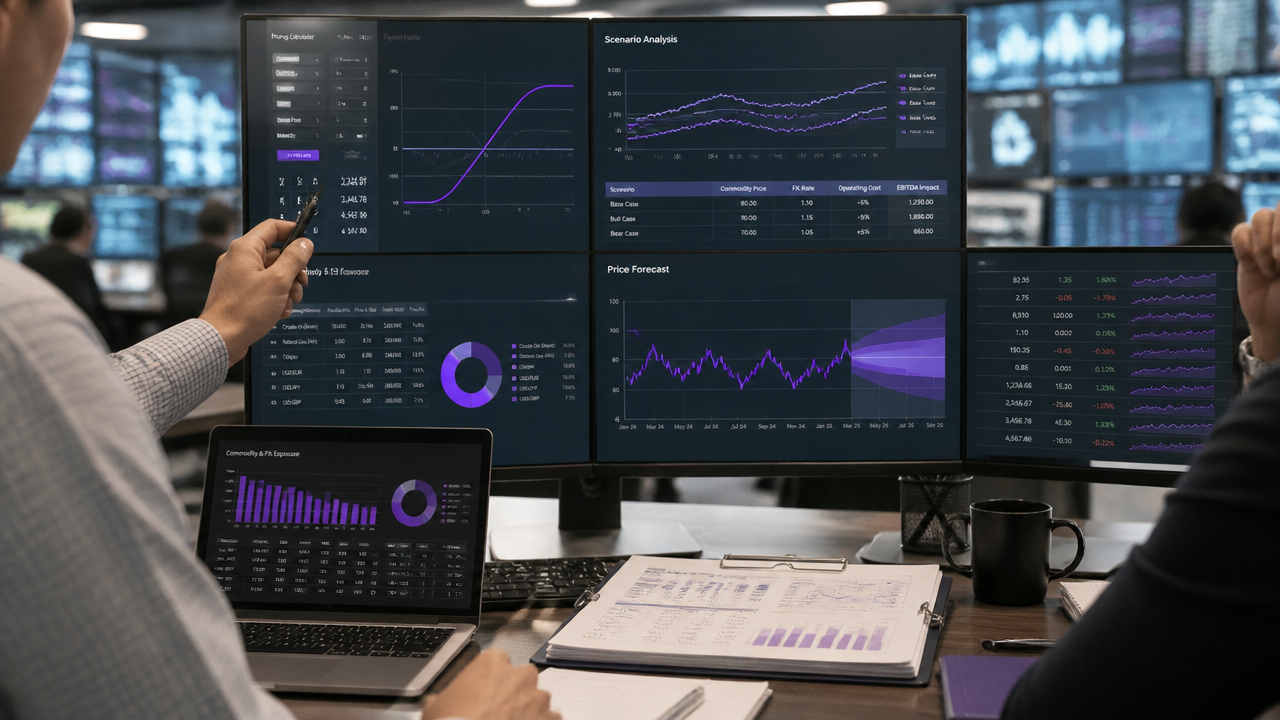
Commodity markets never stand still. Coffee, grains, or sugar—what they are worth can change in a heartbeat. For those working in the agro-financial chain, pricing and risk are daily challenges, sometimes overwhelming ones. Uhedge sees this chaos as an opportunity. The platform’s quantitative approach puts control back in the hands of those who need it most, unifying physical and financial risks, and transforming how derivative instruments are valued, tracked, and managed.
Why derivative pricing matters in commodities
At its heart, the price of a derivative is a number that tells a story—about risk, cash flows, and uncertainty. It is never just about computers and codes. When an agribusiness or biofuel plant sets a hedge, it does so to lock in margins, protect against shock events, or stay competitive. But the reality is that what seems safe today can be tomorrow’s surprise risk. The process of accurately measuring the value of these contracts—swaps, vanilla options, accumulators, even exotics—defends balance sheets and cash flows.
For commodity producers, distributors, food and consumer-goods industries, exporters, and asset managers, knowing the fair price for a contract means:
- Better planning for volatile seasons and sudden market shifts
- Meeting regulatory and accounting demands (like IFRS 9 for hedge accounting)
- Negotiating with banks and brokers from a position of information
- Keeping audit trails clean and defensible
“The difference between margin loss and gain? Often, it’s pricing discipline.”
Core approaches to finding value
Not all derivatives are created equal. The right way to find a fair number depends on the contract type, market infrastructure, and who is involved. The journey always starts with a few cornerstone models:
Spot market and quoted futures
When exchange-traded products exist, prices can be pulled from public sources. These serve as the baseline. Physical contracts (like beans or fuel) will rarely trade at the pure futures price—there is always a “basis,” reflecting location, quality, and logistics. But for mark-to-market purposes, this visible number is the anchor.
Discounted cash flow (DCF) models
For over-the-counter (OTC) contracts, and especially when there is no active secondary market, the present value of expected future cash flows is king. Each piece—future payments, embedded options, even adjustment for credit risk—is discounted back to today with an appropriate rate.
- For plain vanilla swaps: future fixed and floating cash flows are modeled and discounted
- For structured options (like Asian, accumulator, or fence structures): simulation or analytic formulas are required
- The discount curve itself might be a simple risk-free rate, or it could reflect collateral (through OIS discounting) or credit adjustments
Option pricing models
Options on commodities demand specific attention to volatility. The classic Black-Scholes model offers a starting point, but is best suited to liquid, well-behaved underlying assets. For agricultural, energy, or illiquid markets, volatility “smile” or “skew” adjustments, and models like Black 76 or local volatility, will often be used.

Models must also adapt when forward curves jump, as seen in energy and grains. Recent research on UK gas and agricultural products supports using two-factor models (one base, one spike) with a stochastic volatility element to account for sudden, short-term bursts that standard models miss like shown in studies of UK gas markets.
OIS discounting
Since the global financial crisis, collateralized OTC derivatives are often discounted not at Libor or Euribor, but at overnight indexed swap (OIS) rates. This change better matches the true funding costs and avoids valuation mismatches—critical for firms using margin and clearing agreements.
“How you discount cash flows can change a valuation by millions overnight.”
Fine-tuning the price: Market data, volatility, and credit
Inputs that matter
Every valuation stands on the shoulders of its inputs. Market data used might include:
- Spot, forward, or futures prices (from exchange feeds or broker quotes)
- Implied or historical volatility
- Yield curves (risk-free, OIS, or credit-adjusted curves)
- Settlement or delivery conventions (“physical vs. financial”)
- Basis differences across locations or grades
Modeling the right volatility surface, and accounting for real market shocks—these separate basic reporting from truly robust exposure management.
Volatility is especially tricky to estimate during volatile or illiquid periods. Commodity options are infamous for their spikes, which can upend both short- and long-dated value forecasts.
Basis risk, often brushed off in equity or interest rate markets, is a real source of pain in commodities. Different geographies, logistics bottlenecks, or differences between local and reference contracts require careful model calibration. Ignoring basis can lead to misleading risk and the false comfort of a “perfect hedge.”
Credit and counterparty risk
OTC instruments bring counterparty risk. The fair value of a derivative must be adjusted for potential credit loss, known as Credit Valuation Adjustment (CVA). In heavily collateralized markets, this may be small, but in less liquid contracts or regionally specialized deals, it can become material. The global impact of such risks is clearly visible in the overall market metrics—for instance, BIS’s latest data records OTC derivatives notional at US$846 trillion, and commodity segment notional at US$2.6 trillion, with gross market value at roughly US$0.33 trillion—a visible but contained systemic footprint according to BIS semiannual reviews.
Comparing valuation across contract types
OTC versus exchange-traded
Exchange-traded contracts provide standardized pricing, and risk parameters are set by the clearinghouse. Mark-to-market is direct: today’s last price forms the value. But custom contracts, often tailored for volume, tenor, or bespoke settlement, do not have a simple closing price. For these, only a robust analytical approach makes sense.
- OTC trades use more inputs: customized underlying prices, bespoke greeks, collateral effects, counterparty strengths
- Exchange contracts rely on exchange data—simpler but less flexible
Collateralization impacts
Collateral agreements powerfully affect the discount rate and thus the present value of cash flows. If cash margin is posted, OIS rates become the right tool. If no collateral is used, credit risk increases—and so does the discount required for a fair estimate. Proper management of margin, as seen in advanced platforms such as Uhedge’s, reduces cash flow surprises for agribusinesses and producers and brings greater financial stability.
Bringing it together: Risk metrics and real-time visibility
Modern derivative valuation is never just a one-off calculation. The game has shifted toward continuous monitoring, audit-ready reporting, and integration of risk metrics—delta, gamma, vega, theta, and even volatility surfaces—into daily operations. Software now brings together all asset classes and bespoke payoffs, allowing a single dashboard to aggregate exposures, simulate shocks, and visualize real-time cash impacts.
- Volume and performance tracking, with scenario analysis based on the Greek sensitivities
- End-of-day and real-time mark-to-market, designed for defensible and transparent P&L
- Automated compliance with hedge accounting (IFRS 9), with auditable effectiveness tests and designation reports

For sector practitioners—from sugar and ethanol mills to soybean crushers—the practical upside of reliable daily valuations includes easier negotiation for margin offsets, greater confidence in board reporting, and a rock-solid paper trail for hedge audit tests.
Technology’s new era: Software, algorithms, and AI
The world of commodity derivatives valuation would be a minefield without scalable platforms. Uhedge’s own tech meets these demands by integrating:
- A digital treasury and trading management system that tracks all contracts in one place
- Automated risk calculations that go “beyond human” with quantitative engines using statistics, econometrics, and financial engineering
- AI-powered recommendations for optimal hedge mechanisms, tailored to company risk profiles
- Real-time analytics of volatility, futures curves, and P&L scenarios
- End-of-day automated performance and compliance reports
What changes for the end user is clear: fewer errors, fewer unmonitored risks, and less time lost to spreadsheet chaos. And, as hedge accounting rules (like IFRS 9) grow more complex, platforms with built-in effectiveness tests remove friction from external audits.
Practical benefits and sector examples
For agribusiness portfolios, exporters, biofuel players, and even mid-market banks, robust derivative pricing delivers:
- Better basis management—because local physical prices rarely match futures indexes
- Effective allocation to capture margin from volatility and basis moves
- Consistent audit trails satisfying requirements from the Big Four audit process
- Precision in risk/return measurement and Sharpe ratios that feed into board-level strategies
Real-world example? Uhedge helps a coffee cooperative use parametric VaR and restricted risk models to navigate export seasons, providing reports that show compliance and effectiveness for every position. In a sugar mill, accurate pricing prevents cash flow hiccups during Brazilian winter volatility. For a mid-market bank’s commodity desk, control of all exposures across BRL, USD, and seasonal volatility means safer lending and fewer provisioning shocks.
For a detailed practical view of how hedging brings value in agribusiness, you can refer to resources like hedging for agribusiness: predictability with derivatives and a practical hedge guide: strategies for protection in the market. For broader coverage of the topic, the derivatives section contains additional insights.
Best practices for transparent and model-driven workflows
- Adopt a single system for pricing, mark-to-market, and risk control
- Use models tested under local market conditions: custom volatility and basis are key
- Integrate market feeds from multiple price sources for cross-verification
- Regularly recalibrate discount curves, especially when collateral or margin agreements change
- Automate as much as possible—remove manual process risk, ensure defensible audit trails
- Document model assumptions, inputs, and changes for every reporting cycle
- Stay aligned to evolving financial reporting requirements
As commodity markets grow and digital finance accelerates, the firms ready to harness quantitative methods, integrated technology, and auditable documentation will capture the margin others leave behind. Transparency and science are not just buzzwords—they are prerequisites for lasting value creation. Uhedge’s approach pulls these ideas together into real tools for modern portfolio and risk managers.
Conclusion
Valuing commodity derivatives is no longer a specialist’s dark art—it is now an open system of disciplined models, digital tools, and robust risk controls. For market participants, especially those along the food, fuel, and export chains, precision in measurement means stability in outcome. Technology, like that developed by Uhedge, brings together decades of expertise, quantitative engines, and AI-driven support to turn market complexity into opportunity, audit certainty, and higher performance. The best step any commodity-exposed business can take is to move toward unified, data-driven workflows—ones that create value through every price swing. Get in touch to see how Uhedge can bring this transformation to your portfolio and start seeing every risk as a chance for disciplined gain.
Frequently asked questions about valuation of derivatives in commodities
What is derivative valuation in commodities?
Derivative valuation in commodities involves determining the fair, transparent value of financial contracts based on underlying agricultural, energy, or metal products. This relies on models that incorporate current market prices, volatility, contract structure, and risk adjustments. In commodities, the price can be complex, reflecting not just supply and demand, but also location, credit risk, and embedded optionalities specific to the sector.
How do I calculate commodity derivative prices?
The value of a commodity derivative depends on market data (like spot and future prices), the contract structure (swap, option, accumulator), predicted volatility, and the discounting method. For exchange-traded futures or options, quoted prices may suffice. For OTC products, discounted cash flows, volatility surfaces, and even AI-based forecasts might be used. Professional platforms (such as Uhedge’s) combine these into a unified, auditable process for rapid and compliant pricing.
What factors affect commodity derivative values?
Key drivers include the price of the underlying commodity, volatility, time to maturity, interest rates or discount curves, and market liquidity. Additional influences are basis risks (differences between local and global prices), credit risk of counterparties, and whether the contract is collateralized. Regulatory and hedge accounting standards may also impact valuation methods, especially for publicly reported or audited entities.
Is it worth investing in commodity derivatives?
For producers, exporters, and some investors, derivatives offer risk management, margin preservation, and the potential to benefit from volatility. However, effective use requires accurate valuation, strong risk controls, and understanding of both the product and the model used to price it. The decision should be guided by disciplined quantitative analysis, not speculation, as emphasized in Uhedge’s methodology and business model.
Where can I find reliable valuation models?
Reliable models are used in professional-grade risk management systems like that provided by Uhedge, incorporating up-to-date market data, quantitative science, and robust documentation. For those interested in technical and applied perspectives on derivatives in commodities, reading detailed content in the commodities section or articles about margin protection in unpredictable markets provides sector-specific insights. Academic research and regulated financial disclosures offer further model benchmarks, but the most reliable path is technology backed by long-standing expertise and real-world testing.