The headlines are hard to ignore: a major company faces catastrophic losses, and derivatives take the blame. But are derivatives truly the root cause, or is something else hidden beneath the surface? The reality is more nuanced.
It’s not the tool. It’s how the tool is used.
This fear is not unfounded. When used poorly, financial instruments have caused real harm. But the line between disaster and disciplined management is both clearer, and more hopeful, than many realize.
Understanding the controversy: Why do derivatives spark fear?
Financial derivatives have often been painted as risky or even toxic. This reputation stems from high-profile failures, where impressive gains quickly became daunting losses. Many forget, or never see, the calm day-to-day use that quietly preserves value and protects business operations.
Most disasters occur when derivatives are misused for speculation, with unclear limits and loose oversight. Sound risk management and discipline are rarely in the headlines, because they prevent the drama in the first place.
Companies that rely on commodities, from farmers and cooperatives to manufacturers and exporters, face unpredictable markets. Price swings can erode margins, disrupt planning, and even threaten survival. Derivative contracts, when deployed with a clear strategy, can provide the crucial buffer businesses need to safeguard profits and forecast their future. Learn more about the most common errors companies make and how to avoid them in hedging their commodity risks with this guide.
The real risk: Discipline vs. speculation
What separates prudent hedging from reckless exposure?
- Speculation chases profit through leverage, betting on price movements, with no predefined rules to preserve capital. Losses can multiply fast when there is no plan for when to exit.
- Disciplined hedging pre-defines risk, sets exposure limits, and aligns every position with a strict set of rules directly connected to the business’s operational needs.
A company can use the exact same derivative, say, a coffee or soy futures contract, for either purpose. It’s the methodology, not the instrument, that spells the difference.
Discipline, transparency, and structure transform risk into strategic protection.
This disciplined approach is what separates successful strategies from those that spiral out of control. Structured risk management replaces luck with logic.
The Uhedge approach: From chaos to control
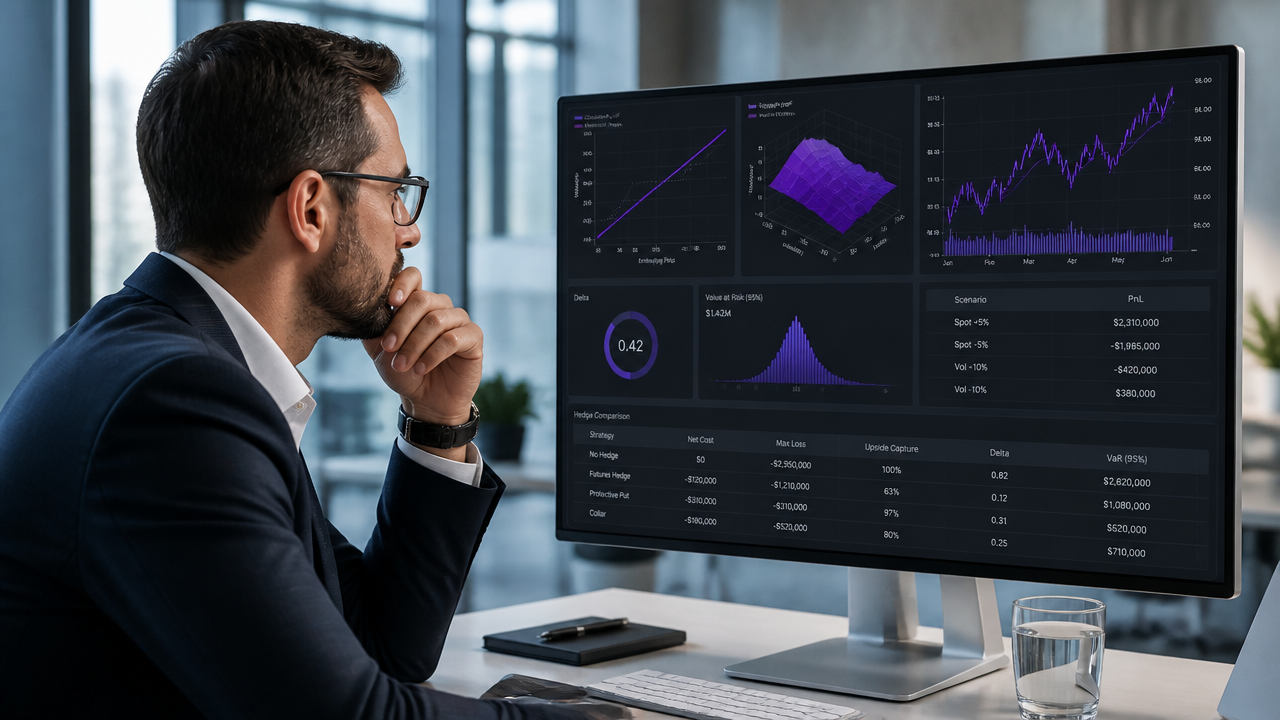
Uhedge was designed as more than a technology platform; it is an external extension of the client’s operations desk. Rather than relying on fragmented tools, Uhedge aggregates all exposures, currency, interest rates, and physical or financial commodities, into a unified management environment. This delivers:
- Real-time dashboards and risk maps that monitor every position and its mark-to-market value.
- Pre-set limits on leverage and risk, defined before any trade is executed.
- Automated AI-driven recommendations that adapt to changing markets but always stay within client tolerances.
- Complete transparency and auditable tracking across each hedging structure, contract, and result.
 The heart of Uhedge’s difference is the discipline it imposes. Before a trade is made, the system defines the absolute maximum leverage, risk budget, and the amount a client is willing to lose, and sticks to those parameters, automatically alerting when limits are reached or action is needed. This focus on process, not just outcome, minimizes surprises and maximizes control.
Concrete case: The Coffee "C" portfolio
Let’s be specific. Imagine a coffee producer with a defined exposure over several months. Volatile coffee prices threaten margin and cash flow. Uhedge applies restricted-risk modeling: only a set number of lots are hedged, never exceeding a predetermined leverage cap, and always with a benchmark in mind.
If prices move, the impact shows immediately on the risk map. No position can grow beyond the client’s articulated tolerance. The proprietary software tracks:
- Volume and value at risk for every open position
- How each market shock would affect overall profit and loss
- Whether any contract is drifting toward a breach of defined limits
This real-time surveillance isn’t just reporting—it’s guardrails that actively enforce discipline, so losses are contained before becoming existential. The software’s Mark-to-Market monitoring and automated end-of-day reports ensure management always sees the full picture and can react instantly if needed, before a problem snowballs.
When the system controls risk, users are free to focus on business, not firefighting.
AI, science, and aligned interest: A new era for commodity risk
Uhedge’s DNA is a fusion of quantitative science, advanced engineering, and human expertise. The team brings close to two decades of hands-on management experience from the world’s leading banks and commodity merchants, now transformed into actionable algorithms and transparent models.
The platform’s AI doesn’t simply analyze data, it transforms overwhelming complexity into timely, practical decisions supporting margin and financial health. Every action is backed by quantitative models derived from econometrics, statistics, and financial engineering, making human error less likely. The outcome is not just better returns, but consistency and resilience in the face of global uncertainty.
Building resilience, not just reaction
The Uhedge perspective isn’t just about avoiding losses. It’s about turning price uncertainty into a source of dependable, steady profit. Clients don’t merely hope for luck, they rely on systems that react faster than any manual process, structured on the following pillars:
- Quantitative restriction: Only engage with the risk necessary to protect the business, not chase windfall gains.
- Alignment of interest: Success is tracked and rewarded only when the client wins, no hidden commissions, no conflicting targets.
- Rigorous, ongoing adaptation: AI models evolve continually, recommending changes as external conditions shift, but never violating baseline discipline.
For further understanding on how commodity hedges bring predictability to agribusiness, consider this article on market strategies.
From threat to shield: The new story of derivatives
The message is clear: Derivatives, when paired with robust, system-enforced discipline, provide the only viable solution for commodity-exposed businesses to create financial stability. Far from being a source of chaos, they are a science-backed, AI-enabled shield that transforms uncertainty into manageable, strategic defense.
The wrong use of power creates disaster. The right use builds security.
Uhedge helps clients write the second story, the one where risk becomes just another managed variable in the pursuit of growth. For a further practical look at building robust hedging strategies, visit the Uhedge derivatives blog.
Conclusion
Derivatives don’t “blow up” companies. Their misuse does. The difference is found in discipline, advanced technology, and alignment with client goals. Uhedge stands for a new era, where risk management means less worry, more consistency, and a stronger bottom line.
To discover how discipline, transparency, and quantitative science can transform your risk into a competitive edge, reach out for a consultative diagnosis or request a demonstration of Uhedge’s digital treasury platform.
Contact Uhedge and see how robust discipline unlocks new value from your commodity exposures.
Frequently asked questions
What is commodity derivatives risk?
Commodity derivatives risk refers to the financial exposure companies face when they use contracts like futures, options, and swaps to manage or speculate on the price movements of commodities such as coffee, grains, metals, or energy. This risk includes the possibility of gains or losses from unexpected price fluctuations, as well as the potential for misuse if not properly controlled.
How do companies use commodity derivatives?
Firms use derivatives to stabilize profits, protect their margins, and plan for the future. For example, a coffee producer might use futures contracts to lock in a sale price months ahead, ensuring costs won’t spiral if market prices fall. The key is matching the volume and duration of contracts exactly to the underlying business need, not taking unnecessary bets on price swings.
What are common mistakes with derivatives?
Common mistakes include failing to set limits on leverage, using derivatives to chase profits rather than to hedge operational exposure, and operating without real-time oversight. Other errors are relying on fragmented systems or manual processes and ignoring the need for clear governance and reporting.
How can firms manage derivatives risk?
Effective management of derivatives risk requires a unified approach: setting predetermined risk and loss limits, using advanced analytics and real-time dashboards, and constantly monitoring every position. Systems like Uhedge’s enforce discipline, automate risk mapping, and ensure all exposure stays within agreed boundaries.
Why do misuse of derivatives cause losses?
Losses occur when companies treat derivatives as speculative tools, chasing windfall gains without disciplined stop-loss or leverage rules. When positions grow unchecked and are disconnected from business needs, even small market moves can escalate into catastrophic failures. That’s why the right framework makes all the difference.
For further strategies and practical guides, see more about hedging best practices and interest rate protection on Uhedge’s education platform.