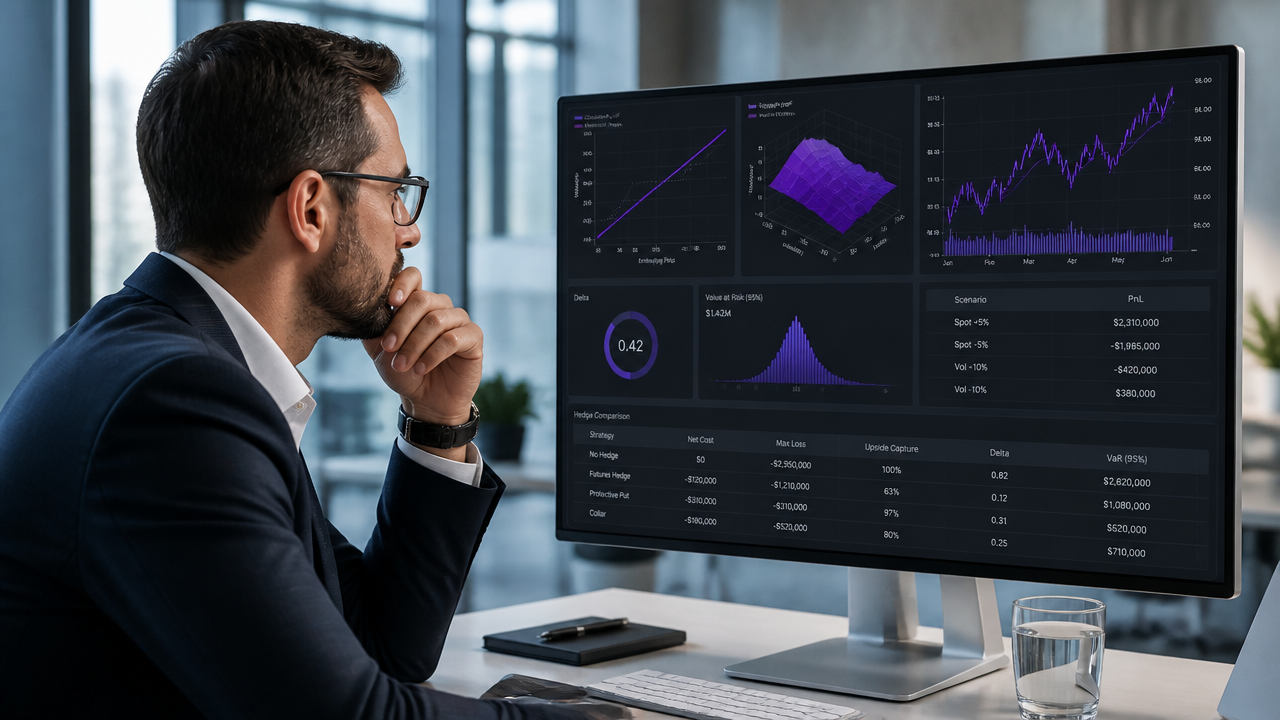
In financial markets where volatility reigns and every decision carries weight, having robust tools for pricing and managing derivatives is not just useful—it is transformative. The modern derivatives pricing engine does more than crunch numbers. It builds the bridge between strategy and execution, ensuring businesses retain visibility and control across FX, commodities, and interest rates. Drawing from the expertise and scientific rigor of Uhedge, this article demystifies the essential building blocks of pricing engines, explains foundational models, and shows the power of new technology for risk management.
The foundation of pricing engines in trading and asset management
A derivatives pricing engine sits at the core of a digital treasury system, shaping the risk and return landscape for companies managing complex exposure. It unifies different asset types, consolidating FX, rates, and commodities within a single management environment. Uhedge exemplifies this by delivering a multi-asset platform designed for nuanced real-time pricing and derivatives calculations.The aim is not simplification of logic, but disciplined pricing and transparent control—making it possible for treasury, trading, and risk teams to act on quantitative insight, not just intuition.
Why does this matter? Inconsistent or fragmented systems lead to undetected risk, missed opportunities, and increased costs. As Uhedge’s experience across global commodity markets demonstrates, true value is unlocked when companies can view all positions in real time and understand the story behind P&L and exposure.

Core models: From Black-Scholes to modern AI
At the heart of any pricing engine are mathematical models that simulate and value contingent claims—derivatives with payouts based on future events. Classic models have stood the test of time, each catering to specific instruments and market contexts:
- Black-Scholes Model: Used for valuing vanilla options, this model introduced closed-form pricing by assuming constant volatility. Its simplicity makes it a staple, but its assumptions can falter in commodities or when volatility changes abruptly.
- Cost-of-Carry Model: Vital for futures and forwards, this model quantifies the relationship between spot and future prices, reflecting interest rate, storage costs, and convenience yield.
- Monte Carlo Simulation: When dealing with path-dependent options or complex structures like accumulators and average price options, Monte Carlo harnesses random sampling to estimate value and risk across multiple scenarios.
For volatility derivatives, enhancements to classic models—such as stochastic volatility and regime-switching frameworks—have been shown to deliver improved valuation and risk hedging, as seen in recent academic studies. Uhedge applies advanced quantitative modeling, blending econometric and financial engineering methods, which broadens the engine's reach across asset types—commodities, FX, and interest rates alike.
Why real time data and unified architecture matter
Fast-changing markets demand real-time data integration. A robust pricing solution pulls in updated prices, volatility data, supply-demand curves, and counterparty information, simultaneously updating risk analytics and trading recommendations.
A unified object-oriented design—one of Uhedge's architectural hallmarks—grants flexibility to accommodate new structures, whether plain vanilla, exotic, or hybrid derivatives. This design streamlines risk checks, scenario analyses, and compliance.
Multi-currency support and supply-demand modeling ensure global reach and relevance. Markets operate around the clock, and the ability to price, clear, and monitor positions in any major currency, on any commodity or rate, establishes confidence and operational consistency.
The engine’s architecture: Science behind the interface
The power of a derivatives pricing engine shines through its structure—how it is built matters as much as the statistics it employs. Uhedge showcases several key pillars:
- Object-oriented architecture: Each asset, derivative, and risk factor is defined as an object, making it easy to simulate trades, test scenarios, and introduce new instruments with minimal re-coding.
- Precision by design: High-fidelity numerical methods and exact handling of floating-point calculations ensure that large portfolio computations do not result in compounding errors or rounding artifacts.
- Support for structured and multi-asset portfolios: The engine not only prices single instruments, but also models baskets and dynamic strategies, aggregating results into unified dashboards.
Behind the scenes, the Uhedge platform also supplies a robust API, supporting connector modules for real-time data feeds and central bank rates, empowering teams to customize their workflow around the engine’s core logic.
Risk management: From Greeks to governance
Correct pricing is only the start. How does a professional desk transform these numbers into risk decisions? The modern pricing engine allows real-time tracking of exposure, performance, and compliance.
- Greeks calculation (Delta, Gamma, Vega, Theta): These risk metrics measure sensitivity to changes in the underlying, volatility, and time, guiding dynamic hedging and stress testing.
- Scenario simulations and risk mapping illuminate potential profit or loss under varied market shocks, while providing transparency for governance and regulatory oversight.
- Automated P&L attribution: Explains performance by breaking down trading results into drivers—be it market movement, hedging efficiency, or model adjustments.
Compliance tools are deeply integrated, tracking policy adherence, producing end-of-day reports, and documenting risk decisions for audit—a valuable feature when dealing with derivatives in multi-jurisdictional portfolios.
For a closer look at risk strategies, practical examples of commodity hedging, and errors to avoid, the Uhedge blog provides a range of use cases: what companies do wrong in commodity hedging illustrates common pitfalls and their remedies.
Discipline and real-time insight are the foundation of sustainable P&L.
The rise of AI: Next-generation pricing and recommendations
Where older systems relied purely on historical volatility and static models, the new wave of pricing engines—like Uhedge’s—taps into artificial intelligence. The platform’s proprietary AI algorithms digest vast data streams, from macroeconomic signals to microstructure patterns, delivering:
- Real-time, context aware pricing and mark-to-market updates on derivatives portfolios.
- Dynamic, automatic recommendations for hedging based on market type, timing, and unique risk profiles.
The ability to suggest optimal hedging structures before risks materialize sets modern engines apart. For example, studies have shown that enhanced stochastic models can increase both pricing precision and hedging performance for volatility-linked products, breaking ground for broader application of machine learning to trading.
On the Uhedge blog, readers will find articles detailing strategic guidelines for risk mitigation, illustrating how AI models adapt to changing markets for consistently superior outcomes.
Validation, regulation, and operational best practice
No pricing system can be effective without regular model checks and regulatory validation. Engines must track benchmark accuracy, compare model outputs against observed market prices, and audit all decisions.
Regulatory compliance is built into the workflow, from historical reporting to stress tests and full governance traceability. As coverage spans more markets and asset types—including structured or exotic derivatives—the documentation and transparency become even more essential, helping clients meet international standards and local requirements.
For portfolio managers and corporate treasurers, best practices also call for frequent scenario analysis, stress testing, and documentation. By integrating these steps, the pricing engine acts as both a guide and a guardian. A deeper discussion on effective hedge planning in agribusiness or metals can be found at hedge planning in agribusiness and hedging strategies in the metals market.
Conclusion: The future is quantitative—are you prepared?
As markets evolve, the professional trading desk or treasury cannot afford to manage risk reactively. Unified, quantitative pricing solutions—like those from Uhedge—offer both scientific rigor and real-world flexibility so users gain clarity, discipline, and competitive advantage. You do not just price risk. You learn to control it, shape it, and use it as an engine for growth.
For those wanting to set a new standard for their asset management and hedging operations, the next step is clear. Reach out to Uhedge for a consultative risk diagnosis, and discover how intelligent systems can redefine what’s possible in treasury and trading management.
Frequently asked questions
What is a derivatives pricing engine?
A derivatives pricing engine is an advanced technology platform or software module that automatically calculates the value, risk metrics, and scenarios for a wide range of derivatives contracts. It consolidates real-time data, employs quantitative models, and supports decision-making for both trading and asset management across FX, commodities, and interest rates.
How does a pricing engine work?
A pricing engine ingests market data streams, applies mathematical models—such as Black-Scholes or Monte Carlo—to estimate fair value, then aggregates and displays this information instantly. It gives visibility of exposures, P&L, and compliance status across all risk factors and allows users to simulate, stress test, and optimize their portfolios.
What models are used in pricing engines?
Common models include Black-Scholes for options, cost-of-carry for futures/forwards, and Monte Carlo simulation for complex and path-dependent structures. In advanced systems, machine learning and AI models also play a growing role, enhancing adaptability and accuracy, as referenced in studies on improved VIX derivatives valuation.
Is it worth building a custom pricing engine?
For organizations with unique asset exposures or complex operational requirements, a custom engine can deliver tailored control, lower costs, and better strategic fit. However, it demands access to quantitative expertise and ongoing maintenance, so weighing the benefits against in-house capabilities and market alternatives is key.
How to choose the best pricing engine?
Consider the engine’s model coverage, flexibility to support new instruments, data integration, regulatory compliance tools, automation level, and real-time risk analytics. Proven experience in the relevant asset classes, as championed by Uhedge, and a transparent, client-aligned business model should factor heavily in the decision.