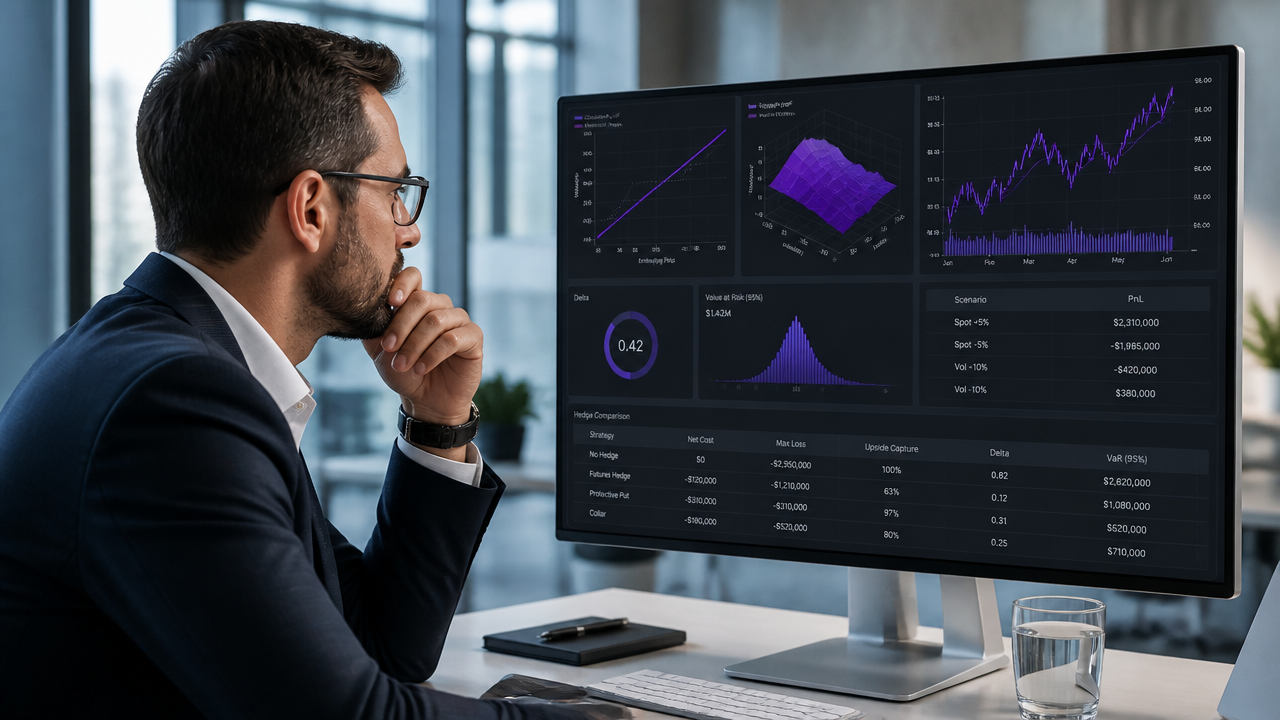
In business, surprises usually mean higher costs and threatened margins. For treasury and risk professionals, accurately pricing and monitoring derivatives is not just a technicality—it's about keeping companies resilient against volatility. Understanding how to assess the worth of financial contracts like forwards, swaps, options, and futures changes the equation. It allows decision-makers to act with confidence and strengthen long-term financial health.
This article explains how valuation works across derivative products and why robust models and up-to-date software (such as Uhedge solutions) are fundamental for strong risk management, disciplined treasury operations, and regulatory compliance.
Derivatives in risk and treasury management
Treasury teams reach for derivatives to manage uncertainty in currency, interest rate, and commodity exposures. These financial instruments make it possible to offset risk or even discover profit opportunities in price movements—if the value is understood clearly and in real time. Typical derivative products fall into these categories:
- Forwards: Private contracts that lock in prices for assets like currencies or commodities, customized to participants.
- Futures: Standardized contracts traded on exchanges for the purchase or sale of underlying assets at a future date.
- Swaps: Agreements to exchange cash flows, such as swapping fixed for floating interest rates, or currencies.
- Options: Give the holder the right, but not the obligation, to buy or sell at a preset price.
Hedging desks often combine these instruments into more advanced structures, such as accumulators and fences, to tailor risk and return profiles with precision. Companies like Uhedge have extended the reach of such solutions, using software to offer advanced pricing and modeling features that democratize previously niche products.
Enabling treasury teams to tame chaos is a hallmark of quantitative risk management.
Why accurate derivative assessment matters
Accurate valuation is at the heart of effective risk management strategies. There are several key reasons for this:
- Capital allocation: Reliable values help companies decide where and how much capital to commit for hedging.
- Regulatory reporting: Compliance demands transparent, up-to-date fair values for audits and documentation.
- Risk comparison: Leaders benchmark positions, P&L, and exposures to market moves.
- Business strategy: Accurate values guide tactical choices—whether to hedge, dynamically adjust, or hold.
- Counterparty negotiations: The ability to calculate fair prices increases bargaining power.
Modern asset managers and trading desks require this discipline for survival, not just success. Failures in valuation have led to notable financial mishaps across industries. Software tools that aggregate and model exposures—as done by Uhedge—embed much-needed discipline and visibility in day-to-day decision-making.
The main approaches to valuing derivatives
Determining the value of a derivative is a blend of art and science. Most methodologies fall under a few key principles:
Fair value estimation
Fair value is the price at which an asset could be bought or sold in an orderly transaction between market participants at the measurement date. For derivatives, this often involves modeling with the best available data inputs—market prices, quotes, and, where these are missing, well-developed mathematical models.
Discounted cash flow (DCF) analysis
The cornerstone for forwards, swaps, and even some options:
- Estimate future expected cash flows of the contract.
- Apply discount factors based on relevant interest rates or risk-free curves.
- Sum present values for a net derivative worth at today’s date.

This approach is favored where cash flow timings and amounts are predictable—like in fixed-for-floating swaps or simple forward agreements.
Mark-to-market and real-time updates
Modern treasury teams rely on mark-to-market routines to refresh the value of derivatives in line with market movements. This ensures exposures and P&L are always based on current information—a practice supported by both regulatory authorities and best-practice manuals. Real-time visibility, as featured in the Uhedge platform, means treasury teams no longer operate "in the dark" and can act on early warning signs right when they emerge.
Credit and counterparty risk adjustments
Counterparty financial health is never static. To reflect the real cost and risk, credit valuation adjustments (CVA) and related measures account for the possibility that the other party might default before the contract matures. Forward-thinking software packages embed this capability, offering governance and compliance checks at every stage.
The impact of volatility, collateral, and discount rates
Market factors can turn a simple contract into a moving target. Three stand out:
- Volatility: Option values, in particular, are highly sensitive to volatility estimates. Rapid or unexpected price swings in commodities, interest rates, or forex can cause wild changes in premium or intrinsic value overnight. The Federal Reserve’s April 2025 Financial Stability Report highlights how swaps-implied volatility points to persistent market uncertainty.
- Collateral: Margin requirements safeguard against default but can change daily. Their effect on balance sheets and liquidity forecasts is substantial, especially when leverage or exposure spikes.
- Discount rates: With interest rates fluctuating and curve inversion events, future cash flows must be updated using the latest market data to reflect time value accurately.
Correctly accounting for these factors is not optional. It is the backbone of robust policy and risk governance, as well as transparent audit trails.
Key models driving consistent results
Certain models, dating back decades, remain at the heart of pricing and valuation:
- Black-Scholes-Merton: Predominantly for pricing vanilla European options. Assumes constant volatility, a risk-free rate, and lognormal price distribution.
- Binomial and trinomial trees: Build up possible future price paths for options and convertible securities, using discrete steps.
- Monte Carlo simulations: Essential for exotic and path-dependent derivatives, these models run thousands of random scenarios to estimate the likely payoff distribution.
- Heath-Jarrow-Morton (HJM): Models forward rates and is vital for pricing interest rate derivatives in complex environments.
- Credit valuation adjustment frameworks: Adapt fair prices to reflect the probability-weighted impact of counterparty risk.
Professional valuation systems allow users to inspect the “Greeks”—delta, gamma, vega, and theta—which give real-time sensitivity data to shifts in price, volatility, and time. The Uhedge dashboard brings these metrics into a unified risk view, supporting better portfolio monitoring and timely alerts.
The right model isn’t just a calculation. It is how risk managers stay ahead of the unexpected.
Risk governance and compliance: the foundation of trust
Boards and regulatory agencies demand evidence that derivative positions are managed with discipline and transparency. For this, strong governance is required:
- Full audit trail on pricing, execution, and settlements.
- Automated controls that flag breaches in limits or deviations from approved models and policies.
- Systematic end-of-day (EOD) reporting, including mark-to-market, performance attribution, and Value at Risk (VaR) calculations.
- Pre-trade and post-trade analytics for better oversight and role-based access for segregation of duties.
Functional tools—like those at the core of Uhedge’s Digital Treasury—aggregate every operation across FX, rates, and commodities into a single, easy-to-inspect view. This provides the basis for routines that make compliance nearly automatic and deeply rooted in day-to-day routines.
The role of advanced software and AI solutions
Algorithms and artificial intelligence change the game when it comes to transforming reactivity into proactivity:
- AI-driven recommendations automatically select the best hedging strategy and timing for each unique exposure.
- Predictive analytics leverage historic and live market data, signaling risks before they become realized losses.
- Automated dashboards aggregate all positions and exposures—no more “blind-spots” or manual spreadsheets.
- End-to-end trade monitoring, real-time risk dashboards, P&L, and governance checks ensure a single version of the truth.
Uhedge’s platform, built on modern statistical, econometric, and financial engineering concepts, gives companies the edge they need. Real-world use cases show that AI-powered modelling adjusts strategies in real time based on client-specific goals, risk tolerances, and changing liquidity needs. When markets get noisy—think global tariff shocks, surges in inflation, or geopolitical uncertainty—data-driven agility delivers results that are measurable and sustainable.

From chaos to consistency: the Uhedge difference
Where others see volatility, Uhedge finds opportunity. As a partner, Uhedge extends the risk desk, combining scientific rigor with proprietary AI to convert noise into actionable insights. The benefit is not just in consistently lower hedging costs, but also in more predictable results and better alignment with enterprise objectives.
The process starts by matching the client’s risk profile, financial objectives, and liquidity constraints to specific hedging strategies. Then, through discipline and real-time insight, actions are continuously adjusted for changing conditions. This strategy is evident in Uhedge’s application for agricultural producers, manufacturing groups, and corporate treasuries requiring structured portfolio protection.
Transforming risk into a controlled source of value is the mission.
Bringing it all together for decision-makers
Designing and running a robust derivatives risk framework is not only about formulas or dashboards. It’s about the confidence that returns are protected, surprises are minimized, and each exposure is mapped to the best path forward. As conditions shift—like the steepening yield curve and heightened interest-rate volatility noted in the Federal Reserve’s 2025 report—firms using advanced valuation and AI-managed systems move ahead while others fall back.
Anyone aiming to redefine what’s possible in treasury or asset management should look at ongoing innovation in technology and modeling. Whether it's learning more about derivative strategies, reviewing robust risk management tools, or following practical guidance for interest rate or agri-market hedging, resources like the Uhedge blog section on derivatives, risk management, or practical hedging examples are invaluable references.

Related reading: practical guides on hedge strategies in markets, hedging in agribusiness, and interest rate hedging in Brazilian markets.
Conclusion: the new standard for derivative practice
Derivative pricing is central to modern financial control, competitive strategy, and risk governance. The combination of quantitative rigor, immediate access to analytics, and the adaptability of AI-driven tools defines the leaders in treasury and asset management today.
With Uhedge, firms have a partner dedicated to demystifying the numbers—creating actionable value from complexity and supporting every step in the risk management journey. Harness this expertise and see volatility not as a threat, but as a managed, even productive, part of your business.
Ready to take the next step? Schedule a diagnosis or experience the Uhedge platform in action, and unlock better outcomes for your treasury or risk management teams.
Frequently asked questions
What is derivative valuation?
Derivative valuation is the process of determining the monetary worth of a financial contract, like a forward, option, swap, or future, based on its expected future cash flows, market data, and risk factors. It blends market prices, mathematical models, and scenario analysis so risk managers and treasuries understand what contracts are worth at any moment.
How do you calculate derivative values?
Calculation methods depend on the type of contract and data available, but typically involve estimating all future cash benefits or obligations, then discounting them to today’s value using current risk-free or market rates. For options and more complex instruments, models—such as Black-Scholes or Monte Carlo simulation—are used, factoring in volatility, time, strike prices, and counterparty risk. Many firms now rely on specialized AI-driven software to automate and adjust these numbers in real time.
Why is derivative valuation important?
Accurate and transparent assessment of derivatives is fundamental for risk management, compliance, and strategic decision-making. It prevents unexpected financial losses, supports regulatory and audit requirements, and gives management reliable data to optimize hedging, negotiate with counterparties, and allocate capital efficiently.
What tools help with derivative valuation?
Modern derivative assessment is anchored in specialized software tools that support real-time data integration, scenario modeling, risk analytics, and governance checks. Uhedge’s platform, for example, offers end-to-end visibility, robust quantitative modeling, AI-driven strategy recommendation, and unified reporting—addressing needs for both treasury and asset management teams.
How often should derivatives be revalued?
Best practices and most regulations demand daily mark-to-market updates for all open derivative positions. In highly volatile environments, more frequent intraday checks may be needed. Whenever there’s a material move in underlying prices, volatility, or credit status, those values must be refreshed to ensure all exposures and financial statements remain up-to-date and compliant.