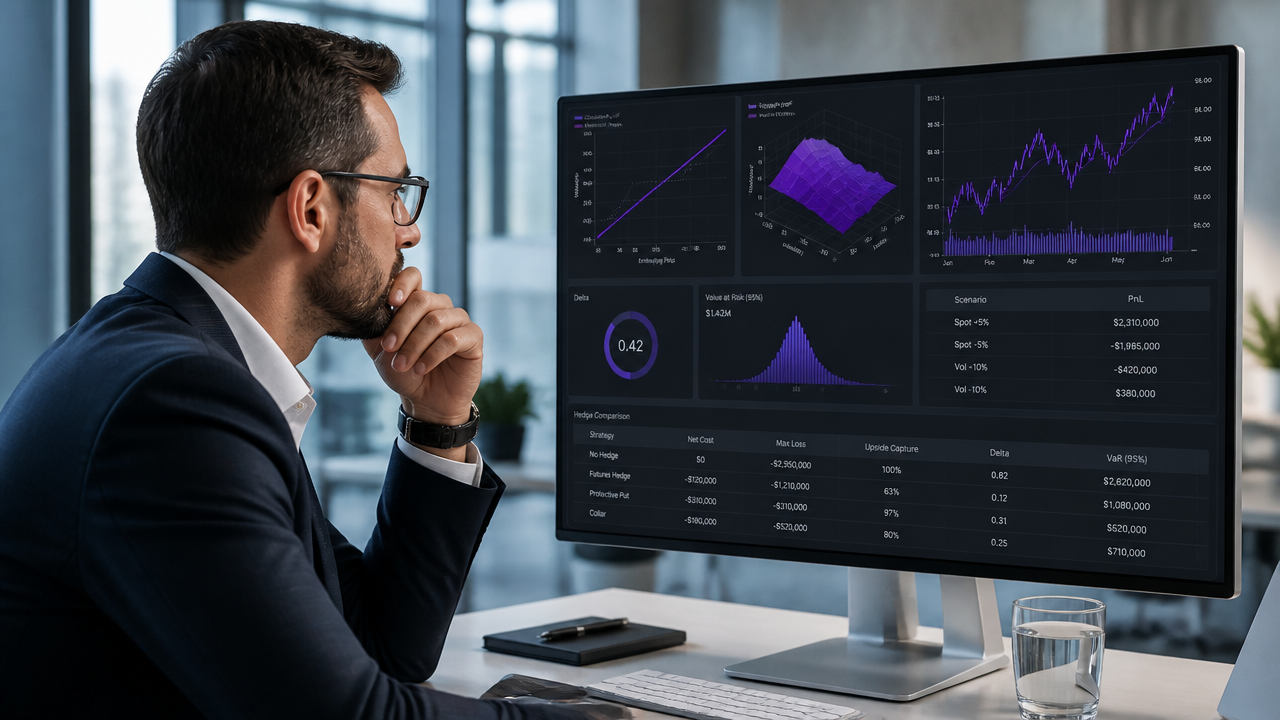
Modern markets are unforgiving to firms with fragmented oversight. Cross-asset volatility, fast-moving information, and regulatory demands make it tough for trading desks and treasury teams to operate blind. A unified platform for multi-asset position aggregation is more than a luxury—it is a necessity for navigating FX, interest rates, and commodities with confidence.
What is a multi-asset position aggregation tool?
A multi-asset position aggregation tool is a software solution that brings together positions, trades, risk exposures, and analytics from various asset classes—such as currencies, rates, and commodities—onto a single platform. By centralizing data that would otherwise be scattered across different trading systems or manual spreadsheets, these solutions make it possible to view, track, and analyze risks and performance in real-time.
For companies exposed to multiple asset classes, the difference between siloed visibility and a unified dashboard often translates into direct financial impact.
Organizations such as Uhedge exemplify how a comprehensive aggregation approach supports not only decision-making but also compliance and strategic agility, notably by integrating advanced quantitative models and AI-driven processes into their Digital Treasury system.
Visibility is power—without it, risk is underestimated.
Why aggregation matters for modern portfolio management
Institutions and corporations have rapidly grown aware that the old approach—treating portfolios piecemeal—leads to avoidable losses and missed opportunities. Today, research from the Commonfundsuggests that the demand for aggregated reporting and transparent risk analytics has never been greater, particularly for teams managing complex, diversified holdings. As new data from theInternational Journal of Intelligent Systems and Applications in Engineering notes, global markets now generate over 147 zettabytes per year, with over 2.1 million quote updates per second.
Without aggregation, firms become frantic, manually reconciling spreadsheets while the market races ahead.
Unified solutions give managers the whole picture at once—for trading, treasury, risk, compliance, and reporting. This single point of truth unlocks:
- Real-time, cross-asset risk tracking
- Instant compliance and governance validation
- Immediate access to derivatives analytics
- Consistent, audit-ready EOD (end of day) reporting
The Uhedge approach in context
Uhedge’s platform is built to fill this gap. By aggregating FX, rates, and commodity exposures—both physical and financial—in a unified Digital Treasury, the software delivers full transparency, AI-automated recommendations, and proprietary analytics. Features such as mark-to-market (MTM) tracking, comprehensive Greeks (Delta, Gamma, Vega, Theta), volatility surfaces, futures curves, risk mapping, and detailed P&L attribution are presented in real time.
The software’s quant-driven process integrates the latest in statistics, econometrics, and financial engineering. This fusion empowers decision-makers and ensures that discipline and governance are wired directly into everyday operations.
A fragmented workflow is a risky business.
How real-time aggregation changes the game
The need for real-time position tracking is acute. According to recent research, trading operations in 2024 must handle data speeds and volumes that are simply unmanageable without automation. Uhedge’s proprietary AI models and advanced analytics are not just a response—they’re a necessity for digesting highly granular, high-frequency data.
Key features include:
- Unified position monitoring across asset types: All FX, interest rate, and commodity positions are tracked in a single system, reducing operational blind spots.
- Instant mark-to-market updates: MTM values refresh with each market tick, supporting daily—and even intraday—risk and P&L oversight.
- Dynamic risk metrics: Real-time calculation and display of value at risk (VaR), Greeks, and margin requirements, letting teams act not react.
- Automated performance analysis: Built-in analytics modules break down returns, highlight outliers, and trace P&L changes to their sources.
Speed alone will not win—but accuracy, delivered in real time, does.
Automation of rebalancing, reporting, and compliance
Modern position aggregation systems automate time-consuming workflows that were once manual, repetitive, and error-prone. By wiring up daily rebalancing and automated reporting functions, platforms reduce compliance mistakes—turning regulatory burdens into routine checks instead of stress events.
Automated report generation offers two advantages: accuracy and peace of mind.
For example, Uhedge’s end-of-day and performance explanation reports (MTD PL Explain) are generated automatically, minimizing human error while maximizing readiness for routine audits or high-stakes reviews. The system also includes governance verification, ensuring that each position and trading strategy lines up perfectly with internal policy and external regulations.
When compliance is automatic, surprises disappear.
Comparing critical features: What should a treasury or trading desk demand?
There’s no benefit in having a tool that can’t keep pace with diverse, real-world requirements. Firms exposed to FX, rates, and commodities should demand the following:
- Cross-market capability: Position data for spot, forward, swap, and option trades—across all relevant markets, including those that are OTC—should be available instantly.
- Multi-currency support: Real-time, accurate aggregation across base and quote currencies, with live conversion for exposure and reporting.
- Analytics for action: Data alone is noise. Systems need to offer actionable analytics, such as scenario stress tests, volatility surface views, and margin impact projections.
- Integration for unified governance: Ensure all trades and positions are checked against policy for full auditability and immediate alerting if thresholds are breached.
- Custom reporting and dashboards: Tailor information delivery to different stakeholders—risk managers, traders, compliance, and senior leadership.
Uhedge’s solution ticks these boxes, drawing on nearly 20 years of quantitative expertise and practical market experience. This ensures that both the scientific rigor and business realities are respected in every workflow.
Key risk metrics and derivatives analytics
Aggregation platforms designed for multi-asset management must support a broad set of risk metrics. These go beyond price and volume data; they encompass:
- Greeks (Delta, Gamma, Vega, Theta): Key for options and complex derivatives tracking.
- Mark-to-market (MTM): Essential for nightly and intraday valuation—across asset types.
- Exposure by counterparty, geography, and market type: Useful for regulatory and management demands.
- Performance analytics: Explains profit and loss by asset, strategy, or instrument, supporting robust attribution and transparency.
- Scenario and stress tests: Projects how portfolios respond to extreme market movements.
- Volatility surface and futures curve: These forward-looking analytics help managers see risk and opportunity before price alone signals them.
Derivative coverage is not just about having a calculator. Uhedge, for example, allows trading desks to construct structures such as vanilla options, swaps, accumulators, average price or strike structures, and fences—all with instantaneous analytics and performance measurement. This is game-changing for teams handling both physical and paper commodity positions.

Benefits of a unified aggregation environment
The measurable gains of aggregation impact both the operational and strategic side:
- Faster, better decisions: With all variables surfaced in real time, actionable signals become clear. For those interested in practical strategies, the article on practical hedge strategies further illustrates actionable frameworks.
- Cost reduction: Automated processes require fewer staff for tedious tasks and dramatically reduce the risk of expensive operational mistakes.
- Improved compliance: Automated checks mean no missed reports, fewer regulatory headaches, and better audit outcomes.
- Stronger governance: All position and risk data are continuously validated against internal and external requirements.
- Greater transparency: From C-level to desk, everyone sees the same data, reducing internal friction and improving cross-team trust.
Studies from TDWI show that 83% of IT leaders are using more than one cloud service provider today—highlighting the increasing complexity and the urgent need for aggregation solutions that work across not just asset classes but also technology platforms.
Implementation and institutional-grade security
Rolling out a multi-asset position aggregation platform isn’t just about buying software. It involves secure integration with existing data sources (from trading platforms to commodity accounting systems), robust user authentication, and strong data governance.
Security is paramount. High-level encryption for data at rest and in transit, multi-factor authentication, role-based access, and frequent review of access controls are all necessary for institutional-grade environments. Audit logs and immutable reporting provide defensible compliance in regulated environments.
Trust is built on transparency and control—without both, no system is truly ready for institutional deployment.
Real-world use: Trading desk and treasury team workflows
Let’s see it in action. Uhedge’s solution is actively used to aggregate and manage multi-asset risk in several major sectors, including agricultural commodity cooperatives, fuel distributors, food manufacturers, and financial intermediaries.
Practical examples:
- Coffee Hedging: A trade desk managing coffee “C” exposures on the NYBOT can designate specific lots for hedging, set leverage restrictions, and use dynamic risk metrics. Performance analytics shows the hedge outperforming simple leveraged derivatives, highlighting the value of data-driven discipline.
- AI-powered commodity decisions: By leveraging AI-based signal detection, treasury teams identify optimal moments to increase or reduce exposure—based on predictive analytics, rather than gut feel. The system flags actionable insights in real time.
- Dynamic risk mapping: Stress scenarios and instant reporting enable desks to adjust quickly during global volatility (think trade shocks, inflation spikes, tariff surprises), avoiding slow manual recalibration and costly errors.

Those searching for decision frameworks will find more in-depth resources on the topics of risk management, managing margin in volatile markets, hedging in agribusiness, and signs that your portfolio needs a hedge strategy.
Challenges and best practices for implementation
Every great tool is only as strong as its weakest connection.Integration complexity and data discipline are the main bottlenecks. Many legacy systems silo asset class data; careful planning is needed when feeding these sources securely into a central platform. Key steps include:
- Mapping internal data architecture before starting—avoid surprises down the road.
- Starting with phased onboarding—don’t rush to aggregate all at once.
- Engaging power users early—empower your risk, treasury, and trading experts to champion adoption.
- Regular internal training and governance reviews—keep teams sharp as tools and rules evolve.
With the right approach, aggregation solutions such as those of Uhedge empower companies to make decisions with conviction, armed with data they can trust.
Conclusion: The new standard for confident market participation
Unified position aggregation is not a niche technical upgrade—it is the modern baseline for treasury and trading desks.As the velocity and complexity of global markets continue to accelerate, platforms that consolidate all exposures, risks, and analytics into one environment unlock better, faster, and safer decisions. Uhedge, with its proven blend of quantitative rigor and advanced automation, stands as an example of this new standard—providing the discipline, clarity, and strategic control required by today’s top decision-makers.
To discover how your organization can transform market uncertainty into consistent results, reach out for a consultative review and experience how Uhedge—by acting as an extension of your desk—can give you an edge. This is not just future-proofing; it is building your next advantage, today.
Frequently asked questions
What is a multi-asset position aggregation tool?
A multi-asset position aggregation tool is a software platform that collects, organizes, and analyzes position, risk, and performance data from multiple asset classes—such as FX, rates, and commodities—into a single interface. This approach provides real-time oversight for all exposures and enables centralized portfolio management.
How does position aggregation improve portfolio management?
Position aggregation eliminates data silos and manual work, allowing managers to see their entire risk landscape at a glance. It enables faster response to market events, easier compliance, and stronger performance analytics, so portfolios can be rebalanced and optimized in real time with fewer errors and lags.
What features should I look for in these tools?
Core features to seek include cross-asset and multi-currency coverage, real-time MTM and risk metrics, automated reporting (including EOD and performance attribution), scenario and stress testing, built-in compliance checks, flexible dashboard customization, and support for both exchange-traded and OTC derivatives.
Are aggregation tools secure for sensitive data?
Yes, when built correctly. Security best practices involve high-level encryption, multi-factor authentication, detailed user roles, strong audit trails, and regular system reviews. Trusted providers enforce strict data governance, keeping sensitive trade and position data safe from both internal and external threats.
How much do multi-asset aggregation tools cost?
The cost varies based on features, scale, and integration needs. Generally, packages can range from monthly subscriptions for SaaS platforms to more significant investment for institutional deployments. It is important to balance upfront costs against tangible ROI—reduced errors, better risk management, and compliance certainty.