The business landscape has become unpredictable. Currency swings, volatile interest rates, and fluctuating commodity prices can wipe out profits overnight. Asset managers, treasury departments, and companies exposed to these forces are actively redefining how they control risk, centralize oversight, and deliver growth.
In response, portfolio management systems have rapidly evolved. Today, the right platform acts as the nerve center for financial agility, combining science, technology, and actionable insight. This article guides readers through what a modern system is, the pain points it solves, and why solutions like Uhedge’s Trading Solutions—founded on AI, quantitative rigor, and real-time data—are reshaping how companies approach treasury and risk management.
Understanding the portfolio management system: core definition and scope
A portfolio management system is an advanced platform designed to aggregate, analyze, and govern the assets, exposures, and financial risks of an organization. Unlike simple project management software, true treasury- or asset-focused systems are built to handle huge volumes of market data, derivative pricing, and compliance needs in real time. Their benefits extend beyond investment choices into critical business domains—treasury operations, commodities trading, foreign exchange, and more.
A system of this kind orchestrates:
- Centralized visibility over all assets and exposures (across FX, rates, commodities, and instruments)
- Risk analysis, automated pricing of derivatives, and scenario modeling
- Compliance reporting, audit trails, and regulatory alignment
- Performance measurement via advanced analytics and KPIs
- Integration of AI-driven recommendations for optimal hedging strategies
According to recent industry risk surveys, nearly half of treasury professionals now rank macroeconomic volatility—like inflation, GDP growth, and interest rate moves—as the most difficult challenges to manage. The urgency for robust platform-based risk frameworks has never been greater.
Single-screen clarity beats spreadsheet confusion every time.
Who benefits most from these systems?
A management platform tailored for treasury and risk acts as an anchor for a variety of market participants. Among those who gain the most: portfolio managers, corporate finance teams, commodity producers, exporters, and organizations with cross-border operations.
- Asset managers use these platforms for disciplined execution of investment strategies, measurement of performance, and automatic rebalancing.
- Treasury departments rely on the system to consolidate cash flows, track exposures, and meet regulatory scrutiny.
- Commodity-centric businesses depend on real-time intelligence to protect margins and minimize the impact of world events.
- Banks and financial institutions need rapid, automated pricing of OTC derivatives, along with scenario and stress-testing tools.
Uhedge’s unified solution, for instance, acts as an “extension of the client’s trading desk,” combining nearly twenty years’ market expertise and cutting-edge quant technology into a single environment that bridges organizational gaps and removes conflicts of interest.
Key components and features: what a real portfolio management solution must deliver
1. Unified data aggregation and real-time pricing
Treasury and asset managers often struggle with siloed systems and fragmented data. A portfolio management platform should:
- Aggregate market, trade, and risk data from multiple sources (including FX, interest rate, and commodity feeds)
- Offer real-time MTM (Mark-to-Market) tracking of portfolios
- Deliver algorithmic pricing of derivatives: Vanilla, Swaps, Options, Accumulators, and more
Uhedge’s platform, for example, creates a “digital treasury” environment where all operations—across physical and financial instruments—flow into a single dashboard, improving data reliability and speed of reaction.
Visibility today prevents surprises tomorrow.
2. Risk management: derivatives, hedging, and compliance
Essential to any portfolio solution are risk controls. The best platforms incorporate pre-trade analytics, scenario testing, and AI-based decision recommendations tailored to a company’s specific profile.
- Risk dashboards centralize exposures (FX, rates, commodities)
- Complex derivative structures—handled instantly with replicating algorithms
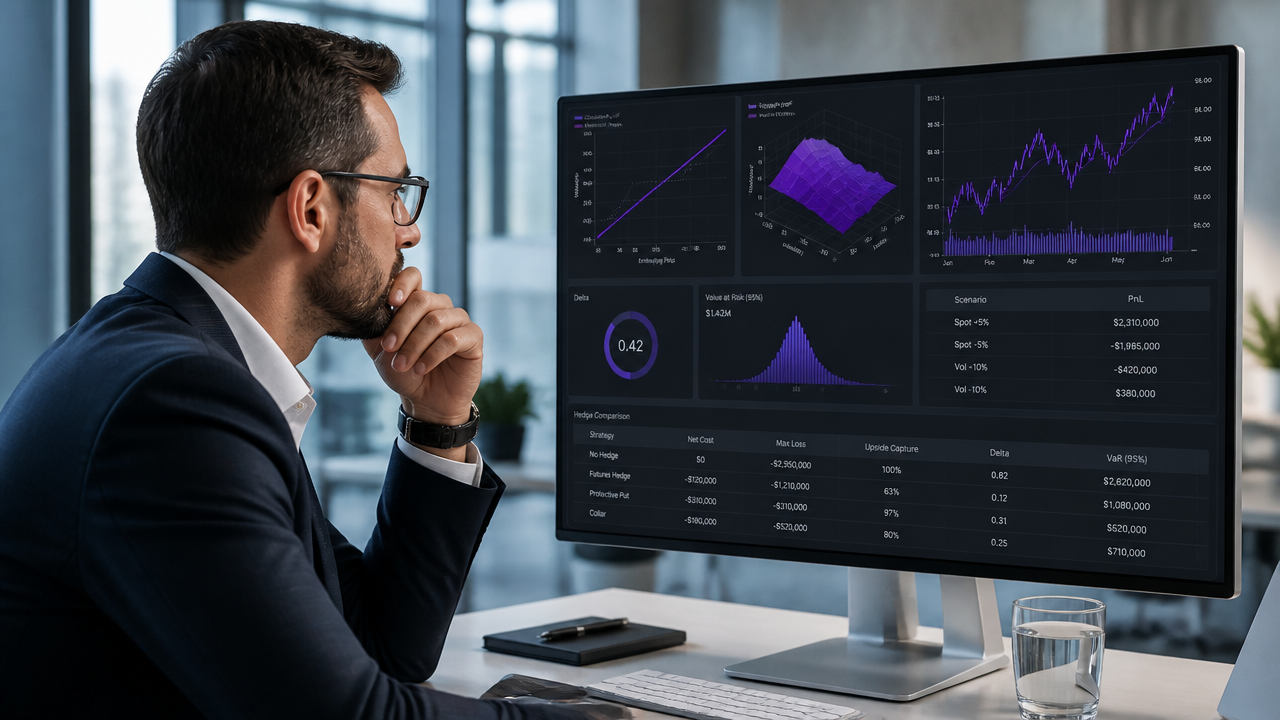
- Simulation tools enable stress tests, value-at-risk (VaR), and “Greeks” (Delta, Gamma, Vega, Theta) analysis
- Automated governance checks, ensuring policies, limits, and regulatory rules are followed
This rigor forms a technical foundation for “disciplined risk-taking” rather than chaotic reaction. Companies using these systems often find their cost of hedging falls and decision timing improves, all while reducing error and compliance risk.
3. Integrated analytics for performance and macro signals
A smart system is more than a logbook or repository. Modern platforms scan the horizon by transforming market signals, macroeconomic factors, and internal KPIs into actionable insight.
Features include:
- Automated P&L attribution and daily performance reporting
- Customizable reports visualizing risk drivers across operations, asset classes, and timeframes
- Proactive alerting for breaches, anomalies, or emerging opportunities
- Dedicated AI-driven modules to convert broad-market signals (like inflation or trade tensions) into hedge actions and trade ideas
The value of this integrated intelligence is highlighted in periods like 2025’s turbulence, as shown by Uhedge Asset Management’s resilience amid global shocks: the platform translated macro signals into dynamic allocation and restricted-risk strategies, cushioning clients from market shocks.

Numbers tell stories that headlines miss.
4. Automation, integration, and ease of use
Automation is now a hallmark of best-in-class platforms. According to Treasurer Magazine, large organizations are centralizing treasury operations, integrating portfolio systems with ERP platforms, and feeding in third-party market data. The outcome is a more automated, less error-prone workflow, freeing staff for analysis and strategy.
- Automatic EOD (End of Day) reports, reducing manual labor
- Risk and compliance checks run in the background
- Straightforward integration with other business systems (ERP, trading platforms, accounting)
- User experience designed to simplify complex tasks, with customizable dashboards and calculators
Uhedge prioritizes experience: although built on state-of-the-art finance and statistical models, the end-user interacts with a clear, simple interface, making even complex derivative strategies accessible and transparent.
5. Cloud-based architecture, security, and scalability
The world runs on cloud tech—and so do robust portfolio systems. Cloud delivery brings scalability, global access, and continual software updates. Security, meanwhile, is paramount as these platforms handle high-value, sensitive financial information across organizations.
- Encrypted data transfers and secure access controls
- Audit trails for all transactions and parameter changes
- Multi-region disaster recovery and backups
- Scalable infrastructure to handle growth and spikes in market activity
These technical foundations guarantee business continuity and client trust, aligning technology standards with the intensity of modern trading and treasury environments.
The shift from reactive to proactive: data-driven decisions and real outcomes
A management system’s greatest value is how it transforms behavior. The journey is from reactive firefighting—chasing after risks and reconciling errors—to proactive foresight, where the platform surfaces risk and opportunity ahead of time.
Recent global treasury surveys capture this mood shift: the majority of treasurers now flag FX volatility as their top risk, closely followed by rate and commodity swings. Many are looking for frameworks to not just react, but to preempt and defend profit margins.
Uhedge’s quantitative, AI-powered approach—backed by disciplined modeling from Wall Street and the world’s commodity centers—embodies this transformation. Its “digital treasury” not only shines a light on exposures but also quantifies the benefit and timing of each hedge action. This is where robust KPIs for treasury teams come into play, such as cash visibility percentages, hedge ratios, and first-time payment success (explored in detail at Treasury Magazine's KPI guidance).
Specialized tools versus generic project software
A recurring question: can companies just use a standard project or workflow management app? The answer is clear. Ordinary project tools track tasks and to-do lists—they simply cannot price complex derivatives, run real-time risk mapping, or synthesize market movements into an actionable risk dashboard.
Specialized management systems—like Uhedge’s Trading Solutions—are built with proprietary quant models and AI to tackle the real-world volatility of financial markets. They’re designed for the continuous aggregation, instant analysis, and rigorous discipline required when managing assets and exposures in a world where market conditions change by the hour.
The performance gap isn’t theoretical. In commodities and macro-driven segments, using generic tools for risk management often leads to missed market signals, undetected exposures, and subpar hedging results.
Real money is made by precision, not by chance.
Modern demands: why cloud, automation, and AI are mandatory
Modern treasury and asset-management work increasingly demands real-time data, AI-driven advice, full automation, and secure, cloud-based environments.
- Speed and scalability: As volumes and complexity rise, only cloud-based and automated systems can scale to handle surges in trading and data processing.
- Real-time intelligence: Decisions are often needed in minutes. AI modules can scan thousands of scenarios instantly, adjusting portfolios with a speed untouchable to manual methods.
- Security and auditing: With regulatory demands tightening, robust audit logs and encryption are now a baseline requirement for all mission-critical treasury technology.
A 2023 industry survey found a sharp rise in concern over ability to respond to macroeconomic risk, echoing the urgency of moving beyond spreadsheets and fragmented legacy systems into scalable, AI-informed architectures.
Putting it all together: building the ideal treasury and risk platform
When evaluating options, decision-makers should consider these practical points:
- Does the platform centralize all exposures (FX, interest, commodities) with real-time aggregation?
- Is it powered by quantitative models and advanced analytics, not just static databases?
- Are hedging and risk recommendations tailored to the organization’s financial goals and constraints?
- Does the system assure compliance, auditability, and easy integration with existing ERPs or market data feeds?
- Finally, will users gain not just reporting, but actionable insight—enabling them to react quickly and strategically, informed by the latest data and market intelligence?
For companies with complex portfolios or significant exposure to currency, interest rates, or commodities, the answer is rarely a generic solution. It’s a purpose-built management environment, blending quantitative science, clean UI, integration muscles, and sophisticated AI.
Uhedge, for instance, approaches market challenges as both an AI-powered software provider and asset manager. Their “digital treasury” is an AI-driven control tower, automating derivative pricing, risk measurement, and governance checks in one view. The focus is clear: turn risk from an uncertain cost into a generator of robust margin and growth.
Case stories: outcomes and impact in practice
The power of a specialized system is unmistakably practical. For instance, Uhedge’s risk-managed portfolio approaches use restricted-risk modeling, resulting in strategies that outperform typical benchmarks during turbulent cycles.
One real example involves a coffee producer using a tailored AI-driven hedging model to navigate a tumultuous year of price swings on the New York futures market. With the platform tracking exposures and suggesting actions in real time, the outcome was not only protection but also the ability to capitalize on disequilibrium in the market.
Another story involves treasury teams that, when equipped with unified control dashboards and daily KPIs, have drastically reduced the time needed for balance-sheet reconciliation and liquidity planning. The system’s alerting prevented several near-misses, where market movements could have impacted cash positions unexpectedly.
Translating market complexity into opportunity is a recurring theme. As the world’s trade flows adjust to new risks—trade tensions, inflation, commodity bottlenecks—the system’s macro-signal analytics have made the difference between reaction and anticipation, transforming how treasury and commodity-centric businesses weather storms.
Conclusion: the way forward for treasury and asset management
Every organization exposed to market risk needs more than static reports and slow manual processes—they need a platform that transforms complexity into control, risk into decisions, and decisions into measurable results.
Solutions like Uhedge Trading Solutions and Asset Management act as the knowledge and execution hub for modern treasury teams and asset managers, using AI, quant rigor, and cloud power to create value, enhance governance, and support growth across cycles.
Those looking to thrive amidst volatility and uncertainty should seek not just a tool, but a partner—one blending expertise, transparency, and next-generation technology. Understanding and harnessing a truly robust portfolio management system now marks the difference between surviving turbulence and seizing opportunity.
Looking for the next step? True transformation begins with a dedicated diagnosis. Discover how a platform built on market intelligence and scientific discipline can power your financial decisions for the future. Learn more about practical strategies for risk protection and let Uhedge be your partner in converting uncertainty into measurable gain.
Frequently asked questions
What is a portfolio management system?
A portfolio management system is a specialized platform that aggregates, monitors, and analyzes financial assets, exposures, and risks, empowering organizations with tools for decision-making, compliance, and automated performance reporting. These systems are typically used by treasury, asset management, and trading teams to manage portfolios that span multiple asset classes and risk factors, integrating data, pricing, analytics, and compliance controls to deliver oversight and maximize value.
How does it help with risk management?
Such a platform transforms risk oversight, delivering real-time dashboards, quantitative models for scenario analysis, and automated compliance checks. It helps companies spot exposures early, structure hedging strategies with AI-driven recommendations, and monitor policy adherence, turning financial volatility into a source of opportunity rather than loss. Uhedge’s solution, for example, deploys scenario models, market analytics, and reporting tools that all contribute to a safer, more agile treasury operation.
What features should I look for?
Look for:
- Centralized data aggregation across FX, interest, and commodities
- Automated pricing and recommendation engines powered by AI and quantitative models
- Risk dashboards, scenario modeling, and Greek analytics
- Comprehensive performance measurement (including daily EOD reports and real-time KPIs)
- Strong integration capabilities (ERP, trading systems, accounting)
- Cloud-based access, stringent security, and audit trails
Is it worth using for treasury teams?
Absolutely. As treasury professionals increasingly take on strategic duties—supporting M&A, working-capital optimization, and cash forecasting—a management system provides visibility and rigor unavailable elsewhere. Surveys show more than two-thirds of treasury teams now directly inform organizational strategy through their analysis and data, making sophisticated systems a foundation for impact and credibility.
How much does a portfolio system cost?
Costs vary with scale, complexity, and required features, but premium solutions pay for themselves by reducing errors, saving time, and allowing smarter risk-taking. Instead of focusing on “cheap” options, organizations should seek platforms proven to generate value by combining transparency, scientific rigor, and automation: hallmarks of a long-term, cost-effective technology investment.
For more insights into managing risk and protecting your company’s bottom line, visit the Uhedge blog on signs your portfolio needs a new hedging strategy or our latest analysis on global markets and risk.