Commodity futures pricing is not just the number on a trading screen. For producers, cooperatives, mills, exporters, and industrial buyers, the usable price is the exchange quote adjusted for carry, basis, freight, taxes, currency, and timing. That is why a good pricing process matters as much as market direction.
This guide explains how futures prices are formed, what curve structure is really telling you, and how to turn a quote into a hedge decision that protects margin. It is especially useful for agribusiness and treasury teams that need disciplined pricing, not just market headlines.
Key takeaways
- Futures are reference prices, not final commercial prices. The local deal price usually includes basis and logistics effects.
- Curve shape matters. Contango and backwardation change roll economics, inventory value, and hedge timing.
- Basis can dominate the result. A correct futures hedge can still underperform if local basis risk is ignored.
- Mark to market changes behavior. Margin calls and daily P&L affect liquidity planning long before physical delivery.
- Integrated systems improve decisions. Uhedge connects physical and financial exposures in one CTRM workflow, from exposure mapping to accounting support.
How are commodity futures prices formed?
Commodity futures prices are built from today’s market conditions plus the cost and value of carrying the commodity to a future date. In simple terms, traders compare the spot market, storage costs, financing, insurance, expected availability, and convenience of holding inventory now versus later.
In practice, this means a corn, sugar, coffee, or soybean contract is never just a pure forecast. It is a tradable equilibrium between current supply and demand and the economics of time. If you need a deeper view of how market forces shape reference prices, the blog’s explanation of commodity pricing risk and market dynamics is a useful complement.
For commercial hedgers, the operational formula is usually closer to this: futures quote + local basis + freight + taxes + currency effects. That is why two companies looking at the same exchange contract can reach very different executable prices.
Why basis matters as much as the futures quote
Basis is often the difference between a textbook hedge and a usable hedge. It captures the gap between the exchange reference and the real local physical market, including region, logistics, quality, and timing.
In agricultural chains, that gap can move sharply during harvest, interharvest periods, port congestion, weather events, or changes in regional demand. Uhedge addresses this by structuring physical price curves with basis, freight, and tax components, then monitoring basis against history inside the same environment as the derivatives book. If your team wants a broader framework, the post on cash and carry in soy and corn helps connect basis and storage logic to daily decisions.
What do contango and backwardation tell you?
Curve shape is a pricing signal, not just a chart pattern. When the market is in contango, deferred contracts trade above nearby months, which often reflects positive carry costs such as financing and storage. When the market is in backwardation, nearby contracts trade above deferred months, which usually suggests prompt tightness or stronger immediate demand.
For hedgers, this affects more than market interpretation. It changes roll cost, inventory economics, and the relative attractiveness of hedging now versus later. A company that hedges one month at a time without reading the curve may protect headline price risk while quietly giving up margin through poor roll decisions.
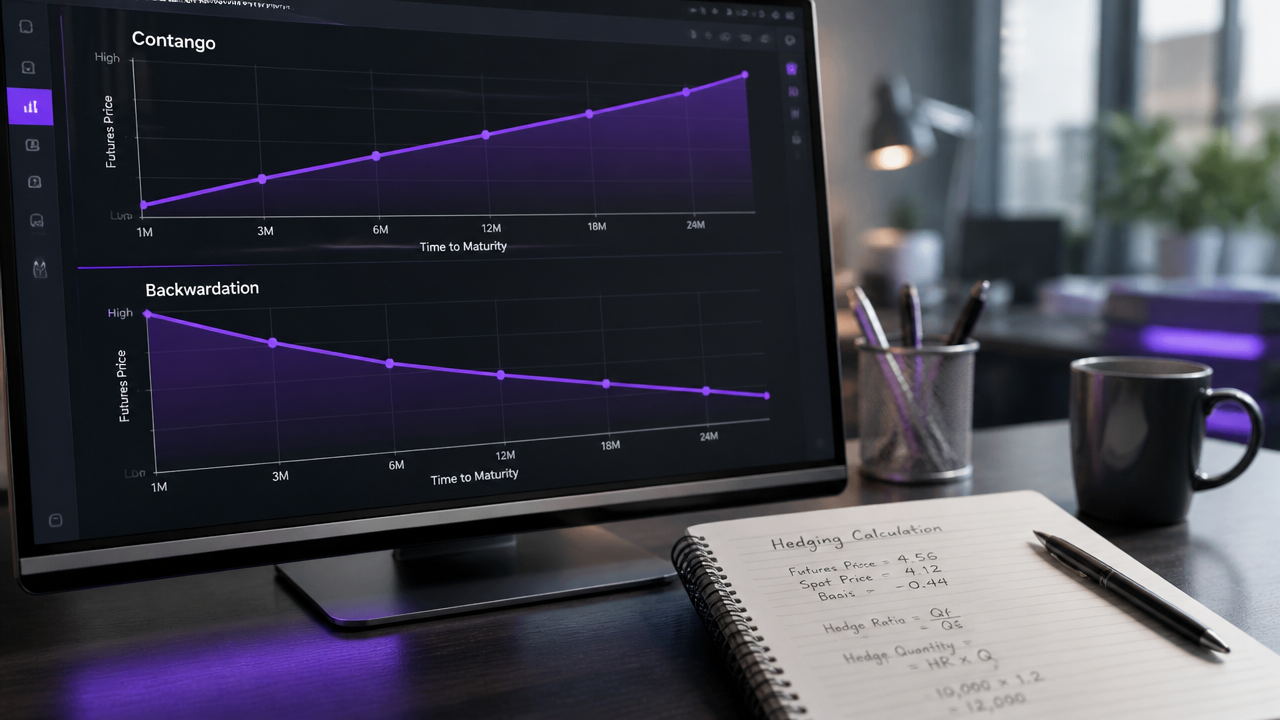
That is why Uhedge combines futures curves, volatility views, and position analytics in one auditable process. Instead of treating curve structure as a side note, treasury teams can evaluate whether the forward months are offering protection, carrying cost, or an expensive hedge that should be redesigned.
Where can you see futures prices, and why is that not enough?
You can see futures prices on exchange platforms, broker terminals, market portals, and data vendors. But a visible quote is only a reference point. A real commercial decision also depends on contract month, lot size, basis, exposure size, hedge ratio, and the liquidity needed to support daily mark to market.
This is where many teams struggle. Physical purchases may live in the ERP, derivatives in broker files, FX hedges in spreadsheets, and risk reports in separate presentations. The result is fragmented visibility and delayed action. The blog’s overview of CTRM software for the trade lifecycle shows why integrated data matters when prices move fast.
Uhedge was built as a pre and post trade CTRM platform, so it records, monitors, and reports physical and financial operations in one place. It does not automate exchange order execution, but it helps teams turn screen prices into measurable exposures, hedge ratios, mark to market reports, and audit ready records.
Are commodity futures risky?
Yes, futures can be risky, but usually not for the reason beginners assume. The main danger is rarely the existence of the hedge itself. The real problem is mismatch: wrong contract month, weak basis assumptions, oversized positions, poor margin planning, or governance that cannot explain daily P&L.
Futures are leveraged instruments with daily settlement, so mark to market can create short term cash pressure even when the hedge is economically sound over the life of the exposure. That is why disciplined risk management matters. The article on real time mark to market is especially relevant for controllers and treasurers who need to prepare for volatility, not just measure it after the fact.
Uhedge’s workflow reflects this reality. The platform maps gross and net exposure, recommends hedge ratios, tracks futures, FX, and basis as separate but connected risk books, and supports scenario analysis, Greeks, stress testing, and value at risk. For firms facing audit pressure or policy upgrades, the practical checklist in commodity hedging governance steps adds a strong control perspective.
How does a commercial hedge turn a futures quote into a usable decision?
A usable hedge starts with the business exposure, not with the market view. The first question is what margin, input cost, or sales value needs protection, over what period, and against which benchmark. Only then does the futures contract become the right tool, or part of the right tool.
In many agribusiness cases, the full structure has three legs: exchange futures, local physical basis, and currency. Uhedge was designed for exactly this problem. Its platform supports separate and auditable books for physical exposure, futures, and FX, while calculating mark to market, risk by factor, and accounting support under IFRS 9 and CPC 38. This matters because a hedge that looks good on the exchange can still fail commercially if basis and FX are unmanaged.
The company’s positioning is clear: institutional quantitative rigor, integrated physical plus financial visibility, and an alignment model without hidden spreads or opaque commissions. According to the client’s reference materials, that model can generate savings of up to 70 percent in hedge costs when compared with traditional bank structures, while giving treasury and commercial teams a stronger benchmark for independent pricing decisions.
Why pricing discipline beats price prediction
The most consistent commodity teams do not win by forecasting every market turn. They win by building a repeatable pricing process. That means defining exposure clearly, choosing the right benchmark, measuring basis separately, checking the curve, planning liquidity for margin, and documenting the economic purpose of the hedge.
Prediction still has value, but discipline compounds faster. A robust pricing framework helps companies act before emotion takes over, and it makes post trade analysis more useful because every hedge can be reviewed against the original objective. In volatile agricultural markets, that is often the difference between protecting margin and merely reacting to headlines.
For firms that want pricing, risk, and accounting logic in the same workflow, Uhedge offers a practical route: one environment for physical and financial books, quantitative analytics that match institutional standards, and governance that stands up to management review and audit.
Perguntas frequentes
How are commodity futures priced?
Commodity futures are priced from the current cash market, financing costs, storage, insurance, time to delivery, and market expectations about supply and demand. For agricultural hedgers, the quoted futures contract is only the starting point, because the final local procurement or sales price also depends on basis, freight, taxes, and currency exposure.
Where can I see futures prices?
You can see futures quotes on exchange platforms, broker screens, and data terminals. That said, a quote alone is not enough for a commercial decision. A producer, crusher, mill, or food company also needs contract month, local basis, hedge ratio, and mark to market visibility before treating a screen price as an actionable hedge level.
Are commodity futures risky?
Yes, they can be risky when used without position sizing, liquidity planning, and basis control. Futures are leveraged instruments, so daily mark to market can create cash flow pressure even when the hedge makes economic sense over the full exposure period. The risk is usually poor governance, not the contract itself.
What is the current price of gold futures?
The current price of gold futures changes throughout the trading session and depends on the specific contract month. For any commodity, including gold, the most relevant question is not only the latest quote, but also which maturity you are comparing, what the curve looks like, and whether that contract matches your exposure horizon.
What do contango and backwardation mean in commodities?
Contango means longer dated futures trade above nearby contracts, often reflecting carry costs such as storage and financing. Backwardation is the opposite, when nearby contracts trade above deferred months, usually signaling tighter prompt supply or stronger immediate demand. For hedgers, curve shape affects roll cost, hedge timing, and inventory economics.