Some stories are bigger than the graphs. When looking at the price of oil in 2024, market watchers often ask: why do benchmarks trade at values so far above what classic supply and demand would suggest? The world, by many accounts, is not short of supply. Yet, pricing seems stubbornly high. The answer lies in a number: a “war premium,” recently estimated by Reuters at $7–$10 per barrel, invisibly tacked onto every shipment due to cascading global risk. This is not just a story of immediate supply loss or headlines—it's a routine adaptation to a new era of uncertainty for energy markets.
The foundation: What do oil fundamentals suggest?
Underneath the surface volatility, the fundamental outlook for petroleum is relatively balanced. Analysis from the World Bank in October 2024 indicated that global crude supply is on track to exceed demand by about 1.2 million barrels per day in 2025. Such a surplus should, by textbook logic, push prices downward. Brent—often the world’s reference price—is projected for a base case near $73/barrel. In other words, if one simply used the expected 2026 reference, it would seem prices should be stable, since incrementally growing supply is meeting demand at a comfortable pace.
But predicting by fundamentals alone can feel like watching the wrong movie. The surface may look calm—underlying currents are not.

Risk premium: The Middle East tension
The war premium is, at its core, a reflection of uncertainty priced into the barrel, not direct loss of supply. Those few dollars above the balance-point are insurance—a cost everyone pays even if disruptions don’t happen. Throughout late 2023 and 2024, geopolitical flashpoints have grown sharper, especially in and around the Middle East. Physical risk is not theoretical. The arrival of aircraft carriers USS Abraham Lincoln and USS Gerald R. Ford to the CENTCOM region tells its own story: power is being projected as insurance for vital maritime corridors. This show of readiness shifts market expectations, sending a signal that risk is being managed, but also that the possibility of major disruption cannot be ignored.
Most of the world’s oil travels through a handful of extremely vulnerable chokepoints. Just the threat of an incident—closing, for example, the Strait of Hormuz, or even imposing delays—can add steep premiums to insurance and freight. Markets do not need an immediate closure to react; the mere chance, however small, is enough.
A few dollars extra for risk—markets can live with that. The price of misjudging a full shutdown? Unthinkable.
Reuters noted a persistent $7-$10 per barrel premium, even when actual flows are stable. It’s a cost of fear.
Europe and beyond: Winter risks and infrastructure attacks
Conflict doesn’t stay in one region. If 2022 and 2023 were shaped by Middle Eastern anxieties, the winter of 2024 has shown how European and Russian energy networks are increasingly embroiled in active conflict risks. The war in Ukraine escalated with coordinated attacks on energy grids: Reuters reported more than 400 drones and 40 missiles aimed at Ukrainian infrastructure—supply-side stress builds up quickly under these circumstances.
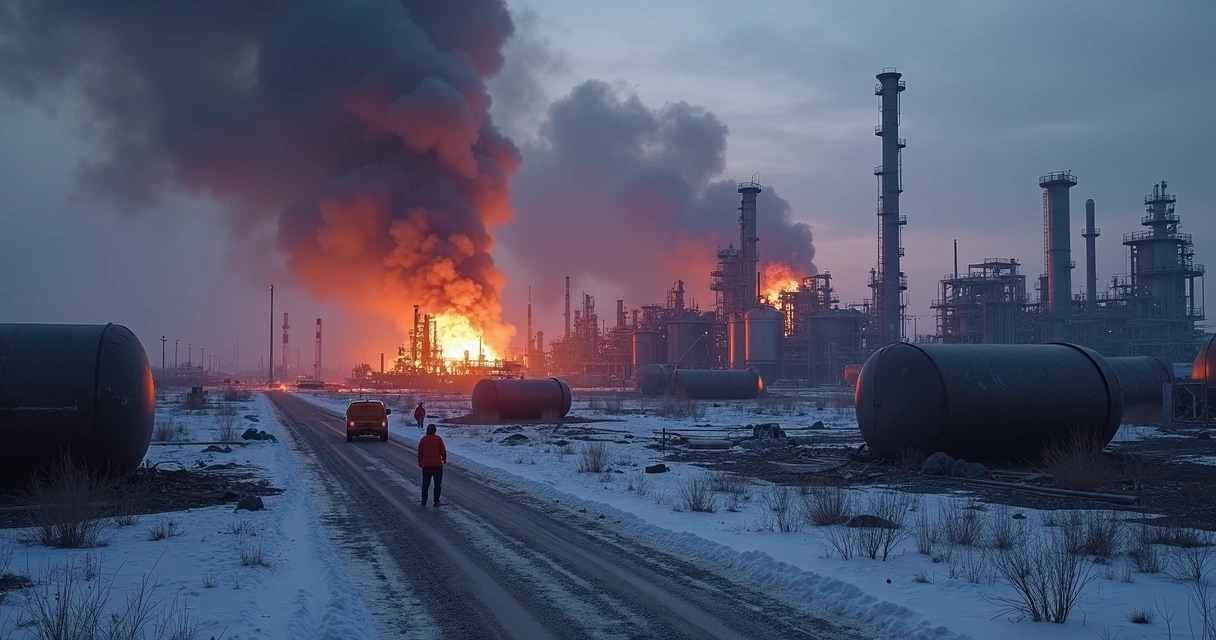
But escalation has not stopped at supply endpoints. Ukrainian drone campaigns against Russian refineries and storage locations have pushed the envelope, causing operational downtime and raising the security premium. Notably:
- Fires at the Ilsky and Lukoil refineries
- Drone strikes in the Pskov region
- Volgograd refinery incidents with significant downtime
These are not clear-cut stories of millions of barrels lost at once. They are, instead, a rising tide of friction: rerouting, delays, more insurance, and system stress.
Understanding market behavior: Asymmetry and the premium
So why does the war premium refuse to vanish, even with stable overall output? The answer lies in asymmetry. Markets accept paying for plausible risk; what they cannot absorb is getting it wrong. If tensions subside, prices can drift lower—as would be expected in a world where supply quietly outpaces demand. Yet, if an escalation shuts a pipeline, bombs a port, or closes a strait, revaluation will be violent and immediate.
Here is what the World Bank made clear: in downside scenarios where up to 8 million barrels per day are pushed off the market due to Middle East supply disruption, Brent could spike to $140–$157/barrel—more than 50% above current projections. Not as a prediction, but as a real risk against which all actors must hedge.
Reuters’ premium estimate is grounded in probability—the market is constantly betting on the average outcome, but the odds are too tilted for comfort. If those odds swing out of control, the current “extra” gets repriced overnight.
Pricing is not about supply, it’s about risk
World Bank’s April 2024 report found that Brent spiked near $91/barrel, almost $34 higher than its average in the less crisis-ridden years of 2015–2019. This spread is visual evidence of premium at work—not because barrels are missing, but because the world can no longer be sure that tomorrow’s physical flows are guaranteed.
The U.S. Energy Information Administration notes that 65% of global oil originates from non-OPEC sources. In a stable world, new supply can quickly offset most local disruptions. But post-2022, the market’s faith in stability has been tested often enough that insurance, rerouting, and contingency plans are now built into the price.
UHEDGE and market intelligence: Quantitative tools in volatile times
Systematic risk management platforms, like those developed by UHEDGE and STATERRA, are now a cornerstone for commercial decision-makers in energy, agribusiness, and other industries exposed to commodity volatility. As shown in materials from UHEDGE, the ability to aggregate, analyze, and react to market signals quantitatively is making the difference between naïve exposure and informed hedging. Their approach, built on real-time analytics and advanced risk modeling, brings much needed visibility and agility to those navigating current uncertainty.
For those interested in commodity strategy, the logic of “war premium”—and the timely quantification of that premium—are explored in depth throughout UHEDGE’s insights on margin protection and market-centric commodity analysis. Real-world, data-informed management meets immediate market needs.
Conclusion: The war premium as a new normal
Energy pricing in 2024 stands as testimony to a historic shift: the world pays, not only for the barrel, but for the chance that the next crisis is a day away. Brent’s current high price does not tell a story of sudden shortage or mysterious demand boom. It reflects a consensus that ignoring low-probability, high-impact scenarios is more expensive than gently overpaying for now. As global infrastructure is put under more direct threat and new geopolitical flashpoints emerge, the premium to insure oil flows will likely remain—a risk surcharge built into every calculation, not a forecast of doom but a rational average of all possible outcomes.
Market participants who rely only on historic fundamentals may find themselves caught off guard by today’s realities. The UHEDGE ecosystem is designed expressly for this era: a toolkit to quantify, visualize, and manage risk in an environment where simple logic doesn’t always win, but scientific rigor and market agility can keep you ahead.
If managing risk exposure with accuracy, speed, and discipline is mission-critical for your operations, now is the time to experience how a data-driven digital treasury like UHEDGE simplifies what used to be humanly impossible. Discover more insights and strategies at protection against commodity volatility and learn why forward-thinking companies choose science-backed solutions for uncertain times.
Frequently asked questions
What is the $10 war premium?
The $10 war premium is an additional cost per barrel that is factored into the price of oil due to ongoing geopolitical tensions, especially in regions where conflicts or threats of infrastructure attacks are present. This premium reflects insurance against the risk of supply disruptions rather than an actual shortage.
Why does oil trade above fundamentals?
Oil trades above fundamentals when market prices include a premium for unexpected risks—such as military conflicts, transportation bottlenecks, or attacks on key infrastructure. When these risks are high, prices often remain well above what traditional supply and demand would set, as seen in recent years due to persistently heightened tensions in the Middle East and other energy corridors.
How does conflict impact oil prices?
Conflicts can raise oil prices directly if they cause physical supply losses, or indirectly if they increase the perceived risk of disruption. For example, military movements in critical shipping routes or drone attacks on refineries can prompt higher insurance and rerouting costs, elevating the market price even without actual output declines.
Is war premium included in all oil prices?
While not always explicit, the war premium is generally embedded in global benchmarks whenever the risk of disruption is elevated. It can dissipate quickly if geopolitical tensions subside, but as of 2024, it remains a persistent feature of the market due to ongoing uncertainties.
How can I track crude oil price changes?
You can track price changes using reputable financial data sources, commodity-specific news outlets, and advanced risk management platforms like those from UHEDGE. These tools provide both real-time prices and deeper insights into the factors driving risk premiums and market shifts. For broader context and strategy, visit the UHEDGE content on how commodities work and the strategic importance of diversification.