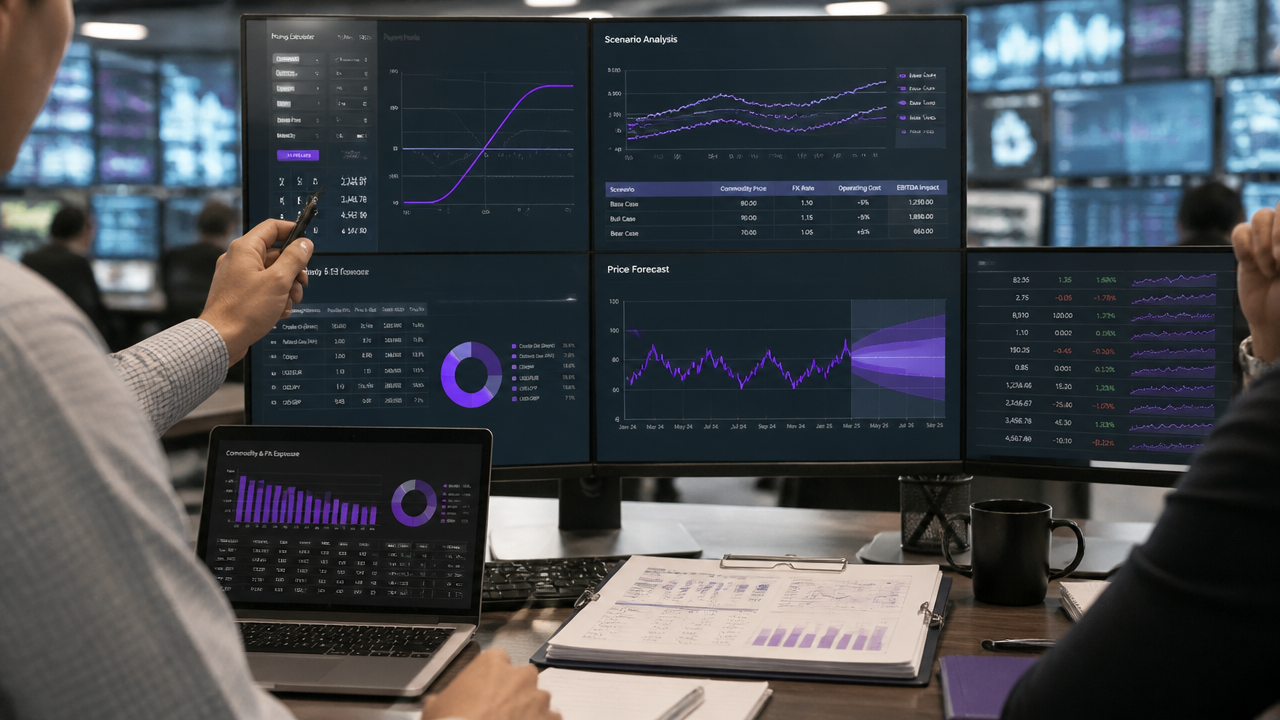
The dilemma between building up physical inventory and managing price risk through financial contracts is a continuous battle for CFOs in agribusiness, energy, and industry sectors. Both strategies present distinctive benefits and trade-offs. In times of market volatility, the right approach can define profit margins, balance sheet health, and even long-term business survival. By examining practical scenarios, this article explores the implications of each method, walking step by step through the core questions facing decision-makers who must steer capital allocation, liquidity, operational complexity, and market timing under pressure. Throughout, the solutions and philosophy brought by UHEDGE and STATERRA will shine light on how advanced risk technologies can fundamentally change the game.
The challenge: Market risks and operational limits
Managing price fluctuations in commodities, currencies, and rates is no small feat. Decision makers grasp that the rise and fall of prices affect contracts, cash flow, and competitive position every day. Many companies resort to building up stocks of goods—physical inventory—in an attempt to shield themselves from swings. Others use derivative contracts, such as futures, options, or swaps, to offload or realign market exposures.
Physical inventory acts as a buffer: tangible, direct, and often considered reassuring because it secures future supply or demand. On the other hand, financial contracts allow for flexibility, lower upfront investments, and dynamic position management.
When physical inventory is favored
Some companies, like large grain producers or energy distributors, view stocking up as a reliable defense. By holding raw materials or finished products, they insulate themselves from price surges or supply disruptions. Inventory management, though, is far from risk-free.
- Tied-up capital: Funds used to build inventory could be spent elsewhere. This can limit flexibility for unexpected opportunities or dangers.
- Storage and insurance: Warehousing brings recurring costs and possible losses from spoilage, deterioration, or theft, especially when inventories are large.
- Liquidity pressure: Turning inventory back into cash is not always fast, especially in weak markets.
- Operational complexity: Each storage decision introduces another moving part—logistics, shelf life, and management oversight.
- Market timing risks: Buying too early or too late exposes the company to adverse price movements regardless of intention.
For example, a mid-sized agricultural cooperative that maxes out warehousing capacity heading into harvest season might find itself illiquid just as fertilizer prices drop, missing out on a critical purchasing window. The margin for error is slim.

How financial contracts change the equation
Financial derivatives enable companies to manage exposures flexibly and directly from the balance sheet, without the need for large inventories. Common instruments include futures, options, swaps, and tailored OTC products like accumulators and fences, as facilitated by platforms such as UHEDGE's Digital Treasury.
Derivatives can help control risk in a cost-effective way, freeing up capital for other uses and allowing companies to react to fast-changing market conditions.
- Better capital allocation: Instead of tying up millions in stock, CFOs can set aside a risk premium for contracts that protect against downward or upward price swings.
- High liquidity: Positions can be adjusted or closed on short notice, which aids cash flow and supports agile strategy.
- Storage-free risk management: Companies avoid the operational headaches and costs of logistics, insurance, spoilage, and depreciation.
- Precision in market timing: Entry and exit can be precisely mapped to business objectives—UHEDGE's platform is designed to help spot optimal moments using quantitative models and AI.
- Lower operational complexity: Automation and advanced analytics enable real-time visibility and decision support, as demonstrated by the integration of all exposures in a single management environment.
One practical example from UHEDGE involves a coffee export cooperative that uses digital derivatives to reduce price risk during international trade. The system allowed them to optimize exposure according to predefined targets and react instantly to adverse price signals without ever moving a single bag of coffee physically.
Main drawbacks of each approach
The trade-off is never black and white. Each method has pitfalls that need to be weighed and navigated with discipline.
Drawbacks of building physical inventory
- Cost of carry: As time passes, stocks carry costs that may erode margins even if market prices eventually move favorably.
- Limited upside in volatile markets: Should the market fall or remain flat, inventory may lose value with no clear recourse short of a sale at a loss.
- Operational risk: Damage, theft, changes in quality, or even regulatory shifts can all impact stored goods.
Drawbacks of using derivatives
- Requires expertise: Understanding and correctly applying derivatives is challenging—mistakes can lead to exposure rather than protection.
- Potential for overhedging or missed opportunity: Without sophisticated analytics—like those offered by UHEDGE—companies may hedge too much or too little, capping gains or leaving gaps.
- Liquidity margin calls: Some contracts may require cash margin, especially if markets move unfavorably, making active monitoring vital.
- Psychological comfort: Some managers are more comfortable with tangible protection, especially where infrastructure has always favored physical assets.
Capital allocation: The case for smart hedging
Capital is always scarce. Choosing how to allocate funds between stockpiling and financial coverage can define profitability. A CFO must consider:
- Expected price volatility in underlying assets
- Cash flow and working capital needs
- Internal risk appetite and governance processes
- The cost of deploying capital in either direction
Modern digital treasury platforms, like UHEDGE, empower financial decision-makers by unifying visibility across physical and financial positions and recommending actions grounded in real-time data and predictive analytics. This closes the gap once created by siloed legacy systems and the overwhelming complexity of market signals.
Flexible hedging instruments can be customized—not just to manage risks, but to fit specific operational and financial goals. This quality, underpinned by technology and quantitative rigor, ensures discipline and transparency, with clear monitoring of mark-to-market exposures and automated governance support.

Market timing and operational complexity
Timing is a double-edged sword in risk management. Inventory requires a forecast not just of price but of all supply chain conditions—transport, weather, labor. Mistimed builds can result in forced sales or cash constraints.
Financial contracts allow for staged entries and exits. If the market outlook changes, derivatives can be unwound, rolled forward, or replaced—much more quickly than organizing a physical stock sale or purchase.
However, sophisticated risk management infrastructure is needed to capture these benefits. Platforms like the UHEDGE Digital Treasury offer trading-oriented calculators, quantitative analytics, and advanced monitoring for MTM and risk exposure, turning market chaos into opportunity.
Storage costs and liquidity
Physical inventory demands cash upfront and ongoing monthly costs. Insurance, spoilage, security, and even regulatory reporting make it an expensive buffer. Liquidity is locked until sales take place.
Derivatives, by contrast, require a fraction of the capital. Only the risk premium and potential margin requirements must be funded, and often these sums are much smaller and adjustable.
For CFOs, the scenario is clear: absent a strategic inventory rationale (such as capturing supply chain discounts or responding to logistical constraints), financial contracts give superior liquidity and keep cash free for other initiatives, acquisitions, or working capital.
The role of advanced solutions in risk control
UHEDGE, as a technology-driven partner, delivers a scientific, disciplined framework for digital treasury and risk management. Its approach, backed by artificial intelligence and advanced modeling, equips organizations to monitor exposures in real time, visualize volatility surfaces, and set up customized hedging structures on demand.
With all operations—from physical to paper—streamlined into a unified environment, operational complexity drops, and strategic agility rises to a level once reserved for major banks and global trading desks. UHEDGE clients gain real, quantifiable value in financial results, cost management, and governance confidence.
If you want to learn more about risk management in practice, read about risk management techniques for corporate treasuries, practical insights on derivatives or see common mistakes in commodity hedging and how to avoid them.
Conclusion: The smarter route to risk management
Neither building up physical inventory nor using financial contracts is a flawless solution. But for most modern CFOs, the right blend leans heavily toward digital, data-enabled financial strategies. Derivatives provide robust, capital-efficient, and flexible risk management methods that can be tuned to business needs in real time. Physical inventory has its place—particularly when supply chain security or logistics demand it—but often comes at high cost and reduced agility. Companies embracing the visibility, automation, and scientific discipline enabled by platforms like UHEDGE set themselves apart as leaders ready to withstand market shocks and grow with confidence.
Make risk your opportunity, not your obstacle.
Start your journey with UHEDGE today and see how advanced risk strategies and digital treasury can create real value for your organization.
Frequently asked questions
What does it mean to hedge with derivatives?
To hedge with derivatives is to use financial contracts—such as futures, options, or swaps—to reduce or offset the risk of price movement in an asset or commodity. Instead of buying or selling the actual goods, businesses use these contracts to “lock in” prices, trading off some potential gains to minimize losses from volatility. This is common in commodities, currencies, and interest rate exposures for companies looking to stabilize their financial outlook.
Is it better to buy more inventory or hedge?
The best choice depends on specific business priorities. Hedging with financial contracts is often preferred because it frees up cash, reduces operational risk, and can be adjusted quickly. However, in some cases—such as supply chain constraints, long lead times, or when physical control of goods is needed—holding inventory makes sense. The smartest approach often blends both, with digital treasury solutions guiding optimal risk posture at each moment.
How do derivatives reduce inventory risk?
Derivatives let companies manage price exposure without physically owning the product, lowering the need to hold large, costly stockpiles for security. Through contracts that track underlying asset prices, CFOs can ensure profit margins and cash flow without moving or storing tons of goods. This keeps capital available and risks contained.
What are the pros and cons of hedging?
Main benefits include: greater financial predictability, capital efficiency, quick decision making, and the ability to adapt in volatile markets. On the other hand, some disadvantages include the need for specialized knowledge, potential margin calls, and the risk of overhedging if not managed with robust systems and analytics.
When should I consider using derivatives?
A company should consider using derivatives when faced with significant price volatility in critical raw materials, large cash flow exposure to commodity prices, or when strategic goals demand flexibility and capital efficiency. Any scenario where market prices can dramatically affect profit or operations is a candidate for structured financial risk management. Platforms like UHEDGE are built to make these decisions safer, faster, and more transparent.