If you searched for a derivative calculator, you probably found math tools that differentiate functions. That is useful for calculus, but treasury, commodity, and FX teams usually need something else: a pricing engine that estimates the value and risk of financial derivatives before and after a hedge is placed. For companies exposed to commodities, currencies, and rates, the quality of that calculation directly affects margin, liquidity, and accounting outcomes.
That is where the topic becomes more practical. A good financial derivatives calculator does not stop at a theoretical option price. It connects contract terms, market data, volatility, basis, and risk sensitivities so the number can support an actual hedging decision.
Key takeaways before you choose a pricing tool
- A math solver and a financial derivatives calculator solve different problems.
- For hedging, the most important output is not a single premium, but a full risk view that includes mark to market and Greeks.
- Commodity and FX exposures need context, especially basis, freight, taxes, and local settlement conventions.
- Structured hedges such as Asians, fences, and accumulators require more than a simple Black Scholes style shortcut.
- Uhedge combines pricing, monitoring, and accounting support in one auditable CTRM environment.
A financial derivatives calculator should answer a business question, not just produce a number
The best way to judge a tool is to ask what decision it helps you make. In practice, teams want to know whether a hedge is fairly priced, how it behaves under different scenarios, and what it does to cash flow, earnings, and risk limits. A calculator that only returns a neat premium without context is often too narrow for real exposure management.
That is why many firms move from isolated formulas to a broader derivatives pricing engine. Instead of treating valuation as a one time exercise, they treat it as part of an ongoing workflow that starts with exposure planning and continues through post trade monitoring.
What is the difference between a calculus derivative calculator and a market pricing engine?
The difference is purpose. A calculus tool finds the derivative of a function, while a market pricing engine estimates the value and risk of a contract tied to an underlying asset. The first is about symbolic manipulation. The second is about uncertainty, market conventions, and decision quality.
That distinction matters because search results often mix both meanings. For a student checking a homework step, a symbolic solver is perfect. For a cooperative, mill, exporter, distributor, or treasury desk deciding how to hedge coffee, sugar, grains, USD/BRL, or rates, the problem is valuation under market conditions, not differentiation rules.
Uhedge is built for the second use case. According to the company material, its CTRM platform supports pre trade and post trade risk management in one environment and prices instruments ranging from vanilla structures to swaps, average price options, average strike options, fences, and accumulators.
What inputs do you need to price a derivative correctly?
Accurate pricing depends on complete inputs. At a minimum, most models need spot or forward price, strike, time to maturity, volatility, interest rate, contract size, and settlement rules. In commodity markets, that list is incomplete unless you also include basis, freight, and tax effects where relevant.
The practical lesson is simple: a calculator is only as good as its assumptions. A polished interface cannot rescue stale market curves or a missing basis adjustment. That is why many risk teams rely on commodity derivatives valuation methods that explicitly connect local physical economics to exchange traded or OTC references.
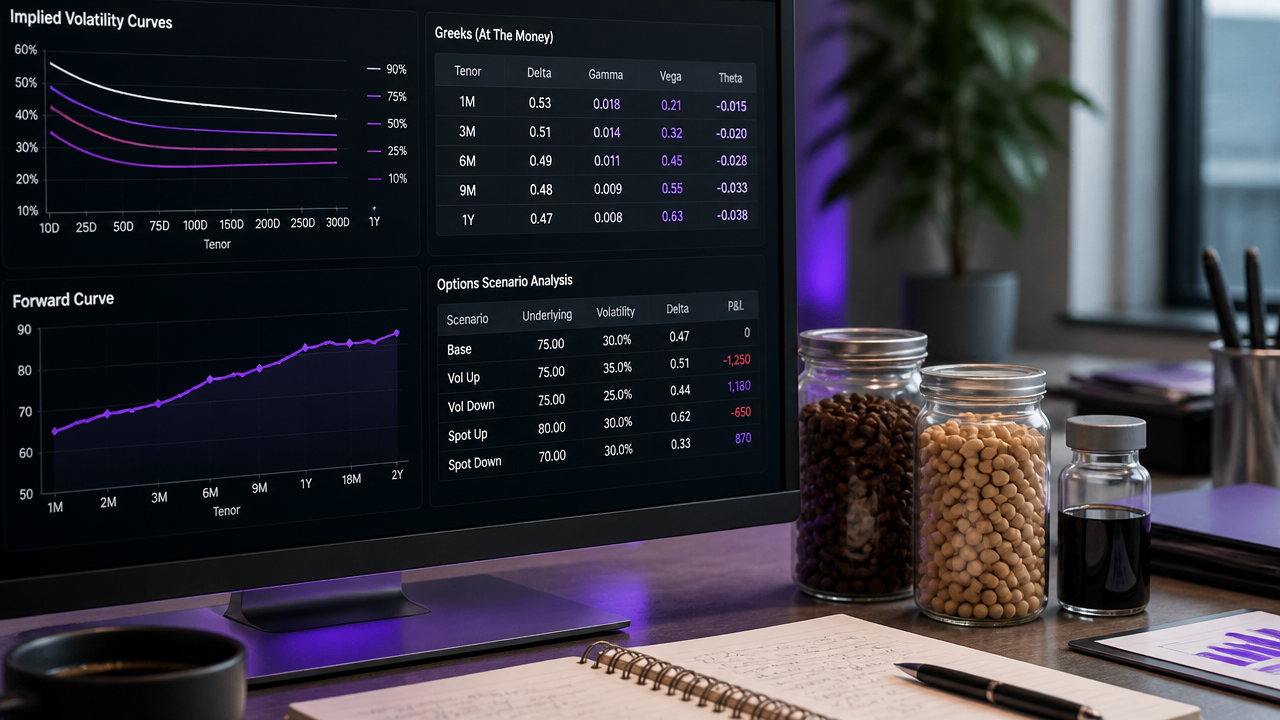
In Uhedge's case, the platform documentation describes a native physical plus financial setup. Physical curves can be configured by commodity and location, with decomposition into basis, freight, and taxes, which makes the calculator more useful for real hedging than a generic options widget.
Why a single premium is not enough
A derivative value is a starting point, not the finish line. Once the trade exists, the real questions become how that value changes over time, what happens if volatility jumps, and whether the hedge still offsets the exposure you intended to protect. A usable solution therefore needs mark to market, scenario analysis, and sensitivities.
This is where tools focused on real time mark to market become more valuable than one page calculators. They help teams see whether a position is working, whether margin pressure is building, and whether rebalancing is needed before the problem reaches the P and L.
Uhedge's product material ties this to broader risk control. The platform includes mark to market, scenario testing, and risk metrics such as the Greeks, allowing the hedge to be monitored as markets move instead of being reviewed only at trade inception.
Why do Greeks matter in a derivatives calculator?
Greeks translate a price into behavior. Delta shows first order sensitivity to the underlying. Gamma shows how quickly delta changes. Vega tracks volatility exposure, and theta shows time decay. Without these measures, a hedge can look acceptable on day one and drift materially a few sessions later.
For structured products, the Greeks are even more important because non linear behavior is the whole point of the structure. If your calculator cannot explain risk in those terms, it may encourage false comfort. A treasury team needs to know not just the cost of protection, but how stable that protection remains under stress.
This is one reason many firms graduate from spreadsheets to a more integrated portfolio risk management workflow. The step up is not about complexity for its own sake. It is about making the hedge legible enough to govern.
Why is basis risk the hidden weakness in many hedge calculations?
Basis risk is often the gap between a mathematically correct price and an economically weak hedge. A model may value the derivative precisely against a reference future, but your physical exposure may live in another location, quality, currency, or settlement convention. That mismatch can erode performance even when the contract behaves exactly as modeled.
For commodity businesses, this is why local detail matters. A useful calculator should not ignore transport, regional pricing, and tax components that shape the real cash market. Teams that want a more robust view usually need basis risk analysis in commodity hedging, not only a headline premium.
Uhedge addresses this problem by integrating the physical book into the same risk environment as financial hedges. In practice, that means valuation is connected to the exposure that the hedge is supposed to offset, which improves both monitoring and decision discipline.
Can an online calculator replace a trading or risk management platform?
Usually, no. A standalone calculator is good for quick checks, education, and simple what if exercises. A platform is necessary when exposures are recurring, documentation matters, or multiple books need consistent valuation and governance.
The difference becomes obvious once you consider workflow. Real hedging requires market feeds, trade capture, valuation history, limit checks, margin awareness, auditability, and sometimes accounting support. That is much closer to a hedge management system with risk and compliance controls than to a browser based pricing box.
According to the company documents, Uhedge positions its CTRM as an extension of the client's operating desk. It unifies physical and financial operations, supports multi source data feeds, and helps reduce hedge friction by removing hidden spread based incentives from the traditional model.

Where Uhedge fits when the goal is better hedging, not just faster math
If your need is academic calculus, Uhedge is not the tool you are looking for. If your need is to price and monitor financial hedges tied to commodities, FX, and rates, the fit is much stronger. The platform was designed for companies and investment teams that need one auditable environment from exposure planning to accounting documentation.
That matters for client groups such as grain producers, coffee and sugar cooperatives, crushers, mills, exporters, fuel distributors, food manufacturers, mid market banks, and family offices with commodity exposure. For them, the value of a calculator is not only speed. It is the ability to support better decisions with integrated pricing, risk metrics, and governance.
In short, the right question is not, “Can this tool calculate a derivative?” The right question is, “Can this tool calculate the contract I actually use, with the market inputs, basis assumptions, monitoring, and controls my business actually needs?”
Frequently asked questions
What is the difference between a calculus derivative calculator and a financial derivatives calculator?
Not in finance. A calculus tool differentiates equations, while a financial derivatives calculator estimates the value and risk of contracts such as options, swaps, collars, fences, Asians, and accumulators. The second type needs market data, contract terms, and risk assumptions to produce a usable hedging number.
What inputs do you need to price a derivative correctly?
It depends on the instrument, but the usual inputs include spot or forward price, strike, maturity, volatility, interest rate, contract size, settlement rules, and, for commodities, basis, freight, and taxes. If any of those are wrong, the result can be directionally wrong even when the formula is correct.
Can an online calculator replace a trading or risk management platform?
Only if the model matches the instrument and the data is current. A quick online tool may be enough for a classroom exercise or a plain vanilla example, but real hedging decisions need updated curves, volatility, basis assumptions, and post trade monitoring such as mark to market and Greeks.
Why do Greeks matter in a derivatives calculator?
Delta estimates how much value changes when the underlying moves. Gamma shows how fast delta changes. Vega measures sensitivity to volatility, and theta captures the effect of time passing. Together, these metrics help teams understand whether a hedge is stable or likely to drift as markets move.
Why is basis risk so important in commodity hedging?
Because the economic exposure is often local while the hedge settles on a reference future or FX contract. A solid calculator must reflect basis, freight, taxes, and settlement conventions, otherwise it may show a clean theoretical value but a weak real world hedge. That gap is often where margin is lost.