
A derivatives calculator is useful only when it helps you make a hedge decision, not just produce a number. For commodity producers, cooperatives, mills, distributors, exporters, and treasury teams, that means pricing structures accurately, showing risk clearly, and connecting the trade to the physical exposure it is supposed to protect. In practice, the best solution is less a standalone calculator and more a controlled decision engine, which is exactly where a platform like Uhedge becomes relevant.
If your team manages commodities, FX, or interest rate risk, the real question is not whether you can calculate a derivative. It is whether you can calculate it in a way that is fast, auditable, and linked to mark to market, basis, liquidity, and accounting.
Key takeaways
- A pricing tool is only the starting point, because hedge decisions require valuation, sensitivities, scenarios, and governance.
- For commodity businesses, the calculator must reflect the physical book, basis, freight, taxes, and FX legs, not just exchange prices.
- Greeks, volatility, stress tests, and daily mark to market matter more than a one time premium estimate.
- Uhedge is designed for this broader workflow, combining derivatives pricing with CTRM controls and hedge documentation.
- Teams that stay in spreadsheets often lose visibility across desks, maturities, and counterparties.
A derivatives calculator should answer a business question, not just solve a formula
The right conclusion is simple: a useful calculator tells you whether a hedge structure fits the risk you actually have. That is very different from a generic tool that only returns an option premium or a payoff chart.
In commodities, a hedge exists inside a larger commercial context. A soybean crusher, sugar mill, coffee cooperative, or fuel distributor usually carries exposure across physical inventory, basis, FX, funding, and margin. A narrow pricer misses that reality. This is why a robust commodity trading and risk management workflow matters as much as the valuation model itself.
Uhedge positions its calculator inside that full workflow. The platform is built for companies with exposure to commodities, currencies, and rates, and it connects pre trade pricing with post trade monitoring in one auditable environment.
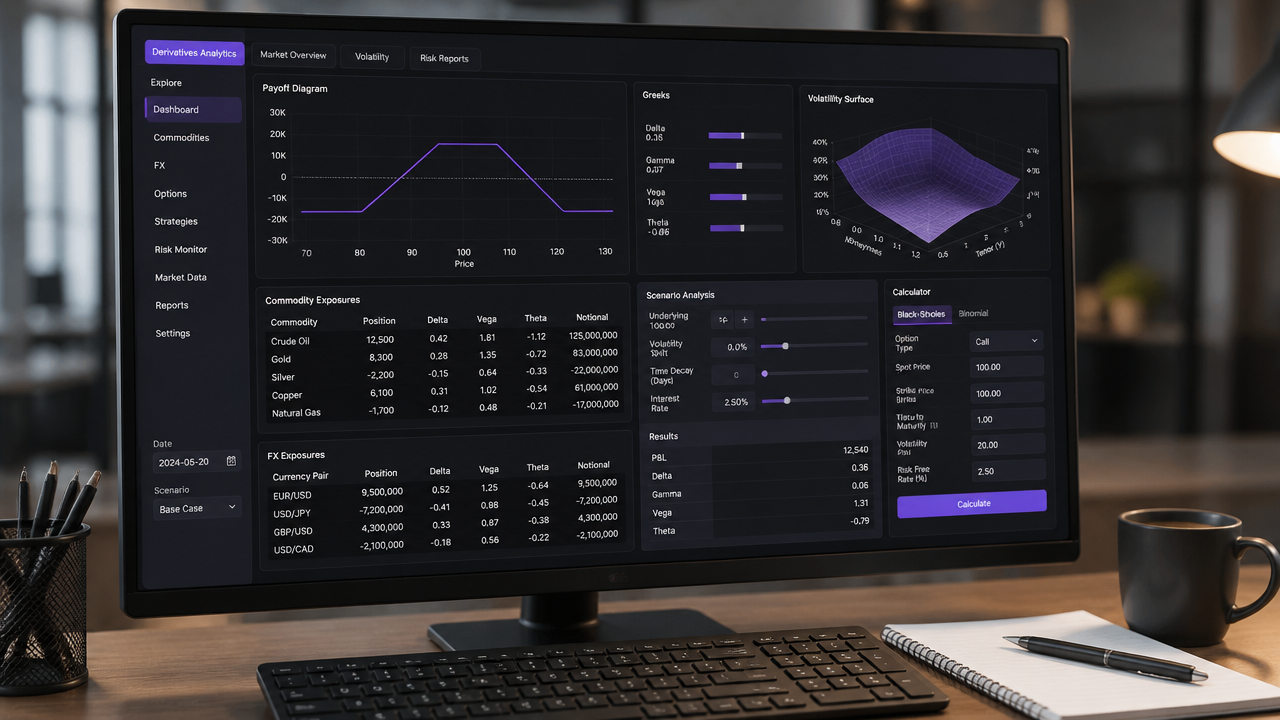
What should a professional tool calculate?
A professional tool should calculate value and decision impact together. If it cannot show how the trade behaves after the quote is accepted, it is incomplete.
Pricing across vanilla and structured hedges
At minimum, treasury teams need support for futures, swaps, forwards, and options. In many real hedging programs, they also need structures such as Asian averages, average strike options, fences, and accumulators. A serious derivatives pricing framework must handle both plain vanilla and more complex structures without forcing the team into opaque bank quotes.
Greeks and volatility, not only premium
Premium alone does not tell you how risk moves. You also need delta, gamma, vega, and theta, because they show directional exposure, convexity, sensitivity to implied volatility, and time decay. For portfolios with options or OTC style structures, access to Greeks and sensitivity tracking is often what separates an informed hedge from a costly surprise.
Mark to market and daily control
Once a trade is booked, the job shifts from pricing to control. Daily valuation, P and L evolution, counterparty exposure, and margin requirements must be visible, which is why integrated mark to market monitoring should sit beside the calculator rather than in a different system.
Why spreadsheets and bank calculators often fail in commodity hedging
The main issue is fragmentation. A spreadsheet may price one leg correctly and still lead to a bad hedge because the rest of the exposure sits somewhere else.
Commodity hedging rarely involves a single market variable. Physical pricing can depend on futures plus basis, freight, and taxes. Exporters may also carry USD exposure. If the team prices the derivative in one file, tracks basis in another, and watches margin through broker statements, decision quality deteriorates quickly. That is why many firms move toward integrated commodity risk management instead of isolated tools.
Uhedge was built to address this gap. According to the company materials, the platform unifies physical and financial books, supports OTC style replication, and helps reduce hidden hedge costs that often come from spreads, opaque commissions, or poorly matched structures.
What makes a derivatives calculator useful for agriculture and energy?
For agro industrial and energy users, usefulness comes from context. The calculator must understand the business exposure, not just the financial instrument.
| Need | Basic calculator | Risk ready platform |
|---|---|---|
| Option or swap valuation | Usually yes | Yes, with broader structure support |
| Physical plus financial integration | Rarely | Built in |
| Basis visibility | Limited | Monitored explicitly |
| Greeks and volatility analysis | Sometimes partial | Portfolio level view |
| Daily MTM and P and L explain | Manual | Automated |
| VaR and stress tests | Rarely | Included in risk control |
| Hedge accounting support | No | Available in workflow |
In other words, the ideal calculator for this audience behaves like an operating layer for treasury and risk, not a classroom utility.
How do Greeks, VaR, and stress tests improve the hedge decision?
They improve the decision because they convert a quote into a risk profile. Before execution, that helps you choose structure. After execution, it helps you defend the position when markets move.
Greeks explain local sensitivity. VaR summarizes potential loss under a chosen confidence level and time horizon. Stress tests reveal what happens under sharper dislocations, including price and volatility shocks. For commodity businesses, this is especially important when FX, futures, and basis move at the same time. A disciplined stress testing process provides a more realistic picture than premium comparison alone.
Uhedge adds another layer by decomposing risk by factor, which is useful when management wants to know whether the portfolio is exposed mainly to commodity price, currency, or regional basis.

Can one tool connect pricing, basis, liquidity, and accounting?
Yes, and that connection is where much of the value sits. A hedge is not fully effective if the price looks right but the margin call, basis mismatch, or audit burden becomes unmanageable.
In Uhedge’s model, the calculator is part of a wider CTRM environment that includes basis intelligence, daily MTM, FCM cash and margin visibility, and support for hedge accounting workflows such as effectiveness testing and designation reporting. That matters for businesses trying to move from reactive protection toward repeatable hedge policy. Teams working on hedge effectiveness evaluation usually discover that pricing accuracy alone is not enough.
This integrated approach is particularly helpful for firms that need a clean audit trail across front office, treasury, finance, and accounting.
How to choose the right derivatives calculator for your operation
The best choice is the one that matches the complexity of your exposure. Most operating businesses do not need a prettier quote screen. They need decision support that scales with real positions.
- Choose a simple pricer if you only need an occasional estimate for a single vanilla structure.
- Choose an integrated platform if you hedge recurrent commodity, FX, or rate exposures across books and entities.
- Prioritize tools that show MTM, Greeks, volatility assumptions, basis, and scenario behavior in the same workflow.
- Check whether margin management and accounting support are available if your governance requirements are high.
- Favor independent pricing logic over opaque black box bank quotes when cost transparency matters.
For companies in the agro financial chain, Uhedge is strongest when the problem is not just pricing a derivative but running the full hedge lifecycle with more discipline and lower friction.
Frequently asked questions
What is a derivatives calculator used for?
A derivatives calculator estimates the value and risk of futures, options, swaps, and structured hedges before and after execution. In a treasury or commodity context, it should show not only a premium or fair value, but also exposure, sensitivities, scenario behavior, and the impact on the physical book.
Is there a calculator that can do derivatives?
Yes, but the right tool depends on the job. A simple calculator may price a vanilla option, while a commercial hedging operation needs a platform that handles commodity, FX, and rate exposures together, updates mark to market daily, and supports governance, margin control, and accounting workflows.
How do you calculate derivatives for hedging?
Start with the exposure you need to protect, then define instrument, tenor, strike logic, volume, currency, and settlement assumptions. Next, calculate fair value, payoff across scenarios, and risk sensitivities. For operating businesses, the final step is linking that result to physical exposure, basis, liquidity, and policy limits.
Can a spreadsheet replace a derivatives calculator?
No. A spreadsheet or single formula can help with a quick estimate, but it is rarely enough for real hedge decisions. Once positions span commodities, FX, basis, and multiple maturities, teams need audit trails, market data, scenario testing, and consistent valuation logic to avoid pricing and control errors.
What should a good derivatives calculator show?
The most important outputs are fair value, mark to market, payoff profile, delta, gamma, vega, theta, volatility assumptions, scenario results, and basis impact. For corporate hedging, it is also useful to see margin needs, counterparty exposure, and whether the trade can support hedge accounting documentation.