In the world of global commerce, few actors wield as much influence as commodity traders. These companies, often called trading houses, are the lifeblood connecting local producers to international markets. Their mission is clear: ensure the steady flow of resources—grains, oil, coffee, sugar, metals—across borders and industries. Yet, behind every transaction lies the battle against unpredictability. Price swings, currency fluctuations, geopolitical events, and the push for regulatory compliance create a uniquely challenging environment.
How do these organizations transform uncertainty into opportunity? What tools and disciplines set apart those that thrive from those that falter?
The fundamental role of trading houses
These specialized firms act as bridges, moving bulk commodities from points of origin to where demand is highest. They bear the physical risk—shipping, warehousing, quality assurance—while navigating the financial exposures that arise from holding inventory and outstanding trades. Some operate global supply chains. Others focus regionally, facilitating import and export operations essential for national economies.
Trading companies are both risk bearers and opportunity makers.
Typically, a trading house buys physical goods from producers, arranges transport and storage, manages paperwork, and sells to refiners, manufacturers, or end consumers. Along the way, they must monitor shifting market conditions, execute currency conversions, and meet contractual delivery obligations. Coffee growers in Brazil, soybean cooperatives in the Midwest, or sugar mills in Asia—their products find paths to consumers largely thanks to these firms.
Managing risk: The trading house perspective
The rewards can be great. So can the risks. Market volatility often impacts the price of metals, energy, or agricultural products. Sudden weather shifts, supply chain bottlenecks, tariffs, or political unrest can cause wild price swings. Currency risk further complicates every cross-border deal.
Effective risk management is what separates successful companies from those caught off guard by sudden shocks.
Types of risk faced
A broad view shows trading operations at the intersection of several exposures:
- Market risk: Price fluctuations in physical commodities and their related financial instruments.
- Currency risk: When trades require moving between currencies, exchange rates can swing profits into losses.
- Basis risk: The spread between local physical prices and the reference price of futures contracts.
- Liquidity risk: The challenge of meeting cash needs for margin calls, financing, and settlements.
- Counterparty risk: The risk of buyers or sellers defaulting.
- Operational and regulatory risk: Mistakes in logistics, documentation, or compliance can prove costly.
For those operating at scale, the problem is no human can simultaneously track market, currency, volatility, and basis dynamics using spreadsheets alone. This demands technology, quantitative expertise, and discipline.
Physical and financial integration: Modern risk solutions
Leading trading houses embrace a model where physical and financial risk management are unified. In practice, this means building platforms to aggregate exposures, price deals, and execute hedges across asset classes.

Some firms still operate with fragmented systems—spreadsheets, brokers, ERPs—losing sight of their complete exposure. The most disciplined ones, like Uhedge’s clients, bring together every risk element into a single, auditable environment. The result: instant visibility and control.
They track not just outright price changes but the more subtle "Greeks"—delta, gamma, vega, theta—which quantify sensitivities to market movements. This lets them understand both immediate and potential future risks.
Types of hedging structures used
The toolkit is varied, allowing for precise adjustment to market conditions and business goals. Structures commonly used include:
- Vanilla options and futures: Straightforward contracts to lock in prices or protect against downside risks.
- Exotic structures: Accumulators, fences, and Asian options for tailored risk-return profiles.
- OTC derivatives: Custom solutions, replicated through advanced algorithms, to fit exposures too complex for standard markets.
- FX forwards and swaps: To hedge currency risk on international trades.
- Parametric VaR: Quantitative models that estimate risk by considering multiple market factors.
- Stress testing: Simulating adverse market scenarios to prepare for the unexpected.
Uhedge stands out by making even the most complex OTC products instantly accessible using proprietary algorithms. This means what was once only possible with large banks or financial intermediaries can now be embedded into a trading house’s daily decision-making process.
Example: The coffee “C” hedge
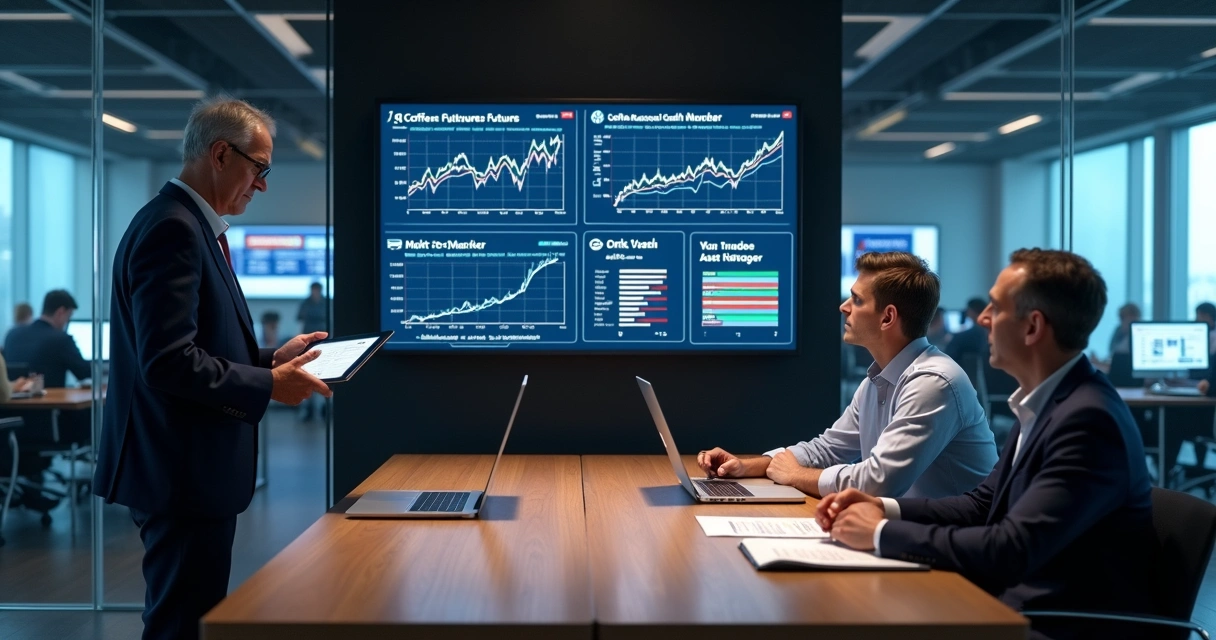
Imagine a cooperative managing sales of coffee beans. Prices are volatile, with local farmers exposed to world market swings. A modern risk platform helps the co-op hedge ten lots of coffee using a blend of futures, options, and AI-driven strategies—adjusting dynamically for market conditions and the firm’s risk profile. Over time, such a strategy ensures the price realized is consistently above what would have been achieved with only standard derivatives.
The difference: turning risk into consistent margin, not just protection from loss.
Bridging physical and financial—A new standard for trading houses
The old model segregated physical operations (transport, storage, contracts) from financial hedging. Today, advanced trading businesses unify these through platforms that bring together every risk factor, from inventory to currency to interest rates. Uhedge exemplifies this shift, offering software where both the physical and financial sides of a trade are visible in real time.
Their environment allows for:
- Unified risk dashboards combining physical positions and financial exposures
- Real-time mark-to-market, Greeks, volatility charts, and futures curves
- Immediate scenario analysis—how price changes, volatility, or currency shifts impact the business
- Automated documentation and hedge effectiveness testing, streamlining compliance

This integration avoids the pitfalls of legacy approaches—fragmented data, slow reaction times, blind spots—ensuring every hedge is matched with real-world exposures.
Compliance and regulation: Hedge accounting
Operating at global scale demands more than commercial skill. Trading houses must comply with international accounting standards, particularly with hedge accounting requirements such as IFRS 9 and CPC 38. Effective documentation, designation of hedges, and periodic effectiveness testing are not “nice-to-haves”—they are mandatory to pass audits and avoid substantial penalties.
Modern platforms automate these processes, embedding controls that make compliance less burdensome and more reliable.
The best systems provide:
- Automated hedge documentation and designation reports
- Dollar-Offset Ratio effectiveness testing
- Full audit trails, integrating physical and financial results
- Visibility across all risk and performance metrics
When a board or auditor queries a risk management process or a particular trade’s designation, the answers are at hand—clear, tracked, and transparent. Uhedge incorporates these standards seamlessly, transforming compliance from a challenge into part of daily discipline.
Decision process: Discipline, data, and expertise
Success in risk management comes from a three-pillar approach:
- Technology: Cutting-edge software, integrating AI and quantitative models
- Scientific methodology: Rigorous quantitative analytics, gathering and interpreting vast market data
- Human expertise: Decades of experience, especially from professionals who have sat at the center of global commodity banks and merchant desks
This discipline is the DNA of Uhedge. Every tool created, every process refined, is meant to move a trading house from reaction to anticipation, from complexity to actionable insight.

Why traditional approaches fall short
Historically, many companies managed risk using ad-hoc spreadsheets, relying on broker statements, and handling exposure in a piecemeal way. This has led to problems such as:
- Excessive cost, due to hidden bank spreads and commissions
- Missed market opportunities, due to delayed or incomplete information
- Poor basis risk management, as local market realities diverge from global benchmarks
- Fragmented audit trails, increasing compliance burdens
- Human error from overwhelming complexity
The lesson is clear: Discipline, automation, and a unified view create lasting results. The “chaos” of unpredictable markets becomes manageable with the right structure and tools. For those seeking a deeper technical background or case examples in Brazilian agriculture, these resources offer valuable insights:How commodity hedges protect margins in unpredictable markets, Errors in commodity hedging and how to avoid them, and A practical guide to hedging and protection strategies.
Modern technology-driven platforms: The new face of trading
Digital transformation is not just a buzzword. For proactive players, risk systems and dashboards powered by AI and data analytics have become the norm. These solutions allow trading businesses to:
- Instantly replicate both vanilla and complex derivatives
- Monitor all exposures in one place
- Receive automatic trade and risk strategy recommendations
- Streamline margin management and cash planning
- Generate robust reports for performance and compliance
This is where Uhedge’s solution excels—standing in as a true extension of a company’s trading desk, handling pricing, risk analysis, and hedge accounting with scientific discipline and real-world practicality. Decisions happen faster, with greater transparency and confidence.
People, process, and purpose: Uhedge’s differential
Uhedge draws on nearly two decades spent at the sharp edge of global commodity markets. Their platform is more than software: it is a blend of proprietary quantitative analytics, automated decision-making, and hands-on sector expertise. Every client receives recommendations tailored to their industry, risk profile, and market goals.
Where others see chaos, Uhedge sees opportunity.
For the boardroom or the trading desk, the value is measurable:
- Up to 70% reduction in hedge costs compared to legacy bank-driven solutions
- Greater margin preservation by cutting out hidden fees and inefficient trades
- Auditable environments, ready for scrutiny by the Big Four and regulators
- Strategic agility, turning volatility into controlled, disciplined opportunities
Conclusion: The path forward for trading houses
Discipline makes the difference.
Commodity traders who excel do not merely react to market shocks; they prepare, analyze, and act ahead of time. With unified platforms, quantitative models, and expert oversight, firms like those using Uhedge solutions turn uncertainty into stable, predictable results. As global commerce grows more volatile and complex, having a true partner—one with the tools, technology, and talent—becomes the defining factor for success.
If your organization seeks to transform commodity risk into lasting value, discover how Uhedge’s platform and expertise can be the foundation for your strategy. Learn more and get insights into global commodity markets and risk strategies at our commodities knowledge base. Connect directly to begin your journey toward more disciplined, scientific trading.
Frequently asked questions
What do trading houses do?
Trading houses act as intermediaries that connect commodity producers to global consumers, managing the journey from origin to destination. They buy, store, transport, and sell commodities, while handling the financial, logistical, and regulatory aspects of these transactions. Their expertise ensures that products flow efficiently through international supply chains.
How do trading houses manage risk?
These companies identify, quantify, and manage risks using a combination of technology, quantitative modeling, and financial instruments. Modern organizations like Uhedge’s clients use integrated platforms to track exposures, execute hedges, and simulate scenarios in real time, ensuring risks are visible and controlled rather than guessed.
What is commodity hedging in trading?
Commodity hedging is the process of using derivatives and structured financial products to lock in prices or limit the impact of market swings on physical goods held or traded. It is essential for protecting profit margins and ensuring cashflow stability in volatile markets.
Are trading houses safe for investors?
Trading houses with robust risk management, transparent governance, and discipline in compliance offer strong protections for both institutions and investors. Platforms that unify control and provide solid audit trails minimize operational and financial risks, making them safer environments for capital.
How do trading houses make profit?
Profits come from expertly buying and selling commodities, timing transactions to market conditions, and managing risks better than competitors. By cutting costs, optimizing margins, and turning market volatility to their advantage, trading firms monetize the difference between buy and sell prices, storage, logistics efficiency, and successful risk strategies.