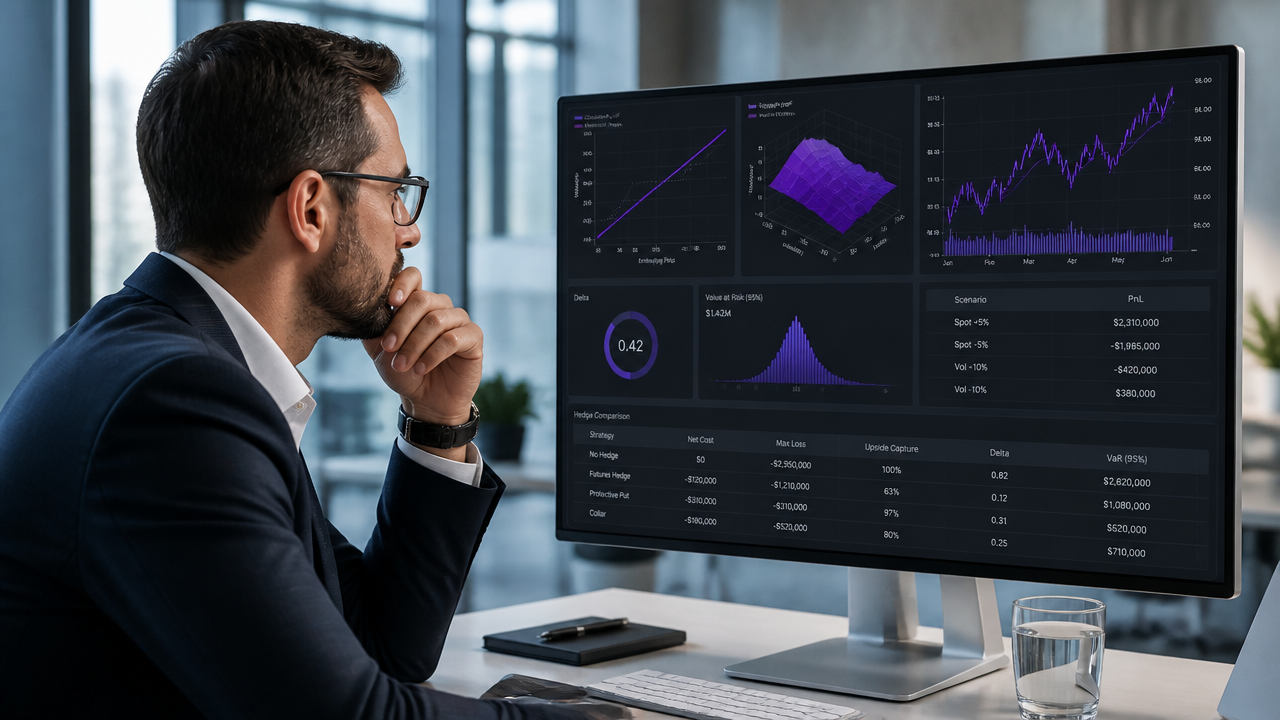
In a fast-moving world where the gap between risk and opportunity narrows by the second, smart treasury management is more than a competitive edge—it’s a necessity. Companies with active exposure to commodities, derivatives, and FX find themselves at the crossroads of risk, liquidity, and regulatory requirements. But how can they transform complexity into clarity, and unpredictability into steady value? The answer is in adopting a modern treasury management solution that puts discipline, data, and decision-making at the entrepreneur’s fingertips.
What is a treasury management system, really?
A treasury management system (TMS) is a centralized digital environment that brings financial discipline and real-time insight to the heart of a company’s operations. The core purpose is to centralize, automate, and monitor all treasury-related activities, replacing fragmented spreadsheets and ad-hoc processes with a single, auditable platform.
At its best, a complete treasury framework will unify cash and liquidity management, automate payments, manage financial and market risk, and link directly to banks and core enterprise applications like CTRM (Commodity Trading & Risk Management) and ERP platforms.
Make every cash flow count.
Uhedge exemplifies this approach, integrating advanced quantitative methodologies and artificial intelligence to manage multifaceted financial exposures for clients across the agro-financial value chain. Their platform showcases the power of a modern, science-driven treasury architecture, serving as a benchmark for what a digital treasury nucleus should achieve.
The main functions: More than just cash in the bank
Treasury management extends far beyond basic cash balance monitoring. A top-tier digital treasury setup must provide a concrete foundation in these core areas:
Cash and liquidity management
Effective liquidity management is about visibility and predictability—knowing not just what’s in the accounts today, but having reliable projections for tomorrow. This includes analyzing available balances, reconciling inflows and outflows, and planning for seasonal or unexpected changes.
With a digital treasury, like what Uhedge offers, cash positions across countries, currencies, and asset types can be tracked in real time, enabling more strategic investment, lending decisions, and precise short-term funding tactics.
Payment automation
Processing payments manually is not just slow; it exposes firms to errors, fraud, and compliance risks. Modern treasury tools automate standardized payment routines (payroll, vendor invoices, interest settlements) and enforce controls, approval hierarchies, and full audit trails.
For businesses involved in commodities, structured products, or complex supply chains, this automation is fundamental. It ensures timely supply chain settlements, margin calls, and quick response to market shocks.
Risk management—Where technology makes the difference
Companies exposed to commodity price movements, interest rates, and FX volatility face major risks. A TMS provides an objective and scientific approach to risk analysis and mitigation, often leveraging advanced analytics, scenario simulations, and automated hedging suggestions. Uhedge’s solution, for example, applies restricted risk modeling and AI-powered algorithms to prescribe optimal hedging tactics given market conditions and client-specific limits.
Risk management functions include:
- Measuring and monitoring exposures in real time
- Generating mark-to-market valuations and ‘the Greeks’ (delta, gamma, vega, theta) for derivatives.
- Stress-testing positions and reporting on potential value-at-risk (VaR) scenarios.
- Supporting compliant hedge accounting, with IFRS 9 and regulatory effectiveness testing.
Integration with banks and ERPs
Bridging the treasury function with bank feeds and core enterprise platforms unlocks efficiency and transparency. This integration enables automated reconciliation, standardized transaction booking, and removes manual bottlenecks that increase audit risk.
Seamless integration fuels decision speed.
For those handling physical and financial instruments together (such as agro-industrials and exporters), the ability to have a single environment for both sides of the risk—like the unified architecture of Uhedge—provides unmatched visibility and control.
Why implement a TMS? Tangible benefits
The move to a professional treasury platform is not just about technology for its own sake. The gains, especially for those handling commodity, derivative, and FX risks, are real:
- Cost reduction: Automated processes and rigorous controls eliminate errors, reduce fraud risk, and – when done right – cut out unnecessary bank spreads and hidden commissions.
- Decision clarity: Real-time dashboards and scenario modeling replace the guesswork of spreadsheet-based management, especially when volatility strikes.
- Visibility and auditability: Unified operations mean better compliance with auditing standards and improved governance. Every transaction is documented, traceable, and testable for effectiveness.
- Market agility: Rapid market moves are addressed decisively with automated hedging suggestions and the ability to replicate OTC structures instantly, as available in robust platforms like Uhedge.
- Consistency: Quantitative strategies enforce consistency—no more ‘gut-feel’ based decisions or missed opportunities due to human limitations.
Crucially, Uhedge’s digital framework allows clients to see opportunities in times of chaos, arming traders and finance professionals with the tools they need to thrive despite market turbulence.
Features that separate a true digital treasury from the rest
A robust treasury management environment stands out by offering features that not only simplify, but also elevate the finance function:
- Automation throughout: Not just payment routines, but also reconciliation, market pricing feeds, and end-of-day reporting.
- Real-time data visualization: Instantly see cash positions, mark-to-market exposures, risk maps, and performance analytics.
- Multi-currency and multi-asset support: Manage currencies, commodities, and derivatives in one place—crucial for regional exporters or mixed portfolios.
- Regulatory compliance and audit trails: Keep all records organized for easy reporting and auditor review. Support for hedge accounting methods (IFRS 9, Dollar-Offset Ratio).
- Advanced financial reporting: Generate detailed, customizable reports covering all facets of treasury activity—from liquidity positions to risk concentrations.
- AI-powered analytics: For top platforms, algorithmic intelligence augments decision quality and speeds up tactical response.
- Integration options: Easy connectors to banks, ERPs, and CTRM platforms ensure data consistency and workflow continuity.
- Scalability and modularity: Grow from basic payment automation to advanced risk management modules as needs evolve.
A digital treasury adapts as your business scales and diversifies.
Selection guide: Navigating the steps from need to full deployment
Selecting and adopting the right treasury system isn’t simply about IT procurement—it is about aligning technology with the business’s risk philosophy and operational requirements. Here’s how an expert would recommend proceeding:
1. Clarify your core objectives
What's the real pain point? Is it fragmented visibility across business units? Manual errors in payment routines? Inability to monitor risk exposures in real time? Start with a diagnosis rooted in your company’s strategy, as Uhedge emphasizes in their approach to discovery and onboarding.
2. Map integration requirements
List all relevant legacy and third-party systems (banks, ERPs, CTRM) that must connect with your treasury platform. A seamless link means full control and maximizes the value of existing infrastructure.
3. Demand quantitative rigor
Does the platform offer modern risk models, predictive analytics, and scenario testing? For any business operating with market, commodity, or FX exposure, these capabilities move treasury from a passive role to a value center.
4. Insist on real-time, configurable reporting
You should be able to drill down into exposures, performance, and compliance status at any time—with dashboards tailored to management, audit, and operational users.
5. Evaluate automation and AI features
Does the solution go beyond simple process automation to offer recommendation engines, algorithmic hedging, and dynamic alerts? AI-powered modules, like those in Uhedge’s technology, unlock greater efficiency and market reactivity, a subject further explored in the internal guide on practical hedge strategies.

6. Prioritize modularity and scalability
You may start with payments and risk monitoring, but as the organization grows, you will want to add modules for complex derivatives, advanced analytics, or additional geographies. Ensure the TMS can expand in capabilities and volume.
7. Confirm regulatory, audit support, and security
Support for region-specific rules (like hedge accounting standards) and rigid internal controls is non-negotiable. Audit readiness and detailed logs keep both regulators and finance teams reassured.
8. Plan for onboarding, support, and training
Don’t underestimate the importance of onboarding and continuous training; some solutions, like Uhedge, stand out through their transfer of expertise, customizing routines to clients’ financial goals and risk tolerance.
Education is as valuable as technology.
The implementation process—how to get it right
Drawing from best-in-class practices, successful implementation generally follows a phased approach:
- Strategic diagnostic: Conduct workshops and interviews to document goals, pain points, and operational constraints.
- System configuration and integration: Map accounts, set up bank connections, define analytic hierarchies, and test system integrations with ERPs and risk engines.
- Custom workflow design: Configure payment approval chains, automated reporting, and risk trigger alerts that fit internal controls and compliance mandates.
- User training and onboarding: Rolling out user-specific training; Uhedge, for example, offers onboarding that matches the firm’s unique liquidity goals and hedge accounting requirements.
- Pilot and full deployment: Test with limited users; scale up upon successful acceptance.
- Continuous improvement: Regular review meetings, KPI tracking, and prompt adaptation as risk policies or market conditions change.
Aligning TMS with CTRM, ERP, and beyond
For businesses handling both physical commodities and financial contracts, full business value only materializes when the treasury platform speaks natively with both CTRM (Commodity Trading & Risk Management) and ERP instances.
The Uhedge solution, for example, allows exposure planning, pricing, margin management, and accounting reporting to all be managed from a single source of truth. This not only eliminates visibility gaps, but also tightly links realized and unrealized P&L, compliance, and funding requirements.
A natural extension is to link your treasury software with modules for risk management and other advanced functions, using live market data to map every part of the organization to its exposures and opportunities.

Trends transforming treasury: AI and digital assets
The future belongs to organizations that can act at machine speed—interpreting more data, in less time, with less human intervention.
New generations of TMS are defined by:
- AI-powered automation: From pattern recognition in market data, to proactive risk alerts, and even automated hedging suggestions, AI is the lever that transforms digital solutions from reactive tools to value-creating engines.
- Digital asset handling: Support for cryptocurrencies and tokenized products, where relevant, is on the roadmap for future-ready treasury stacks.
- Anytime, anywhere access: Cloud platforms, with robust mobile and web apps, mean users can monitor or act on risk from anywhere.
- Advanced risk analytics: Real-time volatility surface analysis, scenario stress-testing, and precise exposure mapping raise the standard for how finance professionals operate.
Uhedge’s history of integrating AI and quantitative analysis—honed by market veterans and technologists alike—illustrates what a modern treasury can and should provide. They “read macro signals and convert them into tactical actions,” whether on agricultural commodities, fuel derivatives, or the USD/BRL FX desk.

Best practices: Optimizing the treasury function for audit and agility
What separates an effective treasury operation from the rest is discipline and clarity—two principles that echo through both Uhedge’s technology and client stories. Here are some practices drawn from years of experience:
- Centralize operations: Consolidate exposures, cash flows, and risk profiles in a single environment to foster transparency.
- Embed quantitative rigor: Use model-driven, not gut-feel, decision tools.
- Automate, then monitor: Apply automation for payments, margin calls, and reporting, but keep dashboards live for human oversight.
- Prioritize compliance: Ensure every rule, limit, and control is mapped digitally and audit logs are always up-to-date.
- Regular training and review: Treasury is not ‘set and forget’—update processes and knowledge as markets change.
When others see chaos, Uhedge finds actionable opportunity.
Finance teams that adopt these principles, especially with the right digital support, transform treasury from a cost center into a source of value creation—a principle at the core of Uhedge’s philosophy. They bridge the complexity of FX, interest rate, and commodity risk with clarity and technological discipline.
When to consider Uhedge for your treasury management
Uhedge operates as an “extension of the trading desk,” offering managed treasury operations and a tech-enabled view on all operational and financial exposures. The platform is designed to aggregate all position data, automate cash and collateral management, and provide analytics with a level of quantitative detail usually reserved for top global institutions.
As Uhedge demonstrates, embracing an institution-grade digital treasury transforms not only task efficiency but also the strategic trajectory of the business. With their unique approach—backed by 20 years of experience and aligned with client outcomes instead of transaction fees—Uhedge is positioned to drive value in even the most complex treasury environments. This support extends to clients working across commodity exports, fuel distribution, and beyond, integrating pricing, risk, P&L tracking, and full hedge documentation.
For more insights on currency risk and protection strategies, the content on currencies and FX and strategic FX hedging is highly recommended.
Finally, for those in Brazil or handling local rates, see the guide to hedging interest rate risk for a deeper technical angle.
Conclusion
The treasury management platform of the future is here now—scientific, automated, and built for decision making. Those who act first capture the lion’s share of value. The best time to transform treasury operations is before the next wave of market disruption.
To see how an institution-grade digital treasury can help transform your business’s financial operations into a value driver, explore what Uhedge brings to the table. The next action is clear: connect with Uhedge for a personalized demonstration and discover how science-driven treasury discipline can make a meaningful impact on your outcomes.
Frequently asked questions
What is a treasury management system?
A treasury management system is a dedicated software platform that centralizes and automates the management of an organization’s financial activities, including cash, liquidity, payments, risk monitoring, and reporting. It’s designed to replace spreadsheets and fragmented processes with a unified, auditable environment that supports better decision-making and regulatory compliance.
How does a treasury software work?
Treasury software works by integrating with bank accounts, ERPs, market data sources, and internal workflows. It automates data collection, processes payments, reconciles transactions, monitors exposures, and produces compliance-ready audit logs and financial reports. Modern treasury systems also offer real-time analytics and support for AI-driven decisions.
What are the key functions of TMS?
Key functions of TMS include: cash and liquidity management, payment automation, risk assessment and mitigation, bank and ERP integration, multi-currency handling, advanced financial reporting, and compliance management. The most advanced systems add AI-powered performance tracking and automatic hedging modules.
How do I choose the right TMS?
Selecting the right TMS means aligning the system’s features with your organization’s unique risk profile and operational needs. Look for automation, compatibility with existing infrastructure (bank, ERP, CTRM), real-time data, scalability, regulatory support, and process customization. Take time to involve decision makers in every department from finance to IT, and consider platforms (like Uhedge) that support rigorous onboarding and training.
How much does a treasury system cost?
The total investment for a treasury system depends on the size of the organization, required features, integration complexity, and user base. Some platforms charge a subscription or license fee, others require setup and training fees. The efficiency gained and risk avoided often far outweigh the cost, especially for firms with significant commodity, FX, or derivative exposures.