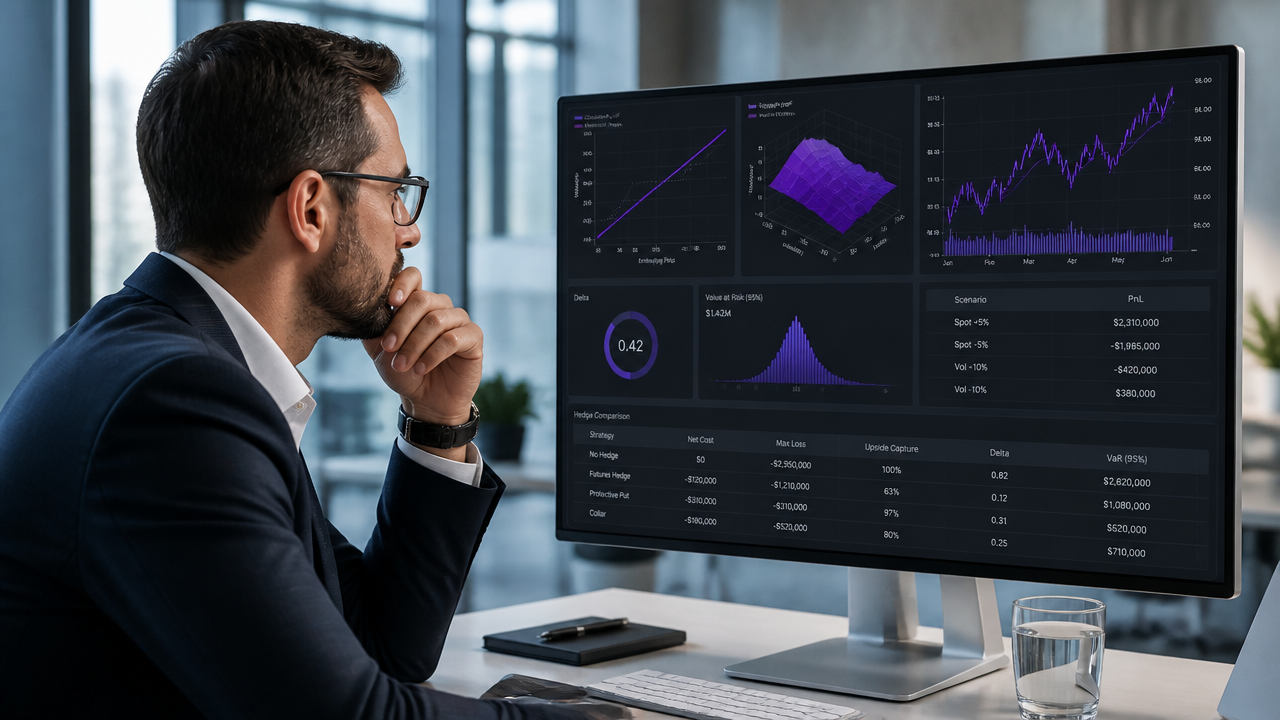
A derivatives calculator is only useful for treasury and commodity teams if it goes far beyond a simple price output. For producers, cooperatives, mills, crushers, distributors, exporters, and asset managers, the real job is to translate market exposure into a hedge decision that is measurable, comparable, and auditable. That means seeing price, payoff, Greeks, basis, FX, liquidity, and accounting effects in one place.
That is the gap Uhedge is built to close. Its CTRM platform connects physical and financial books in a single environment, helping teams price structures, compare hedge alternatives, monitor mark to market, and document decisions with less friction and more discipline.
Key takeaways for treasury and risk teams
- A useful derivatives calculator for commodities is a decision engine, not just a formula box.
- The right output combines fair value, payoff asymmetry, sensitivities, scenario risk, and local basis.
- For agro-industrial hedging, physical exposure and financial hedges must be analyzed together.
- Daily mark to market and risk decomposition matter as much as the initial trade price.
- Uhedge positions this workflow inside one auditable CTRM platform, with OTC replication, VaR, stress testing, and hedge accounting support.
Why a simple pricing widget is not enough
A company does not hedge to know the theoretical value of an option. It hedges to protect margin, stabilize cash flow, and preserve decision quality under volatility. A calculator that only returns a premium leaves out the variables that most often damage hedge performance: basis drift, volatility changes, FX moves, time decay, and counterparty or margin pressure.
That is why a professional workflow looks closer to a risk cockpit than to a retail calculator. In practice, the hedge team needs to compare a future, a vanilla option, and a structured alternative under the same assumptions. It also needs to understand what changes if the market moves tomorrow, next week, or into expiry.
Teams that want a stronger valuation framework often rely on a commodity derivatives pricing methodology that reflects actual commercial exposure rather than textbook abstractions.
What should a derivatives calculator actually calculate?
The best answer is simple: it should calculate decisions, not only prices. In a commodity hedging context, every quote must be linked to exposure, portfolio effect, and execution constraints.
Fair value and payoff profile
The first layer is pricing. The tool should show the fair value of futures, options, swaps, forwards, and structured products, including combinations such as fences, accumulators, or Asian features when relevant. A treasury team must see not only the initial cost, but also the shape of the payoff under different price paths.
Greeks and volatility sensitivity
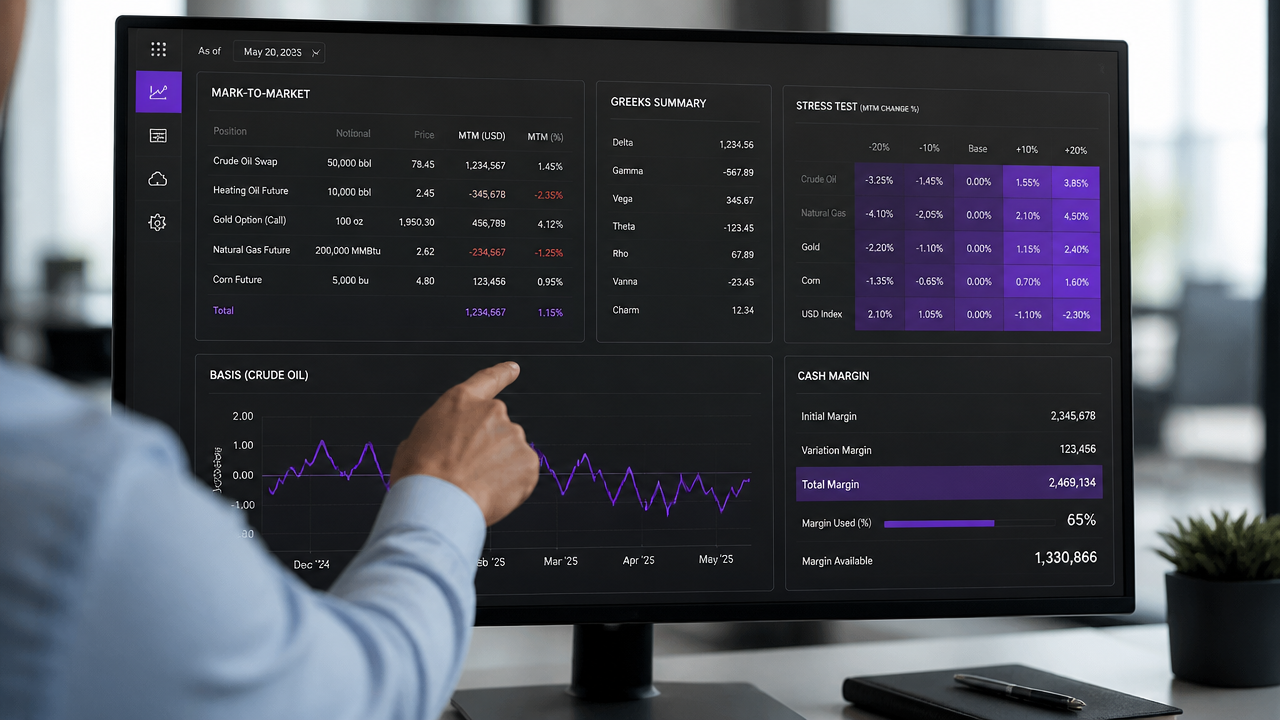
The second layer is sensitivity. Delta, gamma, vega, and theta explain how a hedge behaves after execution, which is exactly where many spreadsheet models become unreliable. A strong risk setup treats these metrics as operating signals, not academic extras. Uhedge includes daily Greeks by position, which fits naturally with a more disciplined commodity risk management process.
Mark to market, VaR, and stress scenarios
The third layer is portfolio control. If a calculator does not update mark to market, decompose risk by factor, and simulate shocks, it cannot support real governance. Uhedge's platform covers daily MTM, parametric VaR by book and consolidated view, plus scenario tables for price and volatility shocks, which aligns with a more robust mark to market and stress testing workflow.
Is this about calculus, or about hedging decisions?
For corporate risk management, it is about hedging decisions. Search results for this topic are dominated by calculus tools, classroom calculators, and TI device tutorials. Those resources help students differentiate functions, but they do not answer what a grain producer, coffee cooperative, sugar mill, or mid-market bank needs to know before committing capital to a hedge.
The business question is different: what structure best protects the exposure, what does it cost, how does it behave across scenarios, and how will it affect reported results? That shift in intent is where generic tools stop being useful. In a live market, a derivative is not solved step by step. It is evaluated against cash flow, inventory, basis, and governance.
Why basis risk changes the answer in commodities
In commodities, the hedge can look correct on the screen and still disappoint in the P&L. The usual reason is basis risk. Exchange futures may hedge the benchmark, but the company earns or pays a local price shaped by freight, quality spreads, location, timing, and regional supply conditions.
A serious calculator must therefore connect the futures leg to the physical leg. Uhedge integrates physical books with basis logic, allowing clients to treat local exposure as more than a rough adjustment. That matters for soybeans, coffee, sugar, ethanol, and other markets where the regional cash price does not move one for one with the reference contract. A deeper basis risk framework is often the difference between a hedge that looks elegant and one that actually protects margin.
How Uhedge approaches a professional derivatives calculator
Uhedge frames the calculator as part of a broader CTRM environment. According to the company's business materials, the platform is designed as a pre and post trade system that records, monitors, and reports physical and financial operations in one auditable environment. That matters because the pricing step should not live apart from trade capture, exposure tracking, and accounting support.
In practical terms, the platform combines several elements that treasury teams usually have to piece together manually:
- pricing for vanilla and structured hedges
- OTC replication inside the platform
- daily mark to market by book
- parametric VaR and factor decomposition
- stress testing by price and volatility shock
- Greeks and volatility surface analysis
- FCM cash and margin visibility
- IFRS 9 and CPC 38 hedge accounting support
Uhedge also positions its model as conflict free, with no hidden spreads or opaque commissions, and states that clients can achieve savings of up to 70% in hedge costs versus traditional bank and broker structures. For firms comparing a spreadsheet process with a more institutional setup, that is a relevant part of the value equation, especially when combined with algorithmic OTC pricing access.
When does a spreadsheet stop being enough?
The answer is earlier than many teams expect. A spreadsheet can work for one commodity, one book, and a small set of linear hedges. It becomes fragile when the company adds multiple maturities, optionality, OTC structures, FX overlays, or hedge accounting requirements.
At that point, the problem is not only model accuracy. It is process risk. Data gets copied between files, market assumptions drift between teams, and audit evidence becomes hard to reconstruct. A dedicated platform helps because valuation, risk, and documentation are generated from the same operational source.
This is also where integrated reporting becomes valuable. If the exposure owner, treasury, CFO, and auditor are all looking at different versions of the position, the company does not really have a hedge process. It has a communication problem disguised as a model.
How to choose the right tool for your hedge program
The right choice depends on whether your goal is education, quotation, or governance. For commercial hedging, the minimum standard should be higher than most search results suggest.
| Need | Basic calculator | Professional CTRM approach |
|---|---|---|
| Single trade price | Usually yes | Yes |
| Physical plus financial view | Rarely | Yes |
| Greeks and volatility analysis | Limited | Yes |
| Basis treatment | Often missing | Yes |
| Daily mark to market | Sometimes | Yes |
| VaR and stress testing | Rarely | Yes |
| Audit trail and hedge accounting | Rarely | Yes |
If your business hedges real commodity exposure, the tool should help you answer three questions fast: what is my risk now, what happens if the market moves, and which structure best fits margin, liquidity, and reporting constraints. If it cannot do that, it is not really a derivatives calculator for risk management. It is just a partial view.
Frequently asked questions
Is a derivatives calculator the same as a calculus derivative tool?
Not in this context. A math derivative tool differentiates equations. A treasury or CTRM derivatives calculator prices hedge instruments, estimates sensitivities such as delta and vega, updates mark to market, and shows how a structure changes portfolio risk and accounting outcomes.
How should a company use a derivatives calculator for hedging?
Start with the physical exposure, hedge objective, time horizon, and liquidity limits. Then compare futures, options, collars, accumulators, or swaps under consistent assumptions for volatility, basis, FX, and scenario shocks. The right tool shows cost, payoff, Greeks, and accounting implications together.
What should a professional derivatives calculator include?
At minimum, it should include pricing, mark to market, stress testing, VaR, delta, gamma, vega, theta, volatility analysis, and basis treatment. For operational use, it should also track counterparty exposure, margin needs, and hedge accounting support.
Can a derivatives calculator measure basis risk?
Yes, if it models the local physical exposure correctly. Many hedge failures come from ignoring the gap between exchange benchmarks and the regional cash price. A useful calculator must connect futures, FX, freight, premiums, and local basis in the same view.
When is a spreadsheet no longer enough?
Spreadsheets can handle simple cases, but they usually break when positions multiply across books, maturities, counterparties, and accounting rules. A CTRM environment is better when the company needs audit trails, daily mark to market, scenario analysis, and integrated physical plus financial risk.