Coffee futures are the benchmark tool for transferring price risk in the arabica market, but they only work well when they are connected to the physical book, basis exposure, liquidity limits, and accounting discipline. For coffee producers, cooperatives, exporters, roasters, and industrial buyers, the question is not simply where the market may go. The real question is how to protect margin if it moves fast. That is where a structured hedge process, supported by Uhedge, becomes more valuable than a directional guess.
In practice, a futures position is just one layer of the decision. A coffee business also needs to define hedge objectives, monitor basis, plan margin cash, and document results in an auditable way. When those pieces stay in separate spreadsheets, the hedge can look correct on paper and still fail operationally.
Key takeaways before you hedge coffee exposure
- Coffee futures hedge price risk, not every commercial risk. Basis, quality, freight, and currency can still move independently.
- The right hedge starts with the physical book. Volume, timing, and quality profile matter more than a market opinion.
- Margin discipline is part of risk management. A correct market view can still create stress if collateral planning is weak.
- Options and structured overlays can improve flexibility. They may fit firms that need protection with less rigid upside sacrifice.
- Auditability matters. Governance, mark to market, and hedge accounting can be as important as the entry level.
How do coffee futures actually work for a commercial hedger?
Coffee futures let a company lock in or offset exposure to future price moves by taking a position in a standardized exchange-traded contract. A producer or cooperative worried about lower prices may sell futures. A roaster or industrial buyer worried about higher prices may buy them. The goal is not to maximize trading profit, but to stabilize commercial margins.
This only becomes useful when exposure is mapped correctly. The relevant variables include harvest or purchase window, expected volume, quality differential, destination, and whether the business is exposed to export pricing or domestic replacement cost. A practical framework is similar to the one discussed in coffee hedging strategies, where the hedge is treated as a business control rather than a market bet.
Uhedge was built for this operational reality. Its CTRM platform records physical and financial positions in one environment, so the hedge can be evaluated against the exposure it is meant to protect, not in isolation.
Why the arabica benchmark is useful, but never the whole answer
The arabica futures benchmark is essential because it gives the market a common reference for price discovery and hedge execution. But a coffee company never buys or sells the benchmark alone. It buys or sells a specific origin, quality, location, and shipment window. That difference is where many hedges succeed or fail.
For that reason, basis is not a side topic. It is often the hidden source of variance between a good futures result and a disappointing commercial outcome. A local cash premium can widen while the board falls. Freight can change. Quality differentials can move. Currency can alter the domestic result even when the futures leg behaves as expected.
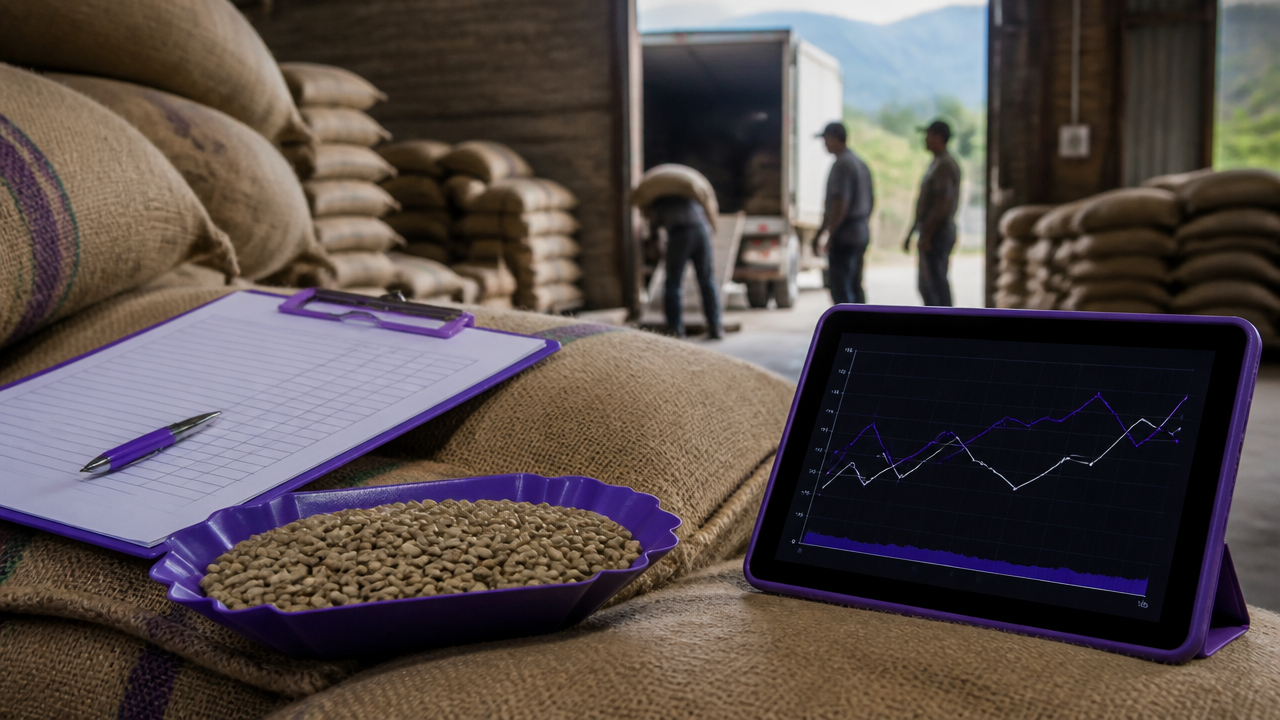
Uhedge addresses this through physical price curve configuration, basis monitoring, and integrated exposure views. That is the same logic behind its coverage of how international coffee prices are set, which helps connect futures screens to the economics of the actual coffee flow.
What makes coffee price risk different from other commodities?
Coffee price risk is unusually sensitive to crop uncertainty, logistics, and quality segmentation. Weather risk can change yield and cup profile. Export bottlenecks can tighten nearby availability. The market can react not only to supply size, but also to what quality is deliverable, where it is located, and how quickly it can move.
That creates a practical challenge for hedgers: the futures market may capture global price direction well, while the physical book still experiences local volatility. A cooperative, exporter, or roaster therefore needs two disciplines at once: macro awareness and contract-level control. This is why firms increasingly look for commodity risk governance steps that define limits, responsibilities, and response rules before volatility hits.
According to Uhedge's business materials, the firm serves coffee cooperatives, commodity traders, exporters, and industrial companies with exposure to commodities, FX, and rates. Its team also comes from institutional commodity banking and merchant backgrounds, which matters when the hedge must reflect both market structure and operating constraints.
When should a coffee company use futures, options, or a structured hedge?
Futures are usually the cleanest tool when the business wants direct price protection and can tolerate daily variation margin. They are transparent, liquid, and easy to mark to market. For many firms, that makes them the first building block of a hedge program.
Options become useful when the company wants downside or upside protection with more flexibility. A producer may want a floor while preserving some participation in rallies. A buyer may want a ceiling without fully locking the market. More structured solutions can also help when the exposure profile is uneven, seasonal, or tied to board plus basis economics.
Uhedge supports vanilla and more advanced structures, including average-based hedges, fences, and accumulator-style setups, inside the same risk environment. That approach is close to the framework outlined in commodity hedge structures for commercial users, where instrument choice follows business constraints instead of product sales pressure.
How important are margin and mark to market in coffee futures?
Margin and mark to market are critical. Many hedge programs fail not because the strategy was conceptually wrong, but because the company did not prepare for cash flow swings while waiting for the physical offset to materialize. A short hedge can be economically correct and still create collateral stress during a rally.
That is why a futures policy should define more than entry triggers. It should specify liquidity buffers, escalation thresholds, and who acts when variation margin accelerates. Businesses that manage this well tend to monitor the hedge daily, not only at month end. The discipline described in real-time mark to market control is especially relevant in coffee because volatility can compress decision time.

Uhedge's platform includes daily mark to market, parametric VaR by risk factor, stress testing, Greek monitoring for options, and cash and margin management. For a commercial coffee desk, that means the hedge can be tested not only for price direction, but also for liquidity resilience.
Can coffee hedges be audited and linked to accounting?
Yes, but only if the hedge is documented from the beginning. An auditor will care about designation, effectiveness logic, valuation method, and the link between the derivative and the exposure. If those elements are reconstructed late, the process becomes expensive and fragile.
This is one of the less discussed gaps in many coffee hedge programs. Trading may be centralized, but documentation remains scattered across broker notes, spreadsheets, and ERP exports. Uhedge was designed to close that gap by connecting exposure planning, deal records, mark to market, and hedge accounting support in one auditable workflow.
That matters for companies that need IFRS 9 or CPC 38 support, especially when management wants the hedge program to survive audit scrutiny and scale beyond one trader's personal spreadsheet logic.
Where Uhedge fits in a coffee risk program
Uhedge combines a CTRM platform with a regulated asset management practice focused on commodity-linked risk. In its own materials, the firm positions itself as a conflict-free extension of the client's operating desk, with integrated physical and financial control, institutional quantitative methods, and no hidden spread-based incentive.
For coffee businesses, that value shows up in three places. First, exposure mapping becomes clearer because physical and financial books sit together. Second, hedge selection improves because futures, options, basis, FX, and liquidity can be evaluated as one system. Third, governance gets stronger because reporting, stress testing, and accounting support are built into the workflow.
If your coffee business already trades the board but still struggles with fragmented visibility, cash calls, or audit readiness, the issue may not be market access. It may be operating architecture. That is the gap Uhedge is built to solve, much like the broader approach described in integrated hedge management systems.
Frequently asked questions
What is the forecast for coffee prices?
Coffee prices are forecast by combining weather risk, crop size, certified stocks, freight, currency moves, and speculative positioning. A useful forecast is not a single number. For producers, cooperatives, roasters, and exporters, the better question is how much revenue or input cost remains exposed if the market moves sharply in either direction.
Will coffee prices go up in 2026?
Coffee prices can rise in 2026 if weather problems, tighter export flows, or a weaker local currency reduce available supply at origin. They can also fall if crop expectations improve or demand softens. Because both outcomes are plausible, many commercial firms focus less on prediction and more on hedge ratios, liquidity, and basis discipline.
Are coffee futures a good investment?
Coffee futures can be useful, but they are not automatically a good investment for every investor. They are leveraged instruments, which means gains and losses can arrive quickly. For commercial users, they work best as risk transfer tools. For financial investors, they require strict sizing, margin planning, and a clear exit framework.
What are the latest news on coffee futures?
The latest coffee futures news usually matters when it changes the market's view of supply, logistics, certified stocks, or currency. Commercial hedgers should pay attention to whether the news affects flat price only, or also changes basis and cash flow needs. That distinction often matters more than the headline itself.
Is there a coffee shortage expected in 2026?
A coffee shortage in 2026 is possible in a local or temporary sense, but shortages are rarely uniform across origins, qualities, and delivery windows. What businesses actually experience is tighter nearby availability, wider differentials, or more expensive replacement costs. That is why physical coverage, futures, and basis management must be viewed together.