Basis is the gap between the price you can trade in the local physical market and the futures price you use as a benchmark. In practice, it is often the difference between cash price and futures price, and that gap can decide whether a hedge works well or disappoints. For grain producers, coffee and sugar cooperatives, crushers, mills, exporters, and food manufacturers, understanding basis is essential because the exchange price is only part of the real commercial equation.
The short version is simple: futures set the reference, but basis sets the local reality. If you manage only the futures leg and ignore freight, quality, location, timing, and regional supply pressure, you are still carrying meaningful risk.
Key takeaways
- Basis is local. It captures the difference between a physical price and the relevant futures contract.
- It matters for hedging. A strong futures hedge can still produce weak commercial results if basis moves against you.
- It is driven by real market frictions. Freight, storage, quality, location, seasonality, and nearby demand all influence basis.
- It is often more stable than outright price. That makes it measurable, comparable, and manageable.
- For agro-industrial firms, basis is a margin variable. It affects procurement, sales timing, inventory decisions, and accounting outcomes.
Basis is the local price adjustment that turns futures into a real cash price
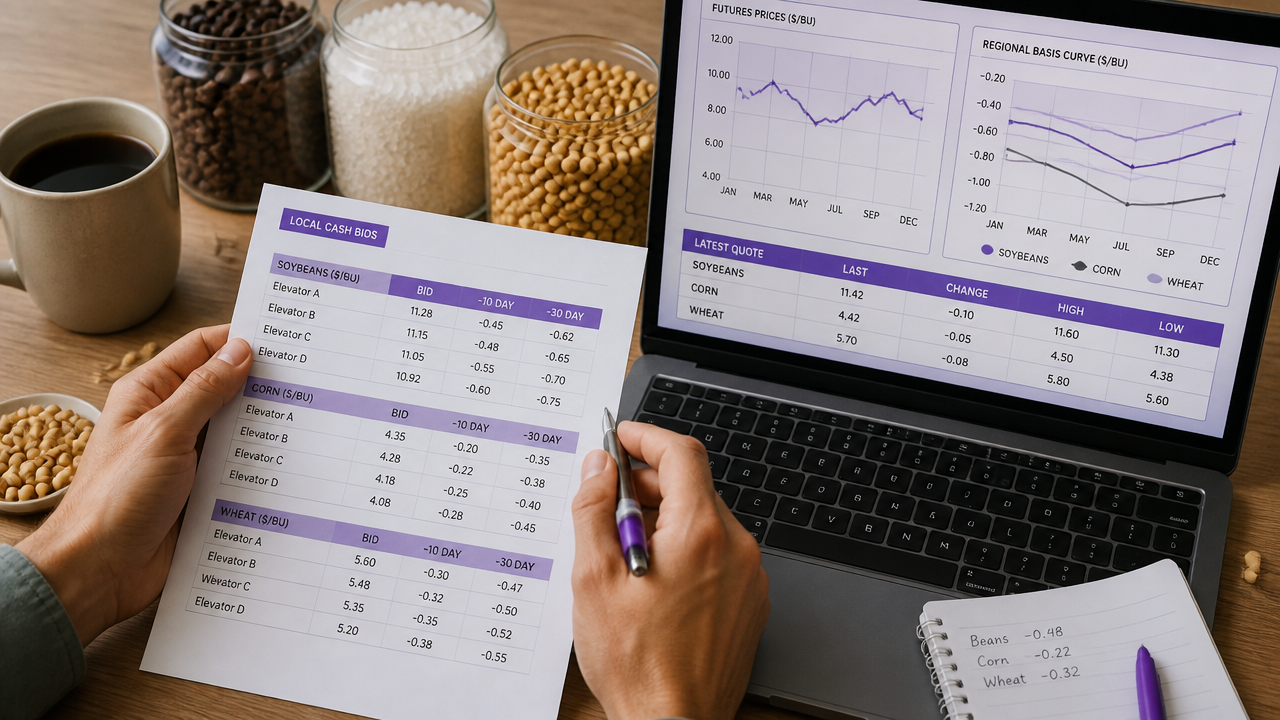
In commodity trading, basis usually means cash price minus futures price. If local corn is trading at 15 cents under the relevant futures contract, the basis is negative 15 cents. If a nearby buyer is paying above the benchmark because supply is tight, the basis may be positive.
This sounds technical, but the idea is practical. A futures contract reflects a standardized benchmark at an exchange delivery structure. Your physical transaction reflects a specific place, date, quality, freight route, and buyer. Basis is the bridge between those two worlds.
That is why basis should not be treated as noise. For many commercial firms, it is the variable that explains why two companies looking at the same futures screen can still end up with very different margins.
What makes basis move
Basis moves when local physical conditions change faster or differently than the benchmark futures market. The exchange price can rise while local basis weakens, or futures can fall while basis strengthens because a nearby consumer needs supply now.
The most common drivers are:
- Regional supply and demand imbalance
- Freight costs and logistics bottlenecks
- Storage economics and carry
- Quality differentials
- Harvest pressure and seasonality
- Port demand, export pace, or crusher margins
- Differences between domestic and reference market conventions
In agriculture, these drivers are especially visible. During harvest, local bids often come under pressure because product is abundant and storage is scarce. Later in the season, basis can strengthen if nearby availability tightens or export channels improve.
Why basis matters more than many hedgers realize
A futures hedge protects against part of the price risk, not all of it. If the physical leg is exposed to local basis and the futures leg tracks only the exchange benchmark, your final result depends on how those two move together.
That is the core reason basis matters: it shapes the difference between a theoretical hedge and an effective commercial hedge. A producer can hedge soybeans at what looks like an attractive futures level and still be disappointed if basis weakens by the time the crop is sold. A crusher can buy futures protection and still overpay for raw material if local basis spikes.
Basis also matters for day to day decision-making. It influences whether to sell now or store, whether to accept a supplier offer, whether to roll a hedge, and whether a quoted price is actually competitive once location and quality are considered.
How basis affects common decisions in grains, coffee, and sugar
Basis is not an abstract metric. It directly affects procurement and sales timing across the agro-financial chain.
| Situation | How basis enters the decision | Typical risk if ignored |
|---|---|---|
| Farmer selling grain | Compares local elevator bid with futures hedge level | Locks futures, then loses on a weaker cash bid |
| Crusher buying soybeans | Evaluates supplier offers by implied local premium or discount | Chooses the wrong supplier based on nominal price only |
| Coffee cooperative marketing inventory | Measures export demand and local availability versus ICE benchmark | Sells too early or too late relative to regional premiums |
| Sugar or ethanol mill hedging output | Connects local commercial flows to futures and FX benchmarks | Underestimates margin volatility across physical and financial books |
For related hedging mechanics, Uhedge has also covered commodity hedge structures, sugar price protection, and coffee hedging decisions in more detail.
What is basis risk?
Basis risk is the risk that the relationship between your local physical price and the futures benchmark changes after you put a hedge in place. In other words, the hedge ratio may be correct and the futures trade may be well executed, but the cash market still moves in a way that hurts your outcome.
This risk is common when the physical commodity is not identical to the futures contract, when logistics shift, or when regional demand becomes unusually strong or weak. Basis risk can also rise when your exposure includes several moving parts at once, such as commodity price, FX, freight, and quality differentials.
That is why sophisticated hedging goes beyond a single screen price. It needs a view of the physical book and the financial book together. A useful starting point is understanding how firms approach basis risk in hedge design and how scenario testing improves decisions in industrial hedging analysis.
Is basis usually positive or negative?
Either is possible. What matters is not the sign alone, but whether the basis is strong or weak relative to its own history and relative to your commercial objective.
A negative basis means the local cash price is below the futures benchmark. That is common when freight is expensive, supply is abundant, or the local market is temporarily oversupplied. A positive basis means the local market is paying above the benchmark, often because nearby demand is urgent or deliverable supply is tight.
Professionals therefore ask a better question than “Is basis positive or negative?” They ask: is the current basis attractive versus history, versus seasonality, and versus the value of waiting?
Why basis can be more actionable than outright price
Outright futures prices react to global macro factors, fund flows, weather shocks, rates, and geopolitics. Basis still responds to those forces, but it is anchored in the mechanics of the physical market. That often makes it more usable for commercial timing.
For example, a procurement team may not know whether futures will rally next week, but it may know that harvest pressure usually weakens local basis in a specific corridor. That insight can improve buying decisions even when outright price remains uncertain.
This is one reason Uhedge treats basis as a first class risk factor inside its CTRM approach. According to the company’s positioning documents, the platform integrates physical and financial books in one auditable environment, applies basis logic by location, and decomposes risk across futures, FX, and regional basis. That is especially relevant for firms that need tighter procurement discipline, cleaner mark to market, and more consistent hedge accounting outcomes.
How professionals monitor basis instead of just watching futures
The best process is systematic. Basis should be tracked by commodity, location, delivery window, and counterparty logic, not as a single average number on a spreadsheet.
A practical workflow usually includes:
- Defining the correct futures benchmark for each physical exposure
- Calculating implied basis on every purchase or sale offer
- Comparing current basis with historical ranges and seasonal patterns
- Stress testing basis alongside futures and FX risk
- Reviewing hedge effectiveness after rolls, deliveries, and physical pricing events
This is where integrated tooling matters. Uhedge’s model for the agro-financial chain combines exposure planning, mark to market, basis intelligence, risk decomposition, and IFRS 9 support in a single environment. For teams trying to move beyond fragmented spreadsheets, that kind of setup is closer to how basis is managed institutionally. The broader logic is similar to centralized risk data in agroindustry and to more advanced digital treasury risk workflows.
Basis is a commercial edge, not just a trading term
Most definitions stop at the formula. That is useful, but incomplete. In real commodity businesses, basis is where logistics, market structure, and risk management meet. It influences who buys, who sells, when inventory moves, and whether a hedge protects margin or only creates false comfort.
If your business buys, processes, stores, finances, or exports commodities, basis deserves regular measurement. Firms that understand it negotiate better, hedge more realistically, and explain results more clearly. Firms that ignore it are often surprised by outcomes that looked impossible on the futures screen.
Frequently asked questions
What is basis in trading?
Basis is the difference between the local cash price of a commodity and the futures price used as a benchmark. The usual formula is cash price minus futures price. It matters because your real revenue or purchase cost is set locally, not only by the exchange price.
How do you calculate basis for futures?
Take the local cash price and subtract the relevant futures contract price. If cash soybeans are $12.10 and the futures contract is $12.40, the basis is negative $0.30. The key is to use the futures month and delivery logic that actually match your physical exposure.
Is basis trading profitable?
It can be, but it is not easy money. Basis tends to be more stable than outright prices, yet it still moves with freight, storage, local supply, quality spreads, export demand, and timing. Profitability depends on execution, market access, and disciplined risk measurement.
Does a futures hedge remove basis risk completely?
No. A futures hedge reduces price risk, but it does not eliminate the difference between your local physical price and the exchange benchmark. If basis changes after the hedge is placed, the physical and futures legs may not offset each other as expected.
Why is basis often more predictable than the futures price?
Basis often behaves more predictably because it reflects regional supply, demand, logistics, storage, and quality conditions. Futures can react instantly to macro news, while local basis usually adjusts through physical market mechanics. Predictable does not mean fixed, so it still needs active monitoring.