
Hedging is the practice of reducing financial risk by pairing an existing exposure with another position that tends to move in the opposite direction. For companies in commodities, FX, or interest rates, the objective is not to guess the market correctly every time. It is to protect margin, cash flow, and planning capacity when prices move against the business.
That distinction matters for producers, cooperatives, mills, biofuel plants, exporters, and food manufacturers. A good hedge helps the firm survive volatility without giving up control of the physical business. It turns uncertainty into a managed range of outcomes.
For BLOG UHEDGE readers, the most useful way to understand this concept is through the lens of real commercial exposure. In practice, the question is rarely “how do I trade?” It is usually “how do I defend my operating margin when futures, basis, freight, FX, and rates all move at once?”
Key takeaways
- Hedging is risk transfer, not profit maximization. It aims to reduce the damage from adverse price moves.
- The exposure comes first. A hedge only makes sense when it is linked to a real commercial, financial, or accounting risk.
- No hedge is perfect. Basis, timing, volume mismatch, and liquidity can still create residual risk.
- In commodities, physical and financial positions must be viewed together. Treating them separately often hides the real risk.
- Execution is only part of the job. Measurement, mark to market, stress tests, and documentation matter just as much.
What does hedging mean in finance?
In finance, hedging means taking an offsetting position to reduce the impact of an unfavorable move in an asset, liability, or future transaction. If your business loses money when soybean oil rises, for example, you may buy a derivative that gains value when soybean oil rises. If you are an exporter hurt by a stronger local currency, you may protect the foreign exchange exposure with an FX hedge.
The core idea is simple: you keep the business exposure because it is part of your operations, then add a protective layer around it. This is why many firms compare a hedge to insurance. The comparison is useful, but incomplete, because hedges have design choices, cash flow effects, mark to market behavior, and accounting consequences.
That is also why firms looking for a more operational view often study commodity hedge strategies rather than generic investing definitions. In commercial markets, the relevant question is not only whether the hedge offsets price. It is whether it protects the economics of the physical book.

How does a hedge actually work?
A hedge works by making losses in one part of the business more tolerable because gains or savings appear elsewhere. The most common structure is a physical exposure combined with a derivative position. The physical side reflects the company’s commercial reality. The derivative side is the shock absorber.
Here is the practical logic:
- A grain producer expects to sell crops in the future and fears a price drop.
- A futures sale can help protect the future selling price.
- If the market falls, the physical sale may be weaker, but the futures position may gain.
- The net result is usually a more stable realized margin than staying fully exposed.
The same logic applies to importers, crushers, mills, and consumer goods manufacturers. Some use futures. Others prefer options because they want downside protection while keeping some upside participation. Firms with more tailored exposures may use swaps or structured OTC solutions.
The right design depends on exposure mapping, hedge ratio, tenor, liquidity, and tolerance for premium or collateral needs. This is where a hedge management system becomes valuable, because the decision is rarely one instrument in isolation.
What are examples of hedging?
Most business hedges are easier to understand through examples than definitions. The structure changes by sector, but the purpose stays the same: protect the economics of an operating decision.
| Exposure | Main risk | Possible hedge | Business objective |
|---|---|---|---|
| Coffee cooperative selling future production | Price decline | Short futures or put options | Defend minimum selling price |
| Sugar or ethanol mill | Commodity and FX swings | Futures, options, or OTC structures | Stabilize crush margin and revenue |
| Food manufacturer buying imported inputs | Higher input cost and weaker local currency | Call options, swaps, or FX hedge | Protect gross margin and budgeting |
| Exporter with USD receivables | FX volatility | Forward or option strategy | Reduce cash flow uncertainty |
These examples show why hedging is broader than a single trade. In agro industrial chains, one exposure may involve futures prices, regional basis, freight, taxes, and foreign exchange at the same time. That is why corporate FX hedging and commodity risk management often need to be coordinated rather than handled in separate spreadsheets.
What can go wrong with a hedge?
The biggest misconception is that a hedge removes all risk. In reality, it transforms the risk profile. That is helpful, but it also creates new management tasks.
The most common problems are:
- Basis risk: the local physical price does not move exactly like the reference futures contract.
- Volume mismatch: the firm hedges more or less than the real exposure.
- Timing mismatch: the hedge expires before or after the physical transaction.
- Liquidity strain: margin calls or option premiums affect cash management.
- Governance failure: the company cannot explain why the hedge exists, how it is measured, or when it should be adjusted.
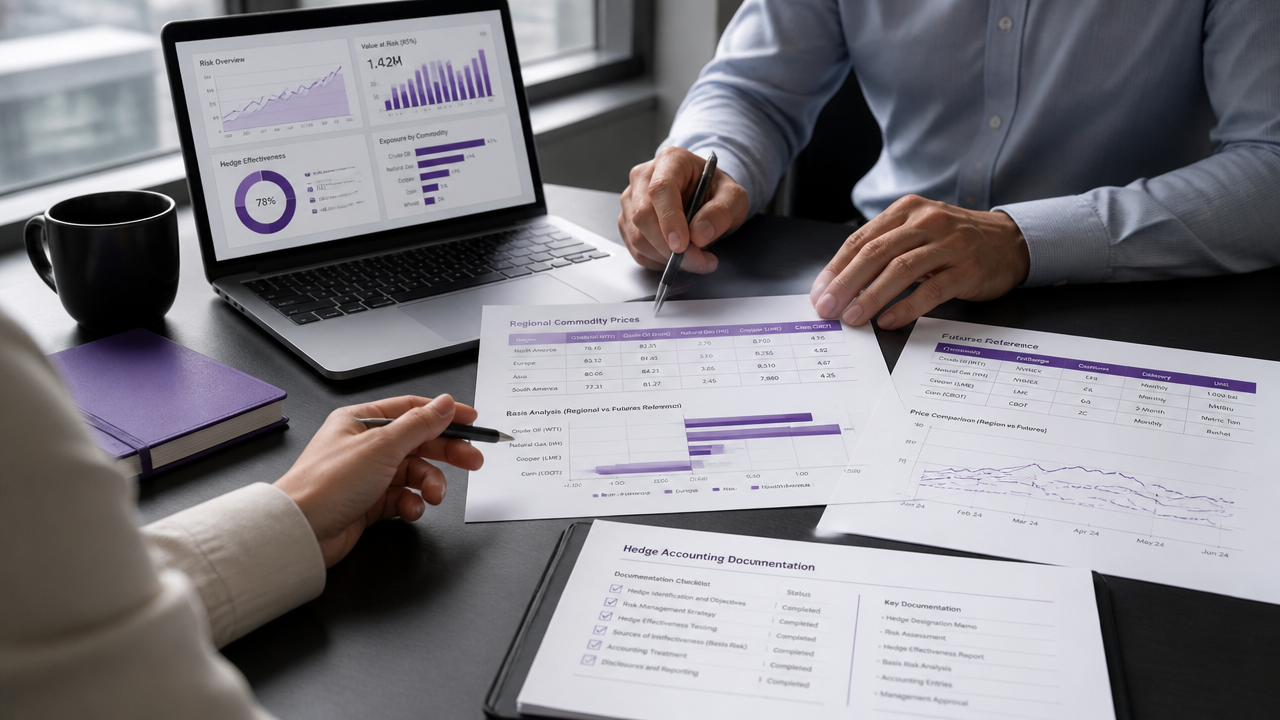
Basis is especially important in real commodity businesses. A soybean crusher, sugar mill, or fuel distributor does not live on a screen price alone. The local economics depend on regional differentials and commercial conditions, which is why understanding basis risk in hedging is essential for anyone managing physical and financial books together.
Which instruments are commonly used?
There is no universal best instrument. The right tool depends on what must be protected and what trade offs the company accepts.
Futures
Futures are standardized and liquid, which makes them useful for straightforward price protection. They work well when the reference contract is close to the company’s real exposure and the treasury can manage mark to market and margin flows.
Options
Options are useful when management wants protection with flexibility. A buyer can cap cost or defend a floor while preserving part of the upside. That flexibility has a price, which is the premium or the embedded cost of the chosen structure.
Swaps and OTC structures
Swaps and tailored structures are relevant when the exposure is more specific than an exchange contract can handle. They can align better with customized tenors, payoffs, or operational constraints. They also require stronger valuation discipline, scenario analysis, and documentation.
For firms comparing these alternatives, different hedging tools in practice often matter more than textbook definitions. A technically correct instrument can still be a poor business hedge if it does not fit the company’s cash flow and basis profile.
Why hedging in commodities is different from retail investing
Commercial hedging starts with an operating exposure, not a market opinion. A producer, processor, exporter, or importer is not entering the market just to seek return. The firm is protecting the margin of a physical activity that already exists.
That is why the most advanced setups unify four layers in the same process:
- exposure planning
- pricing and strategy selection
- risk measurement and stress testing
- accounting and audit support
Uhedge was built around this integrated view. Its CTRM platform is designed for companies exposed to commodities, FX, and rates, combining physical and financial positions in one auditable environment. According to the company’s reference materials, the platform supports exposure mapping, hedge ratio recommendations, pricing of vanilla and more complex structures, OTC replication, mark to market, parametric VaR by risk factor, stress testing, and IFRS 9 or CPC 38 hedge accounting support. Uhedge also states that its model is designed to reduce the friction of traditional bank led hedging and can deliver savings of up to 70% in hedge costs for certain clients.
That positioning is particularly relevant for businesses that cannot afford fragmented visibility. When exposures sit across ERP data, broker statements, bank quotes, and spreadsheets, management often sees the market too late.
How does hedging relate to hedge accounting?
Hedging and hedge accounting are related, but they are not the same thing. A company can hedge economically without qualifying for a specific accounting treatment. Hedge accounting exists to reduce accounting mismatch and present the protection logic more faithfully in the financial statements.
In practice, that means documentation matters. The company needs a clear designation of the hedged item, the hedging instrument, the risk being managed, and the method for assessing effectiveness. For teams dealing with this workflow, risk and compliance features in a hedge system become central, not optional.
Uhedge’s documentation indicates that its platform includes hedge accounting support with effectiveness testing and designation reports, while final validation remains with the client’s auditor or qualified accountant. That separation is healthy: software organizes and measures the process, but governance still belongs to management and assurance functions.
When should a company hedge?
A company should hedge when unmanaged volatility can damage margin, debt capacity, pricing discipline, or investment plans. The trigger is not fear alone. It is a clear decision that some market risks should be transferred because keeping them open does not improve the business.
A practical policy usually defines:
- which exposures qualify for protection
- which instruments are allowed
- minimum and maximum hedge ratios
- who approves trades and exceptions
- how performance and effectiveness are reviewed
This is where disciplined process beats improvisation. Companies that treat hedging as a repeatable risk function usually perform better than companies that hedge only when headlines become uncomfortable.
Frequently asked questions
What is hedging in simple terms?
In simple terms, hedging is a way to reduce the impact of unwanted price moves. A company or investor keeps the underlying exposure, such as crops, fuel, exports, or inventory, and adds a financial position that gains value when the original exposure loses value. The goal is stability, not speculation.
What are examples of hedging?
A grain producer can sell futures to protect the value of a future harvest. A food company can buy call options to cap the cost of imported raw materials. An exporter can use FX hedges to reduce the effect of USD/BRL swings on cash flow and margins.
What are the three types of hedging?
Common forms include futures hedging, options hedging, and OTC hedging with swaps or structured solutions. The right choice depends on the company’s exposure, margin sensitivity, cash flow timing, accounting goals, and tolerance for basis risk, collateral use, and premium cost.
Does hedging eliminate risk?
No. A hedge lowers risk, but it does not eliminate it. Basis differences, wrong volumes, timing mismatches, liquidity needs, and accounting constraints can all reduce effectiveness. A good hedge improves resilience and decision quality, but it still needs monitoring and disciplined governance.
How does hedging relate to hedge accounting?
Hedging can make financial statements more stable when it is designed and documented correctly. For companies applying hedge accounting, the objective is to align the economics of protection with the accounting treatment. That usually requires formal designation, testing, and evidence that the hedge remains effective.