
An accumulator, in a derivatives context, is a structured contract that builds a hedge over time according to a pre-agreed schedule and payoff formula. For commodity buyers, exporters, mills, and treasury teams, it can be useful when exposure is recurring rather than one-off. The catch is simple: a better apparent price or lower upfront cost usually comes with more path dependency, more monitoring, and more downside if the structure is misunderstood.
For BLOG UHEDGE readers, the practical question is not the dictionary definition. It is whether this type of structure improves hedge efficiency without creating hidden basis, liquidity, accounting, or governance problems.
Key takeaways
- Accumulator structures are staged hedges, they add exposure across multiple dates rather than a single maturity.
- The payoff is conditional, often using barriers, knock-out features, or leverage that changes how much volume accumulates.
- They are not automatically cheaper, they simply repackage cost, timing, and risk.
- They work best with predictable physical flows, disciplined hedge ratios, and daily risk visibility.
- They require stronger controls than vanilla products, especially mark to market, Greeks, stress testing, and liquidity planning.
What does an accumulator mean in derivatives?
In structured hedging, an accumulator is a contract that lets a company buy or sell a fixed amount repeatedly, at a preset strike or formula, across several observation dates. Instead of hedging all exposure at once, the position accumulates piece by piece. That is why the instrument appears in commodity and FX hedging conversations, not only in broader finance jargon.
In practice, the structure can be simple or highly engineered. Some versions include a barrier that stops future accumulation if the market reaches a certain level. Others include leverage, meaning the contracted amount can increase when the market moves in an unfavorable direction. This is the point many non-specialists miss: the headline strike never tells the whole story.
For firms comparing alternatives, a good starting point is to understand how derivative pricing in commodities translates payoff formulas into real cash flow risk.
How do accumulator contracts work in commodity and FX hedging?
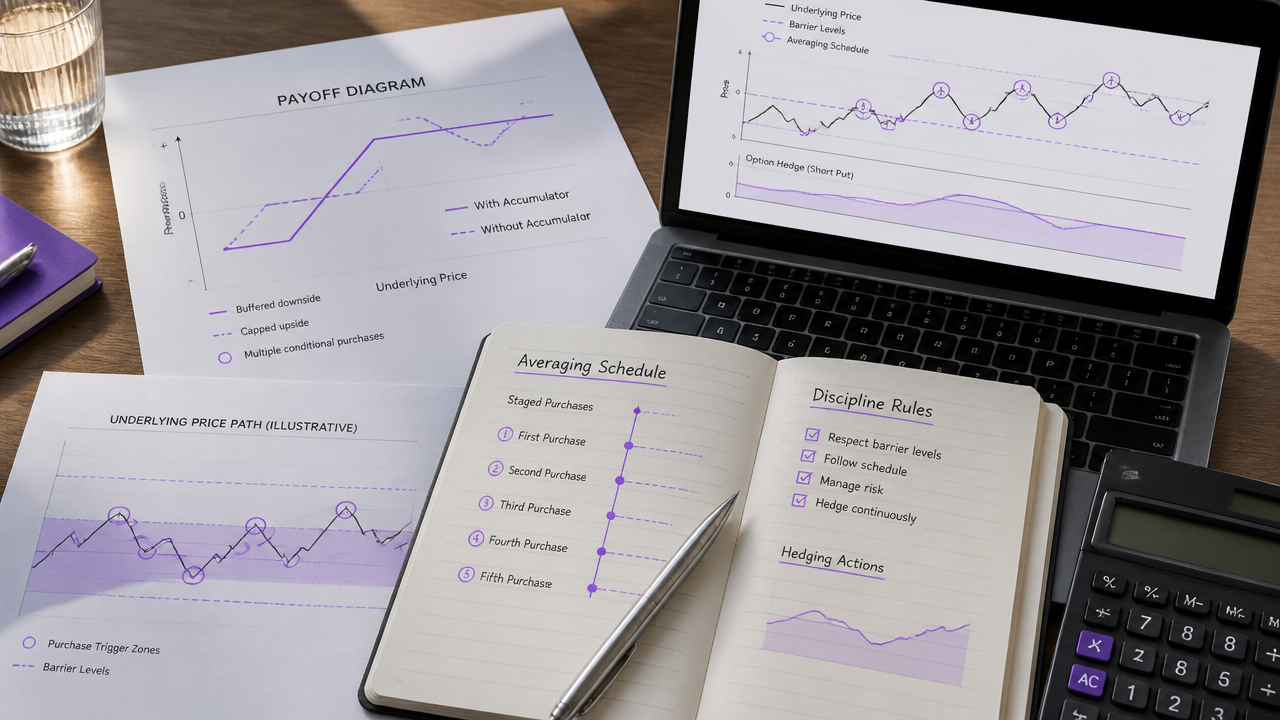
An accumulator works by combining schedule, strike, and trigger rules into one contract. The company agrees to accumulate a specific notional or physical-equivalent amount at each observation date, as long as the contractual conditions remain active.
At a high level, the workflow looks like this:
- The treasury team defines the underlying exposure, such as soybean oil purchases, sugar exports, or USD-linked imports.
- The structure sets a strike, observation calendar, and total target quantity.
- Barrier or leverage rules determine whether future dates stay active, stop, or increase in weight.
- The contract is marked to market throughout its life, not only at maturity.
- The final economic result depends on the full path of prices, not one closing price.
That path dependency is why structured hedges should be evaluated alongside commodity hedge strategy choices, not treated as a pricing shortcut.
Why would a company use an accumulator?
Companies use these structures when they want a hedge that matches recurring exposure and they are willing to trade simplicity for customization. A crusher buying inputs every month, an exporter with a staggered sales book, or an importer with rolling FX needs may prefer a staged structure instead of repeatedly re-entering plain trades.
The potential benefits usually include:
- better alignment with periodic procurement or sales cycles
- more tailored payoff design than a standard forward
- possible reduction of upfront option premium, depending on the structure
- the ability to express a market view without leaving exposure fully open
But those benefits only matter if the hedge fits the physical book. In agro-industrial operations, the real decision is often whether the derivative helps margin stability after basis, freight, taxes, and timing are considered. That is why a strong commodity risk management framework matters more than the product label.
What are the main risks of accumulator structures?
The main risk is false simplicity. An accumulator can look attractive on day one and become uncomfortable when spot, volatility, or basis move in the wrong direction. If leverage or double-up mechanics exist, the company can be forced to accumulate more exposure precisely when the market is least favorable.
The risk set usually includes:
- market risk, because the payoff is nonlinear and path dependent
- liquidity risk, because mark to market losses can pressure cash and collateral planning
- basis risk, because local physical prices may not track the hedge benchmark perfectly
- governance risk, because spreadsheets often hide conditional exposures until it is too late
- accounting risk, because structured documentation is harder than for plain hedges
For that reason, companies should evaluate accumulators with the same discipline applied to basis risk in treasury operations and to portfolio controls beyond Excel.
Accumulator versus forward versus vanilla option
The best instrument depends on the exposure profile, not on what sounds more sophisticated. A forward is usually cleaner. A vanilla option is easier to explain economically. An accumulator can be more precise, but only if the treasury team can manage its moving parts.
| Instrument | What it does well | Main limitation | Best fit |
|---|---|---|---|
| Forward | Locks one price for one maturity | No upside participation | High certainty on volume and timing |
| Vanilla option | Creates asymmetric protection | Usually requires premium | Need for flexibility and capped downside |
| Accumulator | Matches recurring exposure with tailored rules | More complex path-dependent risk | Predictable flow plus strong risk governance |
Teams weighing these choices often benefit from a direct comparison between structured payoffs and more traditional derivative hedging routes.
Can accumulators work for agro-industrial firms?
Yes, but only when the physical book is visible and the company knows what it is trying to optimize. For agro-industrial firms, the right question is not, “Is this structure sophisticated?” It is, “Does this structure improve procurement or sales certainty after basis, local logistics, FX, and accounting effects?”
That is where Uhedge is relevant. Uhedge’s CTRM platform supports accumulator structures, including versions with or without barriers, inside a broader environment that combines physical exposure planning, OTC-style pricing, mark to market, Greeks, stress testing, basis intelligence, and hedge accounting support. For firms that need recurring hedge decisions instead of one isolated trade, that integration matters more than any single payoff diagram.
It also reduces a common failure point: fragmentation. When physical contracts, broker statements, and risk reports sit in separate places, conditional structures become harder to supervise. A unified workflow like hedging software for agribusiness is often what turns a complex idea into an auditable process.
How should treasury teams evaluate an accumulator before trading it?
A treasury team should approve an accumulator only after testing the full life-cycle behavior, not just the entry price. If the payoff cannot be explained in plain language, it should not be traded yet.
Use this checklist before approval:
- map the physical exposure and confirm the hedge ratio
- model best, base, and stressed scenarios for price and volatility
- measure delta, gamma, vega, and time decay through the observation schedule
- check local basis behavior against the chosen benchmark
- estimate collateral, cash flow pressure, and margin usage
- review documentation requirements for accounting and audit
Uhedge’s operating model is built around this kind of discipline. The company positions itself as a conflict-free extension of the client’s treasury function, with no hidden spreads or opaque commissions, and with a platform that supports OTC replication, scenario analysis, and formal hedge accounting workflows. That is especially relevant for companies that need structured protection without losing governance.
Frequently asked questions
What is the purpose of an accumulator?
In derivatives, an accumulator is a structured hedge that builds a position over several observation dates instead of all at once. The contract usually sets a strike price, a schedule, and one or more conditions, such as barriers, that can increase, reduce, or stop future accumulation.
Is an accumulator riskier than a regular option?
Not always. An accumulator can lower the initial premium or improve the strike versus a plain option, but that benefit comes from taking path-dependent obligations. If the market moves sharply against the hedger, the effective volume and mark to market can become much more demanding than expected.
When should a company use an accumulator?
An accumulator fits best when a company has recurring exposure over time, clear volume planning, and strong governance over liquidity, limits, and reporting. It is usually a poor fit for firms with uncertain physical flows, weak margin capacity, or limited ability to monitor Greeks, barriers, and scenario risk.
How is an accumulator different from a forward or a vanilla option?
A forward fixes one price for one maturity and creates a linear payoff. A vanilla option creates asymmetric protection, usually with an upfront premium. An accumulator spreads the hedge across dates and conditions, often changing the final purchased or sold volume depending on where the market trades during the life of the contract.
Can an accumulator be used in hedge accounting?
Yes, but only if the economics, documentation, and effectiveness framework are designed correctly. Structured derivatives can be harder to document than plain instruments, which is why treasury teams often need formal designation reports, ongoing mark to market, and effectiveness testing before expecting hedge accounting treatment.