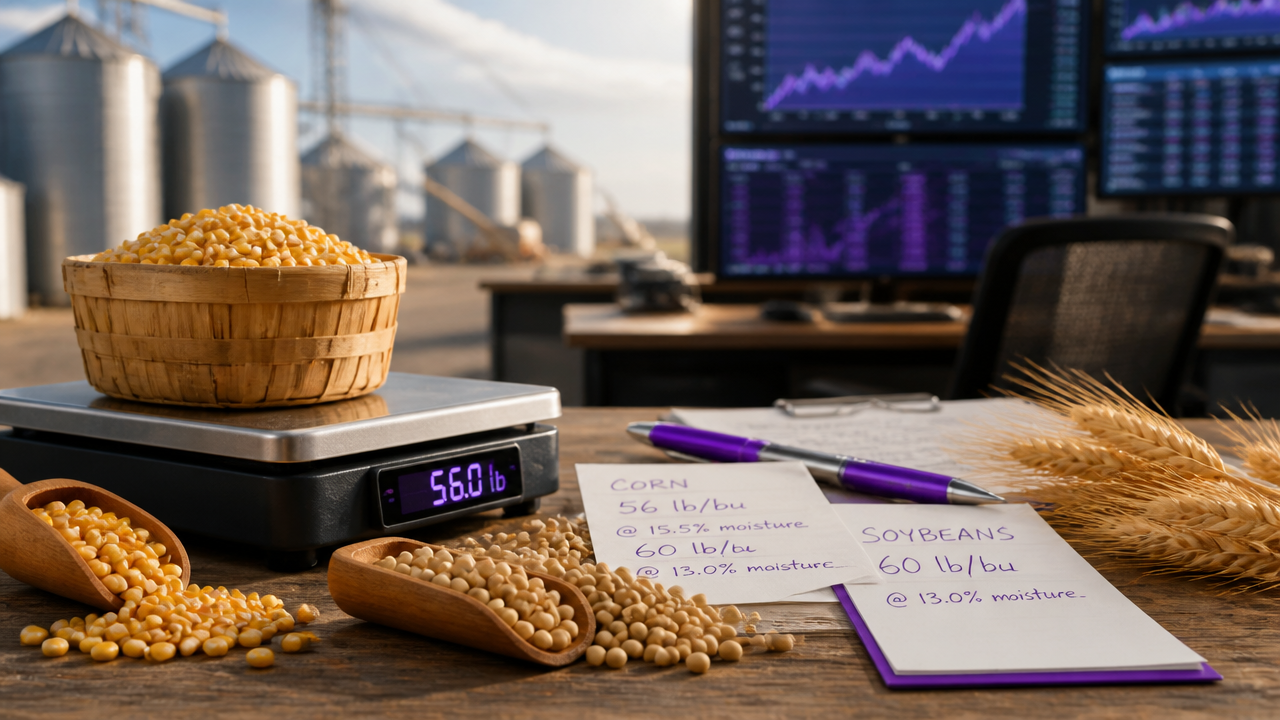
A bushel does not equal one fixed number of pounds. It is a unit of volume, and the weight depends on the commodity inside it. For grain market participants, the most important benchmarks are simple: corn is typically 56 pounds per bushel, wheat and soybeans are 60, barley is 48, and oats are 32.
That answer matters most for producers, cooperatives, crushers, merchandisers, and risk managers who convert physical inventory into market exposure. If your hedge ratio, basis view, or mark to market starts with the wrong unit conversion, the rest of the analysis can drift off course.
At Uhedge, this is not just a farm measurement question. It is part of turning physical commodity exposure into auditable pricing, risk, and hedge decisions inside a single CTRM workflow.
Key takeaways
- A bushel measures volume, not weight. In U.S. trade, one bushel is about 35.24 liters, or roughly 1.24 cubic feet.
- The pound value changes by crop. Standard trade weights are commodity specific.
- Most common benchmarks: corn 56 lb, soybeans 60 lb, wheat 60 lb, barley 48 lb, oats 32 lb.
- Commercial decisions depend on the right conversion. Procurement, storage, freight, pricing, basis, and hedging all use these standards.
- Actual delivered grain can still vary. Moisture, test weight, and quality affect physical lots, even when the market uses a standard bushel weight.
What does a bushel mean in agricultural markets?
In commodity markets, a bushel is best understood as a standardized volume used to quote and compare agricultural products. It is not a universal weight unit. That is why asking how many pounds are in a bushel only makes sense once you name the crop.
This distinction matters because physical trade and futures markets need a common language. A merchandiser may buy corn from a producer, hedge price risk with futures, and evaluate local basis, all while moving between volumetric and weight based records. That link between farm units and market units is one reason many firms invest in commodity trading and risk management processes that keep physical and financial exposures aligned.
In the United States, the bushel remains central for grains and oilseeds. When people discuss corn, soybeans, or wheat prices, the quote is often stated per bushel, even if downstream accounting or logistics later convert the same position into pounds, tons, or kilograms.
Standard pounds per bushel for common crops
If you need a quick answer, use the trade standard for the specific commodity. These are the values most readers are looking for.
| Commodity | Standard weight per bushel | Approximate kilograms |
|---|---|---|
| Corn, shelled | 56 lb | 25.40 kg |
| Soybeans | 60 lb | 27.22 kg |
| Wheat | 60 lb | 27.22 kg |
| Barley | 48 lb | 21.77 kg |
| Oats | 32 lb | 14.51 kg |
| Rye | 56 lb | 25.40 kg |
| Sorghum | 56 lb | 25.40 kg |
These standards are widely used in merchandising, reporting, and contract interpretation. They are also the practical starting point for tracking key numbers across soy, corn, and wheat markets, where small unit errors can distort a position size or hedge ratio.

Why does bushel weight change by commodity?
The weight changes because different crops pack differently into the same volume. Kernel size, density, hull structure, and moisture behavior all affect how much material fits into one bushel. That is why oats and soybeans cannot share the same pound equivalent.
Markets solve this by using standard bushel weights for each commodity. Those standards make contracts easier to price, settle, compare, and hedge. Without them, every buyer and seller would need a separate definition of what a quoted bushel means.
This is also where confusion begins. A farmer may hear that a bushel is a volume, while a trader sees bushel based futures quotes, and an accountant needs weight based inventory records. Good risk practice means connecting those views consistently, especially when commodity pricing risk depends on both the physical product and its financial benchmark.
Why is a bushel of corn 56 pounds?
Because commercial trade adopted 56 pounds as the standard weight for one bushel of shelled corn. It is a convention designed to keep pricing and settlement uniform across market participants.
That does not mean every physical bushel in a bin weighs exactly 56 pounds in real life. Test weight, drying, shrink, and quality can make an actual lot heavier or lighter. The 56 pound figure is the market reference that allows consistent quoting and exposure measurement.
For example, if a grain company is long 100,000 bushels of corn, it can quickly translate that position into 5.6 million pounds for freight, processing, or internal controls. From there, the firm can connect the physical book to futures hedges, basis assumptions, and P&L attribution.
How do you convert bushels into pounds?
The formula is straightforward: bushels x standard pounds per bushel = pounds. The only mistake to avoid is using the wrong commodity standard.
- 100 bushels of corn x 56 = 5,600 pounds
- 100 bushels of wheat x 60 = 6,000 pounds
- 250 bushels of soybeans x 60 = 15,000 pounds
- 500 bushels of oats x 32 = 16,000 pounds
If you need metric conversion, divide pounds by 2.2046 to estimate kilograms, or use the kilogram values in the table above.
This sounds basic, but it becomes high impact at scale. A processor, exporter, or cooperative managing multiple books can misstate exposure if bushels, pounds, tons, and futures units are handled in separate spreadsheets. That is exactly the type of fragmentation a CTRM workflow for the trade lifecycle is meant to reduce.
How many 5 gallon buckets are in a bushel?
Roughly 1.6 buckets. A standard U.S. bushel is about 8 gallons, so dividing 8 by 5 gives 1.6. Put differently, one 5 gallon bucket holds about 0.625 bushel if filled completely.
This is a useful field estimate, but it is not a pricing standard. Buckets are practical for handling grain on site, while bushels are the commercial shorthand used in trade, storage, and market communication. If the grain is compacted, overfilled, or irregularly measured, the real usable volume can shift.
For operational decisions, bucket estimates help with quick handling judgments. For contracts, procurement, and hedging, use standardized units.
Why this simple conversion matters for pricing, basis, and hedging
Bushel to pound conversion is not just a classroom exercise. It affects how agribusinesses translate a physical position into a market exposure that can be priced, hedged, and audited.
Take soybeans as an example. A crusher may buy physical soybeans locally, evaluate the regional basis, and hedge flat price risk with futures. If the physical book is measured one way and the hedge book another, the business can misjudge how much risk is actually covered. That is why firms working on soybean crush exposure and hedge ratios need clean unit logic before they debate structure or timing.
Uhedge is built for that bridge between the physical and the financial. The platform combines commodity pricing, basis intelligence, mark to market, Greeks, stress testing, and hedge accounting in one auditable environment. For producers, cooperatives, mills, food companies, exporters, banks, and family offices, that means a conversion table can become part of a disciplined exposure workflow instead of one more disconnected spreadsheet.
The broader point is simple: correct units support correct risk decisions. In volatile commodity markets, that discipline is often the difference between a hedge that performs as intended and one that creates a false sense of protection.
Frequently asked questions
How large is one bushel?
A bushel is a dry unit of volume, not weight. In U.S. agricultural trade, one bushel equals about 1.24 cubic feet, or 35.24 liters. Its weight depends on the commodity inside it. For example, a bushel of corn is standardized at 56 pounds, while wheat and soybeans are 60 pounds.
Is a 5 gallon bucket a bushel?
A standard U.S. bushel is about 8 gallons, so a 5 gallon bucket is not a full bushel. It holds roughly 0.63 of a bushel if filled to capacity. In practice, the exact usable amount can vary with headspace, crop shape, and how densely the material settles.
Why is a bushel of corn 56 pounds?
Corn is standardized at 56 pounds per bushel in commercial trade because a bushel is a volume measure, and markets adopted commodity specific standard weights to make pricing and settlement consistent. That convention lets producers, elevators, processors, and hedgers compare volumes and values using the same benchmark.
Is wheat 60 pounds per bushel?
Yes. In standard grain trade, wheat is 60 pounds per bushel. That is the benchmark used for merchandising, futures references, and many exposure calculations. It does not mean every physical lot weighs exactly the same, because moisture, test weight, and quality still affect the actual grain delivered.
Is 25 pounds a bushel?
Not always. A bushel only equals 25 pounds if the specific commodity has a lower standard weight or if someone is using the term informally. In formal agricultural markets, common standards are 60 pounds for wheat and soybeans, 56 for corn, 48 for barley, and 32 for oats.