The futures market is a price discovery and risk transfer system, not just a fast trading venue. It helps producers, processors, exporters, importers, treasuries, and investors lock forward prices, measure exposure, and respond to volatility with standard contracts. For companies exposed to commodities, FX, or rates, understanding futures is less about jargon and more about protecting margins with discipline.
That is the practical lens that matters for BLOG UHEDGE readers. If your business buys grain, sells coffee, ships sugar, manages fuel exposure, or carries USD linked cash flows, futures can turn an uncertain future price into a managed risk decision.
Key takeaways
- Futures are standardized exchange traded contracts that define quantity, quality, delivery month, and settlement rules in advance.
- They serve hedgers first, including producers, consumers, exporters, mills, distributors, and treasury teams that need predictable cash flow.
- Margin is collateral, not the purchase price, which makes futures efficient but also highly leveraged.
- Daily mark to market matters because gains and losses are settled every session, affecting liquidity before the contract expires.
- Basis risk never disappears when your physical price differs from the exchange reference price, so a hedge must connect the paper leg to the real commercial leg.
- Governance is the edge, because the best hedge is the one that fits exposure, timing, liquidity, and accounting treatment.
What is a futures market in simple terms?
A futures market is a centralized venue where buyers and sellers trade standardized contracts for a future month at a price agreed today. Instead of negotiating every term from scratch, the exchange sets the contract rules and the market discovers the price.
This standardization is what makes the market liquid and scalable. A coffee cooperative, soybean crusher, ethanol mill, or mid market bank can use the same contract framework to hedge price risk, even if each one has a different commercial reality. For a broader macro context, the interaction between commodities, FX, and rates is visible in recent global market trends.
In practice, futures reduce negotiation friction and concentrate liquidity. That is why they became a core tool for agricultural, energy, metals, and financial risk management.
How do futures contracts actually work?
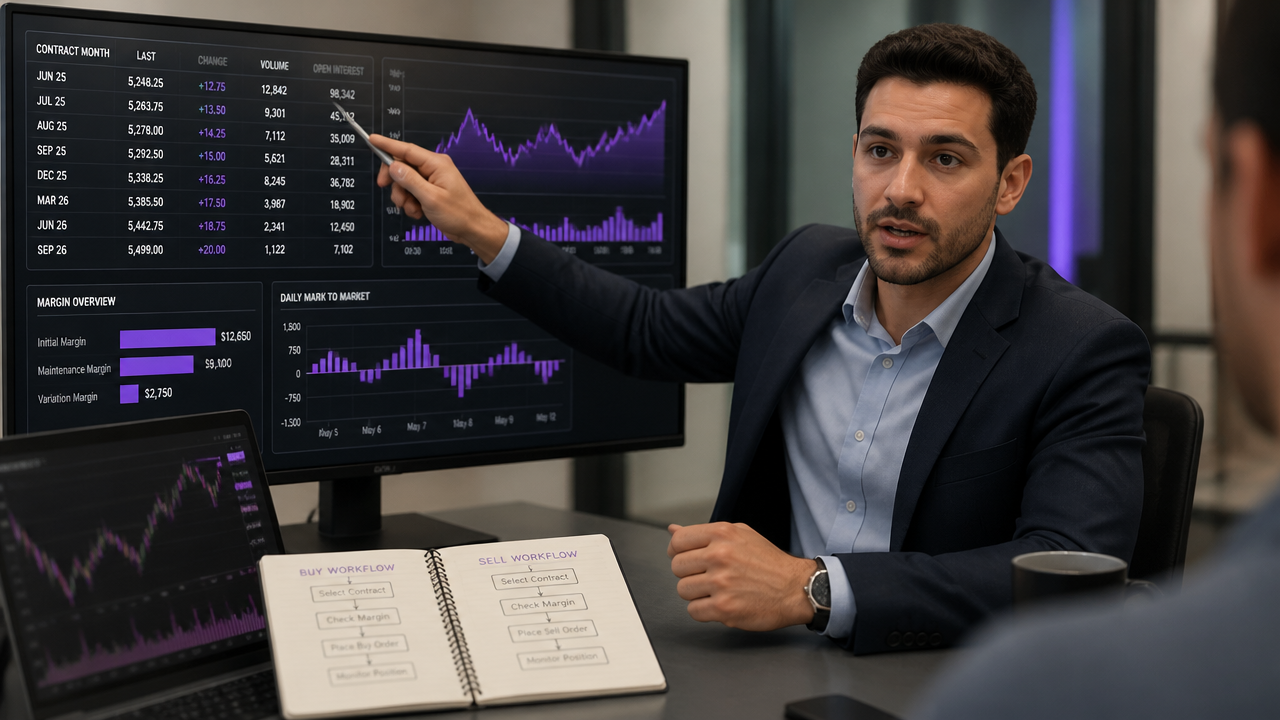
Futures work by converting an uncertain future price into a tradable position today. When you buy or sell a contract, you are not paying or receiving the full notional upfront. You post margin, and your position is revalued every day until it is closed, rolled, or settled.
The mechanics are simple, even if the consequences are not:
- The exchange defines the contract, such as asset, lot size, quality, month, and tick value.
- You enter long or short through a broker or clearing member.
- You post initial margin as performance collateral.
- The position is marked to market daily.
- You either offset the position before expiry or go through the contract settlement process.
This workflow becomes easier to understand when paired with an operational view of how agricultural futures are traded step by step.
Why margin and leverage make futures powerful and dangerous
Leverage is the main reason futures are efficient for hedgers and dangerous for undisciplined traders. Because margin is only a fraction of contract value, a company can hedge a large exposure with limited initial cash. The trade off is that adverse moves create margin calls fast.
This is why a treasury team should care less about headline price views and more about liquidity planning. A correct market view can still hurt cash flow if the hedge structure is oversized or if the company ignores variation margin timing. For businesses exposed to margin volatility, a disciplined framework for quantitative risk control in commodities is often more important than the entry signal itself.
At Uhedge, this is where a CTRM platform adds value. The firm positions its software as a pre and post trade environment that records physical and financial books together, supports futures, swaps, options, and FX forwards, and helps clients monitor mark to market, Greeks, stress, and margin in one auditable workflow.
Who uses futures markets, hedgers or speculators?
Both use the market, but they use it for different reasons. Hedgers want to reduce the impact of adverse price moves on a real world exposure. Speculators want to profit from those moves. The market needs both, because hedgers bring commercial need and speculators bring liquidity.
| Participant | Main goal | Typical question |
|---|---|---|
| Producer | Protect selling price | Can I secure revenue before harvest? |
| Consumer or processor | Protect input cost | Can I defend my processing margin? |
| Exporter or importer | Manage price and FX exposure | How do I stabilize landed or realized price? |
| Speculator | Capture market movement | Where is price momentum or dislocation? |
| Arbitrageur | Exploit relative value | Is there a temporary pricing gap? |
For commodity businesses, the relevant question is not whether speculation exists. It is whether your hedge policy clearly distinguishes risk reduction from directional trading.
Why basis risk matters more than most explanations admit
A futures hedge is never complete if your physical price does not move one for one with the exchange contract. That gap is basis risk, and it is often the difference between a textbook hedge and a real commercial outcome.
A soybean crusher, sugar mill, or coffee exporter does not live on the exchange screen alone. Local premiums, freight, quality, taxes, timing, and location all affect realized price. That is why strong risk management must connect the futures leg to the physical book. A useful starting point is this explanation of commodity pricing risk and market dynamics.
Uhedge builds around this reality. Its platform integrates physical and financial positions, models basis by location and commodity, and separates the futures leg, physical leg, and FX leg into auditable books. For agro industrial firms, that integrated view is often more valuable than a standalone trading screen.
What does daily mark to market mean for a business hedge?
Daily mark to market means your futures gain or loss is recognized every session, not only at expiry. Economically, that makes the market safer for the clearing system. Operationally, it means your hedge can create short term cash needs even when it protects long term margin.
This is the part many basic guides skip. A hedge may be correct in economic terms and still strain working capital in a volatile week. Treasury, procurement, and risk teams must coordinate position size, collateral buffers, and hedge horizon. If your team needs a clearer view of this process, real time mark to market monitoring is the discipline that turns futures from a trade into a managed program.
Uhedge highlights this operational layer with daily MTM, stress testing, VaR by risk factor, and FCM cash and margin management, which is particularly relevant for firms that cannot afford liquidity surprises during sharp market moves.
Is futures trading good for beginners?
Usually not, at least not with real size. Futures reward preparation and punish casual execution because contract size, tick value, liquidity windows, and margin rules all matter from day one.
Beginners often focus on direction and ignore structure. They ask whether corn, coffee, or USD should go up, when the better first question is how much one contract can gain or lose in a normal session. Businesses should teach futures internally as a risk tool before treating them as a return engine.
That is also why many companies outsource part of the process. Uhedge combines software with a CVM regulated asset management practice, which allows clients to pair technology with specialist oversight when the exposure is too large or too complex for spreadsheets.
How should a company decide when futures are the right hedge?
Use futures when the exposure is measurable, the reference contract is liquid, and the hedge objective is clear. Do not use them just because they are available. The right instrument depends on your commercial exposure, basis behavior, cash flow tolerance, and accounting requirements.
A practical checklist looks like this:
- Define the exposure in volume, timing, and pricing formula.
- Choose the contract that best matches the risk driver.
- Estimate basis, not only futures direction.
- Size the hedge ratio instead of defaulting to 100 percent.
- Plan liquidity for margin calls and contract rolls.
- Document governance, approvals, and reporting.
When hedge results must flow cleanly into finance and audit, the discussion should extend to risk compliance and hedge management systems. This is where Uhedge differentiates itself: the platform was designed to connect exposure planning, pricing, hedge execution records, risk metrics, and hedge accounting support in a single environment.
Frequently asked questions
What is the futures market in simple terms?
A futures market is an exchange where standardized contracts trade for delivery or cash settlement at a future date. In simple terms, it lets companies and investors lock, transfer, or take exposure to a price before the physical transaction happens. That is why futures are central to hedging, not just speculation.
Is futures trading good for beginners?
Futures are usually not ideal for beginners who do not yet understand leverage, contract size, margin calls, and daily mark to market. They can be useful for learning market structure, but real trading should start only after position sizing and risk limits are fully understood.
Why would anyone trade futures?
Businesses trade futures to reduce uncertainty, not only to seek profit. A grain buyer may lock input costs, an exporter may protect margins, and a fund may adjust market exposure efficiently. The market exists because transferring price risk has real economic value.
Can I lose more money than I invest in futures?
Yes, you can lose more than your initial cash deposit in futures because margin is only collateral, not the full contract value. If the market moves sharply against your position, losses can exceed the amount first posted and create additional margin calls.
Why is futures trading so risky?
Futures are risky mainly because they combine leverage, volatility, and strict daily settlement. A small move in the underlying price can create a large percentage gain or loss on posted margin. The risk rises further when traders ignore contract size, basis, liquidity, or stop rules.