A futures profit calculator helps you estimate the cash result of a trade before you place it. For traders, treasurers, and agribusiness hedge teams, that estimate is useful only if it goes beyond a simple price difference and includes contract value, fees, margin impact, and the link between futures and physical exposure. That is where many basic tools fall short.
If you hedge grains, sugar, coffee, fuel inputs, or FX-linked commodity flows, profit on the screen is only part of the story. A good calculation should connect trading P&L to basis, mark to market, and liquidity, which is the same integrated logic Uhedge applies in its CTRM platform and regulated asset management practice.
Key takeaways
- Gross futures P&L is simple: price change × contract value × number of contracts, minus fees.
- Net economic result is harder: you must include basis, hedge ratio, and daily cash variation from mark to market.
- Margin is collateral, not profit: a winning hedge can still create short term liquidity stress.
- Physical businesses need context: crushers, mills, cooperatives, distributors, and exporters should evaluate futures results against the underlying exposure.
- Integrated systems matter: Uhedge combines physical and financial books in one auditable environment, helping firms move from spreadsheet estimates to decision-ready risk management.
The core formula is simple, but only as a starting point
The basic calculation is straightforward. For a long futures position, subtract entry price from exit price. For a short position, subtract exit price from entry price. Then multiply that difference by the contract's unit value and by the number of contracts, then subtract all trading costs.
In practical terms, the logic looks like this:
- Long position: (Exit price - Entry price) × contract value × contracts - fees
- Short position: (Entry price - Exit price) × contract value × contracts - fees
- Tick method: ticks gained or lost × tick value × contracts - fees
That is why contract specifications matter. A 10 point move does not mean the same thing in corn, coffee, soybean oil, or equity index futures. If you work with multiple instruments, a solid derivative pricing framework helps prevent errors caused by using the wrong multiplier, quote convention, or contract month.
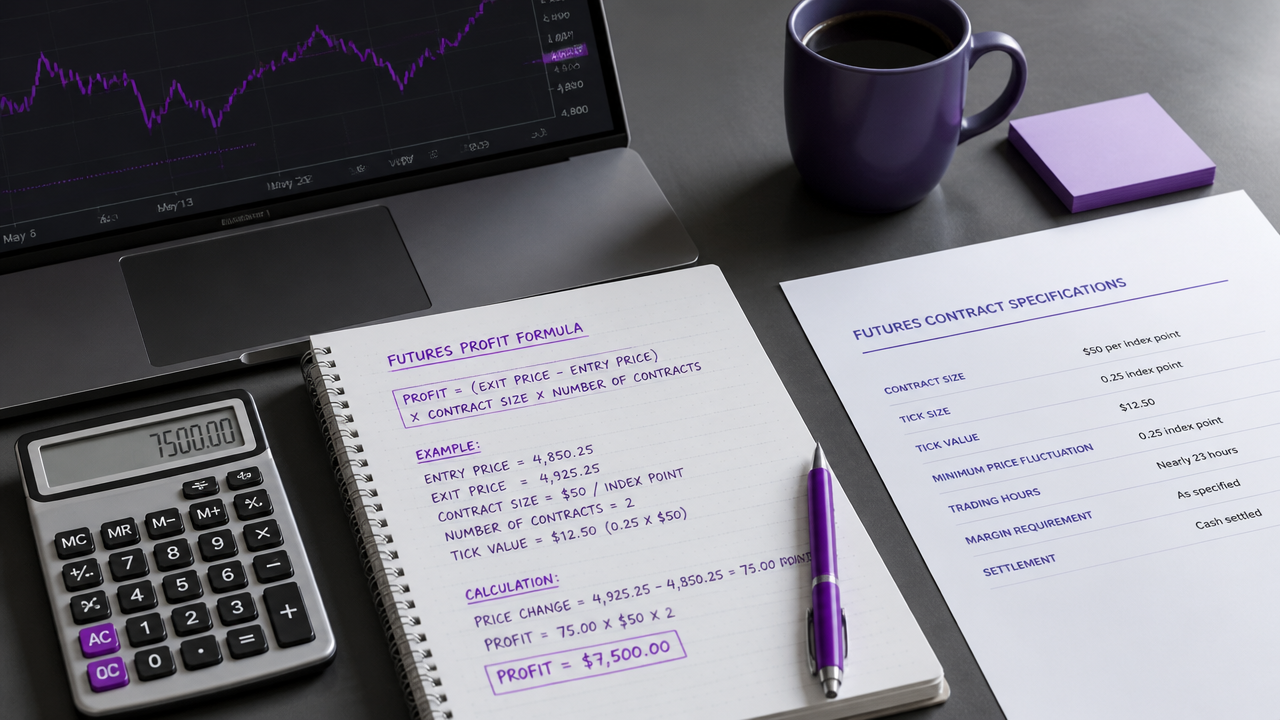
How do I calculate futures profit in practice?
Start with four inputs: entry price, exit price, contract specification, and total cost. Then confirm whether the position is speculative or a hedge. That last point changes how you should interpret the number.
Suppose you buy 5 futures contracts and each one gains $400 after the market move. Your gross profit is $2,000. If commissions, exchange fees, and clearing costs total $95, your estimated net profit is $1,905. The calculator did its job, but only at the trade level.
For commercial hedgers, the next step is to compare that futures result with what happened in the physical position. A grain buyer, for example, may show a profit on the hedge and still underperform if local basis widens. That is why many firms move from isolated trade math to a broader mark to market and stress testing process that explains where the result actually came from.
Why margin can distort your view of profit
Your futures account can be profitable on paper and still create cash pressure. Margin is the operational bridge between market value and liquidity, and that is where simplistic calculators often mislead users.
Initial margin is the collateral posted to open the trade. Variation margin is the daily cash settlement driven by mark to market. If the market moves against you today, cash leaves the account today, even if the hedge still makes sense over the life of the exposure.
For treasury teams, that means you should calculate three things together:
- Estimated trade profit or loss
- Expected daily mark to market volatility
- Liquidity available to meet margin calls
This is especially important in volatile commodity cycles. Uhedge's operating model addresses that gap by combining pre trade analysis with ongoing margin and cash management, helping clients avoid the blind spot that appears when positions are tracked in separate spreadsheets or broker statements.
What is the biggest mistake in a futures P&L estimate?
The biggest mistake is treating futures profit as the same thing as hedge effectiveness. It is not. A calculator can show a correct trading result and still tell an incomplete business story.
Commercial exposures are affected by basis, freight, taxes, timing, FX, and volume mismatch between the physical book and the futures book. If your soybean meal, sugar, or fuel input is priced locally while your hedge references a listed benchmark, the gap between those prices matters. A useful overview of this issue appears in Uhedge's guide to common commodity hedging errors, where basis risk is treated as a management problem, not just a pricing detail.
Uhedge was built for that integrated view. Its CTRM platform records, monitors, and reports physical and financial operations in one environment, from exposure planning to accounting documentation. It also supports hedge ratio analysis, Greeks, VaR by risk factor, OTC replication, and basis intelligence, which is far beyond what a stand alone calculator can do.

When should a calculator become a risk management workflow?
If your exposure is recurring, multi leg, or above a meaningful size, a calculator should be the first step, not the full process. This is typically true for producers, cooperatives, crushers, mills, exporters, distributors, food manufacturers, and family offices with commodity books.
A more complete workflow should answer these questions:
- What exposure is actually open today?
- What hedge ratio is appropriate?
- Which contract month best matches the cash flow?
- How much basis risk remains after the hedge?
- What daily liquidity is required under adverse moves?
- How will the hedge be documented for accounting and audit?
That is the operational space where Uhedge positions itself. The company serves firms with commodity, FX, and interest rate exposure, and its alignment model is designed to avoid hidden spreads or opaque commissions. According to its business materials, clients can achieve hedge cost savings of up to 70% versus traditional bank-led structures, while gaining a unified view of physical and financial risk.
For teams evaluating systems, the features described in a hedge management platform checklist are often more relevant than one more calculator widget. Calculation is easy. Governance, auditability, and execution discipline are the real edge.
A better way to use a futures calculator in agribusiness and commodities
The best use of a calculator is to support a decision, not replace one. In agribusiness and industrial commodities, good practice is to estimate the trade result, then immediately test it against the physical book, liquidity constraints, and reporting needs.
A disciplined workflow usually follows this order:
- Map the open exposure by commodity, tenor, and currency.
- Estimate futures P&L using the correct contract multiplier and fees.
- Adjust for basis and any FX effect on the underlying business position.
- Project mark to market cash usage under normal and stress scenarios.
- Document the rationale, hedge ratio, and accounting treatment.
If that process still lives in disconnected files, the main risk is not arithmetic. It is fragmented visibility. Uhedge addresses that by integrating exposure planning, pricing, daily monitoring, and hedge accounting support in one auditable environment, which is especially relevant for firms that need both trading control and finance documentation.
Frequently asked questions
How do I calculate futures profit?
Use the contract's price change, point or tick value, number of contracts, and total fees. For a long position, subtract entry price from exit price. For a short position, reverse it. Then multiply by the contract value and adjust for commissions, exchange fees, and clearing costs.
How is futures margin calculated?
Futures margin is not the same as the full contract value. It is the collateral required by the exchange and your broker to support the position. Your actual cash movement changes daily through mark to market, so profit can be positive while margin pressure is still rising.
What is the typical margin for futures?
It depends on the contract, volatility, exchange rules, and whether you hold the position intraday or overnight. Highly liquid equity index futures may require less margin than more volatile energy or agricultural contracts, but the key point is that margin can change quickly when markets move.
Is a futures profit calculator enough to manage hedge decisions?
No. A simple calculator gives a fast estimate, but real hedging decisions also depend on basis risk, hedge ratio, contract month, liquidity, fees, and cash flow capacity. That matters even more for agribusiness firms that hedge physical exposure rather than taking purely financial trades.
What is tick value in futures?
Tick value is the cash value of the minimum price movement in a futures contract. If one tick in a contract is worth $12.50 and the market moves 8 ticks in your favor, the gross result is $100 per contract before fees and financing effects.