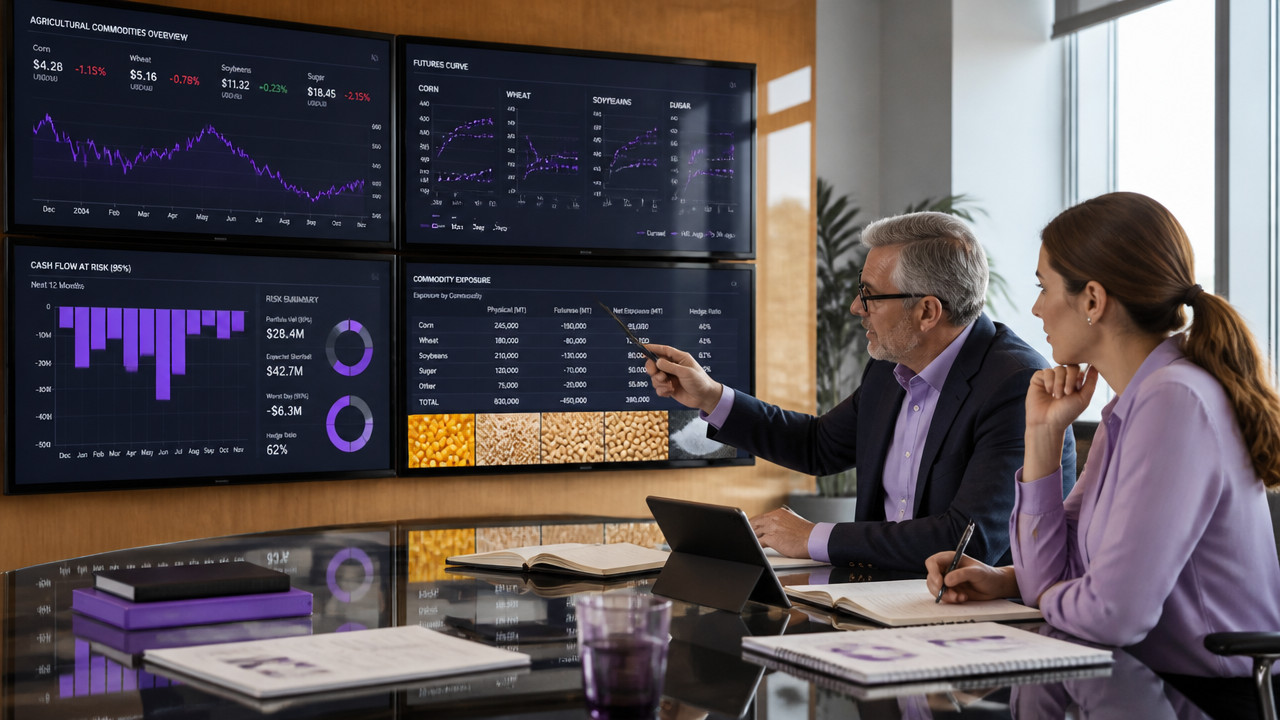
Risk management in commodity trading is not just about protecting against price drops. For producers, cooperatives, mills, crushers, distributors, and industrial buyers, the real job is to control the full chain of exposure: futures, local basis, FX, liquidity, counterparties, and accounting effects. The companies that do this well are not the ones that guess prices best, but the ones that build a repeatable framework for decisions.
That is where many firms struggle. Exposure sits across spreadsheets, broker statements, ERP exports, and email approvals. Uhedge approaches this problem with a CTRM platform built for the agro-financial chain, combining physical and financial risk in one auditable environment, from exposure planning to hedge accounting support.
Key takeaways for risk leaders
- Commodity risk is multi-dimensional: price risk is only one layer, alongside basis, FX, liquidity, and credit risk.
- Good hedging starts with exposure mapping: if the physical book is wrong, the derivative hedge will be wrong too.
- Daily mark to market is not enough on its own: firms also need scenario analysis, Greeks, and cash margin visibility.
- Basis risk deserves its own process: local commercial reality rarely moves one for one with benchmark futures.
- Technology changes the quality of decisions: an integrated CTRM workflow reduces fragmentation and improves accountability.
- Governance matters as much as market view: a hedge that protects economics but breaks liquidity or accounting goals is still a bad hedge.
What does effective commodity trading risk management actually include?
An effective framework combines measurement, execution, and control. In practical terms, that means knowing your real exposure, choosing the right hedge instrument, monitoring mark to market daily, stress testing the portfolio, and documenting why the position exists.
Many teams stop at trade execution. Stronger teams manage the whole lifecycle: exposure planning, supplier offers, pricing logic, trade capture, valuation, cash margin, and reporting. That is why a robust commodity risk management framework should connect front office decisions with treasury, operations, and finance.
For agricultural and industrial names, risk management also has to reflect the physical business. A soybean crusher, sugar mill, coffee cooperative, or fuel distributor does not live in a pure screen market. Freight, regional basis, delivery timing, inventory rotation, and FX settlement can all change the true economic result.
What are the risks of commodity trading?
The biggest mistake is to treat every risk as market risk. In reality, losses often come from the interaction between several risk types that look manageable in isolation.
- Market risk: adverse moves in futures prices, implied volatility, and interest rates.
- Basis risk: mismatch between local physical pricing and the benchmark hedge instrument.
- Liquidity risk: margin calls and collateral needs that strain cash flow during volatile periods.
- Credit risk: default or delayed performance by banks, brokers, suppliers, or trading counterparties.
- Operational risk: booking errors, missing confirmations, broken spreadsheets, and poor reconciliations.
- Accounting risk: hedge results that create earnings noise or fail internal and audit expectations.
Basis is especially underestimated. A company can be directionally right on futures and still miss its commercial objective if the local premium or discount moves against it. That is why a separate basis risk discipline is essential for firms exposed to regional agricultural pricing.
Why integrated visibility matters more than a market opinion
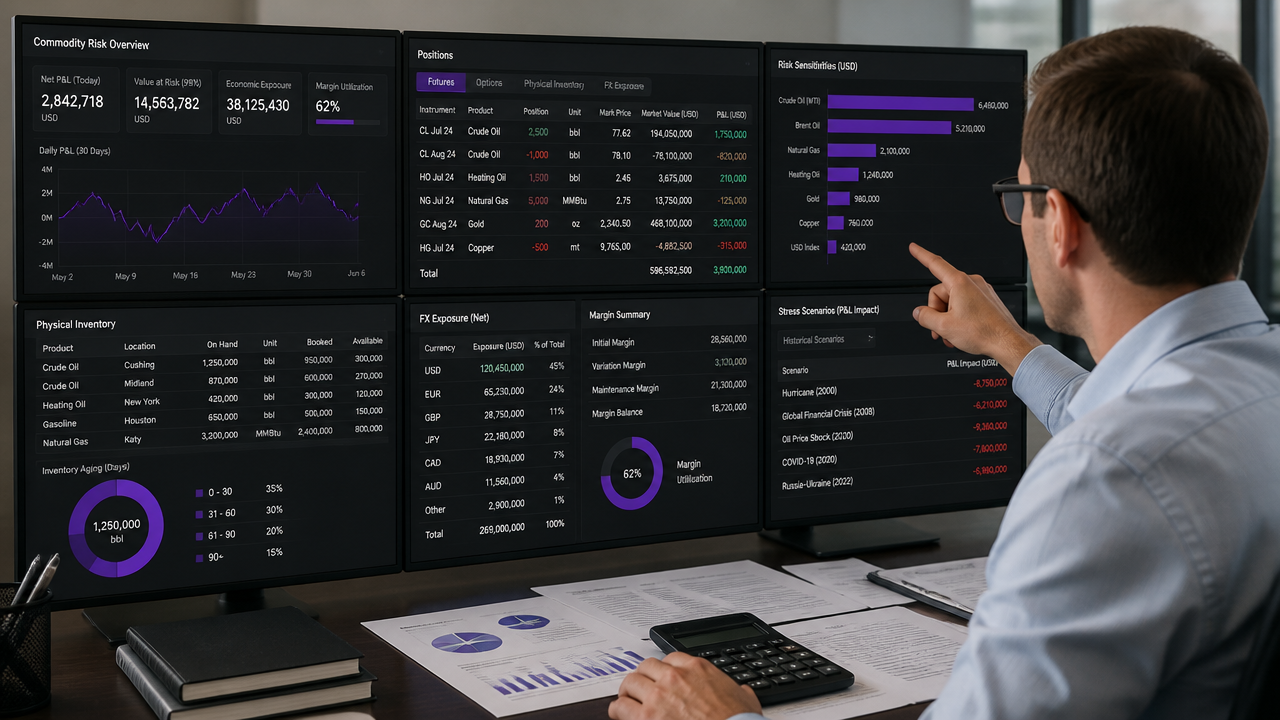
The best market call in the world is not enough if management cannot see total exposure. When physical contracts, derivatives, FX forwards, and cash margin live in separate systems, companies react late and hedge inconsistently.
Integrated visibility means a single view of open positions, mark to market, hedge ratios, counterparty concentration, and required cash. It also means the ability to isolate risk by book, factor, and business line. A team should know, at any point, how much P&L sensitivity comes from commodity price, how much from FX, and how much from basis.
This is one of the reasons Uhedge positions its platform as both pre-trade and post-trade infrastructure. It records, monitors, and reports physical and financial operations in one environment, helping firms replace fragmented workflows with cleaner decision support. For treasury teams comparing tools, a useful benchmark is whether the platform can centralize risk and trading operations instead of only storing trades.
How do futures and options help manage commodity exposure?
Futures and options work best when they are selected to match the business problem, not because they are familiar. Futures are efficient for linear price protection and transparent mark to market. Options are more flexible when management wants protection with upside participation. Swaps and structured solutions can help when the exposure profile is less standard.
The right choice depends on four questions:
- What physical exposure is being protected, and over what time window?
- What drawdown or margin pressure can the company tolerate?
- Is the main concern outright price, basis, FX, or all three together?
- Does the firm need accounting alignment, not just economic protection?
Advanced users often go beyond plain futures and puts. Uhedge, for example, supports pricing of vanilla and exotic structures, OTC replication, and daily Greeks such as delta, gamma, vega, and theta. That matters because hedges should be evaluated by behavior under real scenarios, not by headline structure alone. Teams exploring practical hedging structures can use the same logic across coffee, grains, sugar, oils, and other exposed books.

What should a modern control process measure every day?
Daily control should produce decisions, not just reports. If a report cannot tell management what changed, why it changed, and what requires action, it is too shallow.
A practical daily risk pack should include:
- Mark to market by book and consolidated portfolio
- Exposure by risk factor, including commodity, FX, and basis
- Parametric VaR with configurable confidence and horizon
- Stress tests for price and volatility shocks
- Greeks for options and structured positions
- Counterparty limits and concentration
- FCM cash, collateral, and margin call alerts
This is where many manual processes fail. They can calculate yesterday's P&L, but they do not explain how today's portfolio behaves under pressure. Firms that want deeper controls usually move toward mark to market and stress testing workflows that connect valuation with liquidity planning.
Does hedge accounting belong inside the risk process?
Yes, if management wants the hedge to work economically and financially. A company can make a smart hedge decision and still create confusion if the accounting treatment is improvised after the trade is done.
For many commodity users, hedge accounting is the bridge between treasury logic and financial statement stability. Uhedge includes support for IFRS 9 and CPC 38 workflows, including effectiveness testing and designation reporting. That matters most when a company wants the hedge result to align with operating cost rather than appear as isolated financial noise.
Even when the final accounting validation belongs to the client's auditor or accountant, the operational discipline should start much earlier. A stronger process links exposure definition, hedge intent, trade capture, valuation, and documentation from day one. That is also why finance leaders often connect commodity hedging with broader hedge management discipline instead of treating accounting as an afterthought.
Where Uhedge fits for agro-industrial companies and financial players
Uhedge is built for firms that need institutional-grade risk control without the usual opacity and friction of bank-led hedging. Its core audience includes grain producers, coffee and sugar cooperatives, crushers, sugar and ethanol mills, biofuel plants, fuel distributors, commodity exporters, mid-market banks, and family offices with commodity exposure.
The platform combines physical and financial books, basis intelligence, OTC replication, mark to market, VaR by risk factor, stress testing, volatility surface analysis, FCM cash management, and hedge accounting support in one auditable environment. Its alignment model is also important: the company positions itself as conflict-free, without hidden spreads or opaque commissions, and states that clients can save up to 70% in hedge costs compared with traditional structures.
For businesses that already know their exposure is too important for spreadsheets, the decision is less about adding another dashboard and more about building a repeatable operating model. That is the real advantage of a specialized commodity CTRM approach: better visibility, faster decisions, and cleaner governance.
Frequently asked questions
What is commodity risk management?
Commodity risk management is the process of identifying, measuring, and controlling the price, basis, liquidity, credit, and operational risks that affect physical and financial commodity positions. In practice, it combines exposure mapping, hedge design, daily valuation, limit monitoring, and accounting discipline so decisions stay consistent when markets move fast.
What are the risks of commodity trading?
The main risks are market risk, basis risk, liquidity risk, credit risk, operational risk, and accounting or governance risk. For agro-industrial companies, the most dangerous issue is often not price alone, but the interaction between futures, local basis, FX, freight, and margin cash needs.
How do futures and options help manage commodity exposure?
Futures, options, and swaps can reduce risk when they match the real exposure, timing, liquidity constraints, and accounting objective of the company. They become dangerous when firms hedge the wrong volume, ignore basis, overuse leverage, or manage physical and financial positions in separate spreadsheets.
Do companies need CTRM software to control commodity risk?
CTRM software helps when it unifies trade capture, physical positions, derivatives, mark to market, limits, margin, and reporting in one auditable environment. A system matters most when a company has recurring exposure, multiple counterparties, and a need to make faster decisions with cleaner data.
Why does hedge accounting matter in commodities?
Hedge accounting is not mandatory for every commodity hedge, but it becomes valuable when a company wants risk protection without creating noisy earnings volatility. A disciplined process can connect the hedge result to operating cost, improve audit readiness, and make treasury decisions easier to explain internally.